
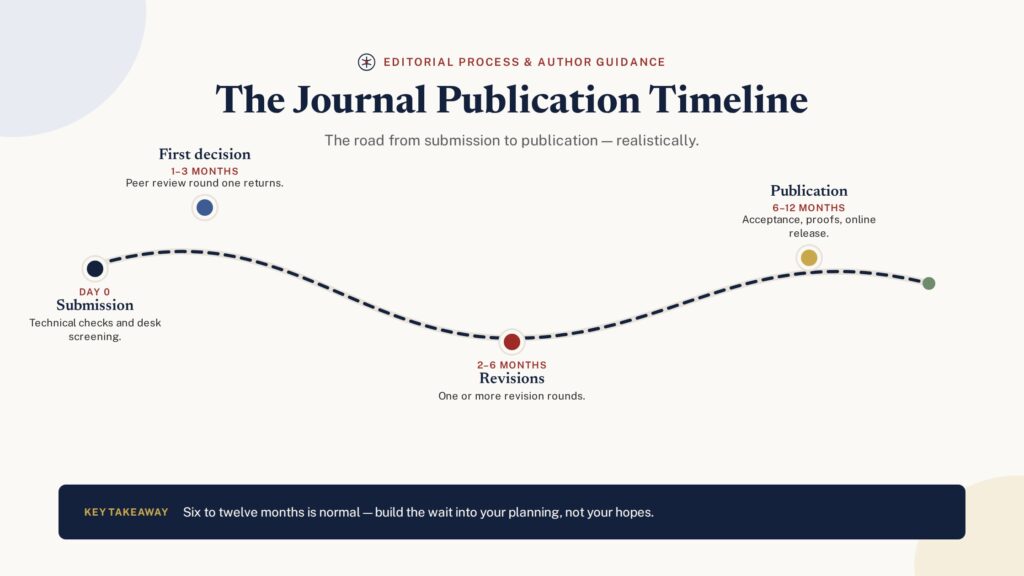
Journal Publication Timeline Explained: How Long Does Publishing Really Take?
Reading time - 7 minutes
Introduction
One of the most common questions researchers ask is: “How long will it take for my paper to get published?”
The honest answer is—it depends.
Journal publication timelines vary widely across disciplines, journals, and even individual manuscripts. While some papers move from submission to publication within a few months, others can take over a year. Understanding each stage of the process helps researchers set realistic expectations, plan career milestones, and reduce anxiety during long waiting periods.
This article breaks down the typical journal publication timeline and explains what influences delays and decisions.
Overview of the Journal Publication Process
The publication journey generally follows these stages:
- Manuscript submission
- Editorial screening
- Peer review
- Author revisions
- Final decision
- Production and publication
Each stage contributes to the overall timeline.
Stage 1: Submission and Initial Checks (1–2 Weeks)
After submission, journals perform basic checks to ensure:
- Manuscript completeness
- Adherence to formatting guidelines
- Ethical declarations and approvals
- Plagiarism screening
If issues are found, authors may be asked to resubmit corrected files, causing early delays.
Stage 2: Editorial Screening (1–4 Weeks)
During this stage, editors decide whether to:
- Send the manuscript for peer review
- Reject it without review (desk rejection)
Editors evaluate:
- Journal fit
- Novelty and relevance
- Overall quality and clarity
High‑volume journals often complete this step faster, while selective journals may take longer.
Stage 3: Peer Review (4–12 Weeks)
Peer review is usually the longest phase of the publication process.
Time depends on:
- Reviewer availability
- Number of review rounds
- Complexity of the study
Delays often occur when reviewers decline invitations or submit late reports.
Stage 4: Author Revisions (2–8 Weeks)
Once reviews are received, authors are asked to revise their manuscript.
Revision time varies based on:
- Extent of requested changes
- Additional analyses required
- Co‑author coordination
Prompt and thorough revisions can significantly shorten the overall timeline.
Stage 5: Final Editorial Decision (1–3 Weeks)
After revisions are submitted:
- Editors assess responses to reviewers
- Additional review rounds may be requested
- A final accept or reject decision is made
Some manuscripts require multiple revision cycles, extending timelines.
Stage 6: Production and Publication (2–6 Weeks)
Once accepted, the manuscript enters production:
- Copyediting
- Typesetting
- Proofreading
- Online publication
Many journals publish articles online ahead of print, reducing wait time for visibility.
Typical Total Time to Publication
Journal Type | Average Timeline |
Rapid‑review journals | 2–4 months |
Standard journals | 4–8 months |
Highly selective journals | 8–18 months |
These are averages—individual experiences may vary.
Factors That Influence Publication Speed
Several factors affect how quickly a paper is published:
- Journal workload and submission volume
- Efficiency of editorial management
- Reviewer responsiveness
- Quality of the initial submission
- Number of revision rounds
Well‑prepared manuscripts generally move faster through the process.
How Authors Can Reduce Delays
Authors can help speed up publication by:
- Selecting an appropriate journal
- Following author guidelines precisely
- Writing clear cover letters
- Responding to reviews promptly
- Submitting high‑quality initial drafts
Preparation saves time later.
When Should Authors Follow Up?
If no update is received:
- After 4–6 weeks (editorial stage)
- After 10–12 weeks (peer review stage)
Polite inquiries are acceptable and often helpful.
Managing Expectations as a Researcher
Publication timelines can feel frustrating, especially for:
- Early‑career researchers
- Students facing graduation deadlines
- Grant or promotion applicants
Planning submissions early and maintaining multiple projects helps manage uncertainty.
Conclusion
Journal publication is a multi‑stage process that requires patience and persistence. While timelines vary, understanding each phase helps researchers navigate publishing more confidently. By preparing manuscripts carefully and choosing journals wisely, authors can improve both speed and success.
Publishing is not just about acceptance—it’s about endurance.
FAQs
Q1. Can journals guarantee publication timelines?
No. Most timelines are estimates, not guarantees.
Q2. Does paying open‑access fees speed up review?
Generally no. Fees affect access, not peer review speed.
Q3. Is slow peer review a bad sign?
Not necessarily—it often reflects reviewer availability.
Q4. Should authors submit to multiple journals simultaneously?
No. This is considered unethical.
Related Posts:
- Researcher Exit and Re-Entry Policies in Academic Publishing:…
- Breaking Down the "Preprint Hierarchy": Can Anyone Become a…
- Peer Review Time Transparency in Academic Publishing: Building…
- A Preprint Revolution for the Human Brain: Can Neuroscientists…
- The Peer Review Timeline: What Happens After You Submit