
Journal Aims and Scope Explained: How to Align Your Research for Acceptance
Reading time - 7 minutes
Introduction
One of the most common—and avoidable—reasons for manuscript rejection is poor alignment with a journal’s aims and scope. Even high‑quality research can be rejected if it does not match what a journal intends to publish.
Understanding a journal’s aims and scope is not just a formality; it is a strategic step in the publication process. Editors rely heavily on this alignment when deciding whether a manuscript should proceed to peer review. This article explains what aims and scope mean, why they matter, and how authors can ensure their research fits the right journal.
What Are Journal Aims and Scope?
A journal’s aims and scope describe:
- The subject areas it covers
- The types of studies it publishes
- Its target audience
- The methodological and theoretical focus
This section defines the journal’s identity and guides editorial decisions.
Why Aims and Scope Matter So Much
Editors use aims and scope to:
- Filter submissions efficiently
- Maintain journal focus and consistency
- Serve the expectations of readers
If a manuscript does not clearly align, it is often rejected without peer review.
Common Misunderstandings About Journal Scope
Authors sometimes assume:
- Broad topics fit all journals
- Interdisciplinary work is universally welcomed
- High‑quality research will be reviewed regardless of fit
In reality, fit matters as much as quality.
How Editors Evaluate Journal Fit
During initial screening, editors assess:
- Topic relevance
- Theoretical or practical orientation
- Methodological alignment
- Audience interest
This evaluation is usually quick but decisive.
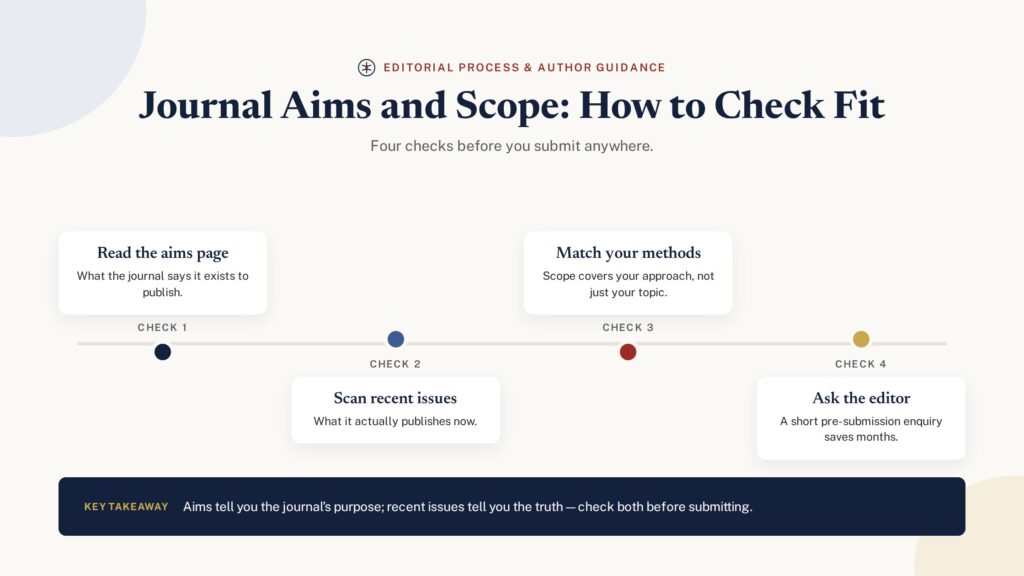
How to Analyze a Journal’s Aims and Scope
1. Read the Aims and Scope Carefully
Pay attention to:
- Keywords and phrases
- Included and excluded topics
- Preferred research approaches
Avoid assuming—read every line.
2. Review Recently Published Articles
Look for:
- Recurring themes
- Common methodologies
- Types of research questions
Recent issues reveal what the journal actually publishes.
3. Identify the Target Audience
Ask yourself:
- Who reads this journal?
- Is it theoretical, applied, or policy‑oriented?
- Does my research address this audience’s interests?
Audience alignment strengthens editorial confidence.
Aligning Your Manuscript with Journal Scope
Authors can improve alignment by:
- Adjusting the framing of the introduction
- Emphasizing relevant aspects of the study
- Using terminology common in the journal
- Highlighting contributions relevant to the journal’s focus
Minor framing changes can make a major difference.
Using the Cover Letter to Demonstrate Fit
A strong cover letter should:
- Explicitly reference the journal’s aims
- Explain why the study fits the scope
- Highlight relevance to readers
Editors appreciate clarity and intentional submission.
When Your Research Doesn’t Perfectly Fit
If alignment is partial:
- Consider a different journal
- Revise the manuscript focus
- Look for interdisciplinary or broader‑scope journals
Submitting despite poor fit rarely succeeds.
Aims and Scope vs Journal Impact
Choosing a journal solely based on:
- Impact factor
- Prestige
without considering scope often leads to rejection. Strategic fit matters more than reputation alone.
Benefits of Strong Scope Alignment
When a manuscript aligns well:
- Editors are more receptive
- Reviewers are more engaged
- Revision processes are smoother
- Acceptance chances increase
Alignment sets the foundation for successful peer review.
Conclusion
Understanding and respecting journal aims and scope is one of the most effective ways to improve publication success. By carefully analyzing journal expectations and aligning manuscripts accordingly, authors can reduce desk rejections and navigate academic publishing more strategically. The right journal fit turns strong research into published research.
FAQs
Q1. Can a manuscript be revised to fit a journal’s scope?
Yes, often through reframing rather than changing results.
Q2. Should authors contact editors about scope fit?
In some cases, a brief inquiry can be helpful.
Q3. Do journals ever change their scope?
Yes, especially as fields evolve.
Q4. Is broad scope better than narrow scope?
Not necessarily—narrow scope journals can offer targeted visibility.
Related Posts:
- Desk Rejection Explained: Top Reasons Journals Reject Papers Early
- Breaking Down the "Preprint Hierarchy": Can Anyone Become a…
- Desk Rejection vs Peer Review Rejection: Key Differences Explained
- How Blockchain Is Impacting Scholarly Publishing:…
- A Preprint Revolution for the Human Brain: Can Neuroscientists…