
Data Availability Statements Explained: A Guide for Research Authors
Reading time - 7 minutes
Introduction
As academic publishing moves toward greater transparency and reproducibility, data availability statements (DAS) have become a standard requirement in many journals. These statements inform readers where and how the data supporting a study’s findings can be accessed.
For many authors, data availability statements are confusing, especially when data cannot be fully shared due to ethical, legal, or practical constraints. This article explains what data availability statements are, why journals require them, and how authors can write clear, compliant statements.
What Is a Data Availability Statement?
A data availability statement is a short section in a research paper that:
- Describes whether data are available
- Explains where the data can be accessed
- States any restrictions on data sharing
It promotes transparency and allows other researchers to verify or reuse findings.
Why Journals Require Data Availability Statements
Journals require data availability statements to:
- Support research transparency
- Encourage reproducibility
- Promote responsible data sharing
- Clarify access conditions for readers
Many funders and institutions now mandate data sharing policies aligned with journal requirements.
Where Data Availability Statements Appear
Data availability statements are usually included:
- At the end of the manuscript
- Before references or acknowledgements
- In a dedicated “Data Availability” section
Journals specify placement and formatting in author guidelines.
Common Types of Data Availability Statements
1. Data Available in a Public Repository
Used when data are openly accessible.
Example:
“The data supporting this study are available in a public repository at [repository name], accession number [XXX].”
2. Data Available on Reasonable Request
Used when data cannot be publicly shared.
Example:
“The data are available from the corresponding author upon reasonable request.”
3. Data Contain Confidential or Sensitive Information
Used when ethical or legal restrictions apply.
Example:
“The data are not publicly available due to privacy and ethical restrictions.”
4. No New Data Were Generated
Used for theoretical or review papers.
Example:
“No new data were generated or analyzed in this study.”
Choosing the Right Statement for Your Study
Authors should consider:
- Journal data policies
- Funder requirements
- Ethical approvals
- Participant consent agreements
The statement must accurately reflect data access conditions.
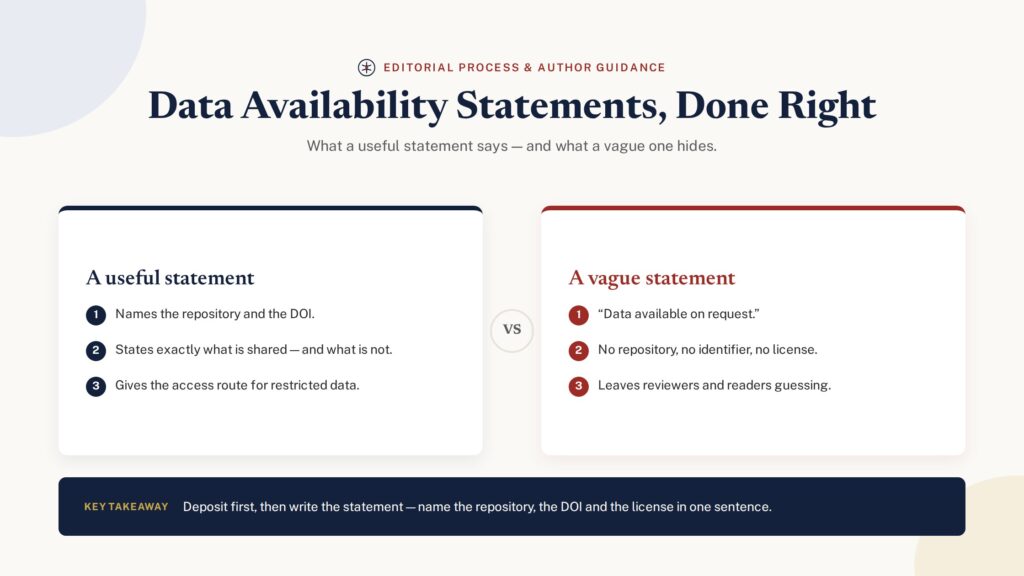
What Journals Look for in Data Availability Statements
Editors and reviewers expect statements that are:
- Clear and specific
- Honest about limitations
- Consistent with methods and ethics sections
- Aligned with journal policy
Vague or misleading statements may delay acceptance.
Data Repositories and Persistent Access
When sharing data, journals often recommend:
- Trusted repositories
- Stable identifiers
- Long‑term access solutions
Proper data archiving supports future research reuse.
Ethical Considerations in Data Sharing
Authors must balance openness with responsibility. Data sharing may be restricted due to:
- Participant privacy
- Confidential agreements
- Intellectual property concerns
- National or institutional regulations
Transparency about restrictions is essential.
Common Mistakes Authors Make
Avoid:
- Omitting the data availability statement
- Providing broken or temporary links
- Making promises of access that cannot be fulfilled
- Using generic statements without verification
Accuracy prevents post‑acceptance issues.
Data Availability and Peer Review
Reviewers may:
- Check data access links
- Evaluate consistency with methods
- Request clarification
Clear statements streamline peer review.
Data Availability and Research Credibility
Well‑written data availability statements:
- Build reader trust
- Demonstrate ethical awareness
- Align with open science principles
- Improve research transparency
They are now a standard part of responsible publishing.
Conclusion
Data availability statements are no longer optional—they are a core element of modern academic publishing. By understanding journal expectations and writing clear, accurate statements, authors can meet transparency requirements while protecting ethical and legal obligations. Thoughtful data sharing strengthens both individual studies and the broader research ecosystem.
FAQs
Q1. Are data availability statements mandatory for all journals?
Many journals require them, but policies vary.
Q2. Can data be restricted and still comply with journal policies?
Yes, if restrictions are clearly explained.
Q3. Do reviewers access the data during peer review?
Sometimes, depending on journal policy.
Q4. Should data availability statements be updated after revisions?
Yes, if data access conditions change.
Most journals require a code statement alongside the data one, answering a different question. See how to write a code availability statement for the templates and the DOI requirement.