
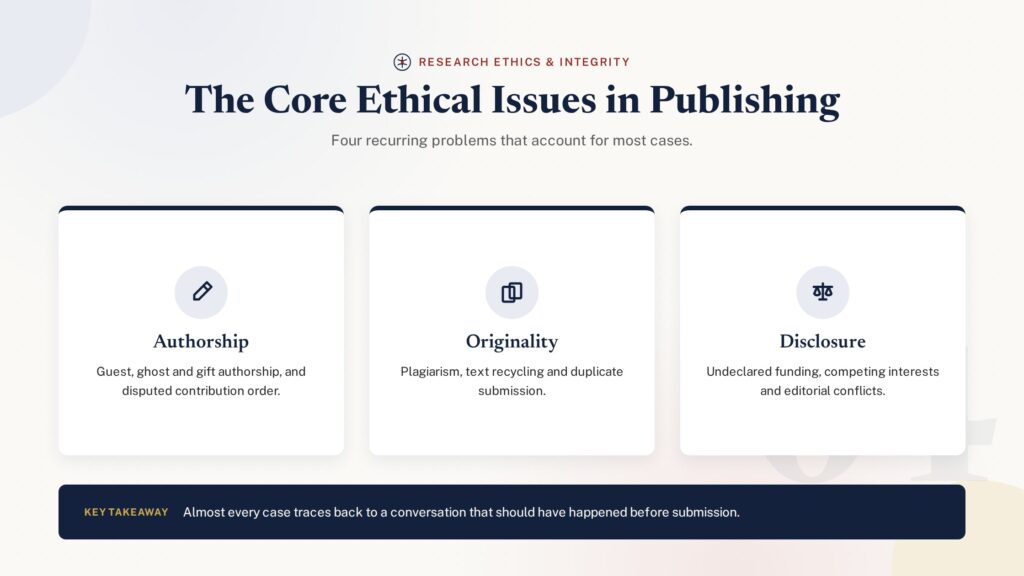
Ethical Issues in Academic Publishing: A Practical Guide for Researchers
Reading time - 7 minutes
Introduction
Academic publishing is built on trust—trust that research is conducted honestly, reported accurately, and evaluated fairly. When ethical standards are compromised, the credibility of individual researchers and the scholarly record itself is at risk. As publication pressure increases, understanding ethical issues in academic publishing has never been more important.
This article explores the most common ethical challenges in academic publishing, their consequences, and how researchers can uphold integrity throughout the publication process.
Why Ethics Matter in Academic Publishing
Ethical publishing ensures:
- Credibility of research findings
- Fair recognition of contributors
- Protection of research participants
- Trust between authors, editors, reviewers, and readers
Violations can damage careers and undermine public confidence in science.
Common Ethical Issues in Academic Publishing
1. Plagiarism
Plagiarism involves presenting others’ work or ideas as one’s own without proper attribution.
Forms include:
- Direct copying
- Paraphrasing without citation
- Self‑plagiarism (duplicate publication)
Most journals use plagiarism detection software to screen submissions.
2. Data Fabrication and Falsification
This includes:
- Making up data
- Manipulating data or images
- Selectively reporting results
Such practices are considered serious misconduct and can lead to retractions and bans.
3. Authorship Disputes
Ethical authorship requires that:
- All listed authors contribute meaningfully
- Contributions are acknowledged fairly
- Gift or ghost authorship is avoided
Clear authorship agreements help prevent disputes.
4. Duplicate and Redundant Publication
Submitting the same or very similar work to multiple journals without disclosure is unethical. It wastes editorial resources and distorts the scholarly record.
5. Undeclared Conflicts of Interest
Conflicts may arise from:
- Financial relationships
- Institutional affiliations
- Personal or professional connections
Failure to disclose conflicts can bias research interpretation.
Ethical Issues in Peer Review
Peer review also carries ethical responsibilities:
- Maintaining confidentiality
- Declaring conflicts of interest
- Providing objective, constructive feedback
- Avoiding misuse of privileged information
Unethical reviewer behavior undermines the review process.
Ethical Responsibilities of Editors and Journals
Editors are responsible for:
- Fair and unbiased decision‑making
- Managing conflicts of interest
- Addressing misconduct allegations
- Upholding publication standards
Editorial transparency is essential for trust.
Consequences of Ethical Misconduct
Ethical violations can result in:
- Manuscript rejection
- Article retraction
- Damage to professional reputation
- Loss of funding or employment
- Institutional investigations
Consequences often extend beyond a single publication.
How Journals Address Ethical Issues
Journals may:
- Follow established ethics guidelines
- Investigate allegations thoroughly
- Issue corrections or retractions
- Notify institutions or funders
Preventive policies are increasingly emphasized.
Best Practices for Ethical Publishing
Researchers can promote ethical publishing by:
- Citing sources accurately
- Maintaining transparent data practices
- Following authorship guidelines
- Disclosing conflicts of interest
- Respecting peer review ethics
Ethics should be integrated into every research stage.
Role of Training and Awareness
Many ethical issues arise from:
- Lack of awareness
- Inadequate training
- Cultural or institutional differences
Formal training in publication ethics reduces unintentional misconduct.
Ethics and the Future of Academic Publishing
As publishing evolves with:
- Open access
- Preprints
- AI‑assisted tools
Ethical guidelines must also adapt to address new challenges responsibly.
Conclusion
Ethical issues in academic publishing are not rare exceptions—they are ongoing challenges that require awareness, education, and responsibility. By understanding common ethical pitfalls and adhering to best practices, researchers can protect their work, their reputation, and the integrity of the scholarly record. Ethical publishing is a shared responsibility that sustains academic progress.
FAQs
Q1. Is self‑plagiarism considered unethical?
Yes, when prior work is reused without disclosure or citation.
Q2. What should authors do if they discover an error after publication?
Contact the journal promptly to request a correction.
Q3. Are all ethical violations intentional?
No, many result from lack of awareness—but consequences can still apply.
Q4. Who investigates publication misconduct?
Journals, institutions, and sometimes funding agencies.