
ORCID, DOI, and Researcher IDs Explained for Academic Publishing
Reading time - 7 minutes
Introduction
In today’s global and digital research environment, identifying who created a piece of research and how that research can be reliably found is more important than ever. Common author names, institutional changes, name variations, and fragmented databases have long caused confusion in scholarly communication.
To solve these problems, academic publishing relies on persistent identifiers, most notably ORCID iDs for researchers and DOIs for research outputs. These identifiers form the backbone of modern scholarly infrastructure, enabling accurate attribution, discoverability, and long‑term preservation of research.
This article explains what ORCID, DOI, and researcher IDs are, why they matter, and how researchers can use them strategically throughout their careers.
What Are Persistent Identifiers in Scholarly Publishing?
Persistent identifiers (PIDs) are unique, stable digital codes that:
- Permanently identify researchers or research outputs
- Remain unchanged even if affiliations or URLs change
- Enable reliable linking across platforms
They ensure that scholarly records remain accurate over time.
ORCID: A Unique Identifier for Researchers
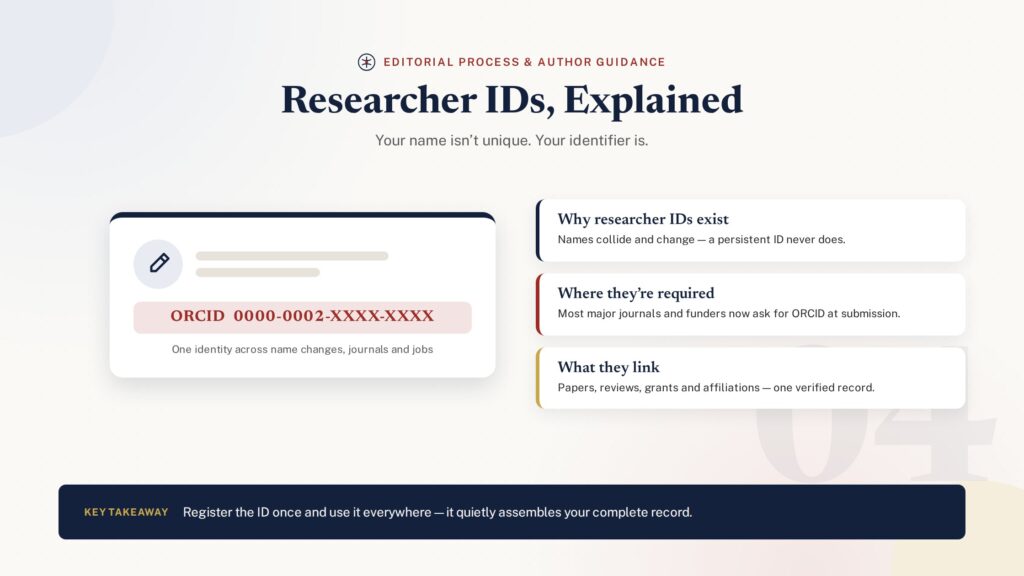
ORCID (Open Researcher and Contributor ID) provides researchers with a unique 16‑digit identifier that distinguishes them from others with similar names.
Why ORCID Was Created
ORCID addresses issues such as:
- Name ambiguity
- Name changes
- Different naming conventions across countries
- Inconsistent author records
It provides a single, persistent identity throughout a researcher’s career.
How ORCID Works
An ORCID iD:
- Is owned and controlled by the researcher
- Can be linked to publications, grants, affiliations, and peer review
- Integrates with journal submission systems and funding platforms
Many journals now require ORCID during manuscript submission.
Benefits of ORCID for Researchers
Using ORCID helps researchers:
- Ensure correct attribution of their work
- Reduce administrative repetition during submissions
- Maintain a centralized academic profile
- Improve visibility across databases and platforms
ORCID also supports career mobility by preserving identity across institutions.
DOI: A Permanent Identifier for Research Outputs
A Digital Object Identifier (DOI) is a unique alphanumeric code assigned to research outputs such as:
- Journal articles
- Preprints
- Datasets
- Book chapters
- Conference papers
Unlike URLs, DOIs remain stable even if the content’s web location changes.
Why DOIs Are Essential in Academic Publishing
DOIs enable:
- Persistent linking to research outputs
- Accurate citation tracking
- Long‑term digital preservation
- Integration with indexing and analytics systems
They ensure research remains accessible and citable over time.
DOI and Citation Reliability
Because DOIs are standardized:
- Citations remain valid even if websites change
- Articles are easier to discover
- Reference linking becomes automated
Most journals now require DOIs in reference lists where available.
Researcher IDs Beyond ORCID
In addition to ORCID, researchers may encounter:
- Institutional researcher IDs
- Platform‑specific author profiles
ORCID acts as a central connector, linking records across systems and reducing fragmentation.
How Journals and Funders Use Identifiers
Journals use identifiers to:
- Verify author identity
- Reduce authorship confusion
- Improve metadata quality
Funders use them to:
- Track grant outcomes
- Monitor research impact
- Support transparent reporting
Identifiers strengthen accountability across the research lifecycle.
Best Practices for Researchers
Researchers should:
- Register for an ORCID iD early
- Use ORCID consistently in submissions
- Link publications, grants, and affiliations regularly
- Ensure DOIs are included in citations
Consistency maximizes the benefits of persistent identifiers.
Common Mistakes to Avoid
Avoid:
- Creating multiple ORCID profiles
- Leaving ORCID records incomplete
- Ignoring DOI inclusion in references
- Using inconsistent name formats
Small errors can reduce discoverability.
The Future of Research Identification
Persistent identifiers are expanding to include:
- Grant IDs
- Organization IDs
- Data and software identifiers
Together, they form an interconnected scholarly ecosystem.
Conclusion
ORCID, DOI, and researcher identifiers are no longer optional—they are essential tools in modern academic publishing. By adopting and maintaining these identifiers, researchers protect their scholarly identity, improve discoverability, and ensure long‑term impact. Persistent identifiers strengthen not only individual careers but the integrity of the entire research record.
FAQs
Q1. Is ORCID mandatory for all researchers?
Many journals and funders now require it.
Q2. Can researchers control their ORCID data?
Yes, researchers control privacy and content settings.
Q3. Do all research outputs receive DOIs?
Most published outputs do, including articles and datasets.
Q4. Can DOIs expire?
No, DOIs are designed to be permanent.
A persistent identifier matters most for the person the journal writes to. See the corresponding author role for why an ORCID outlives the institutional email it replaces.