
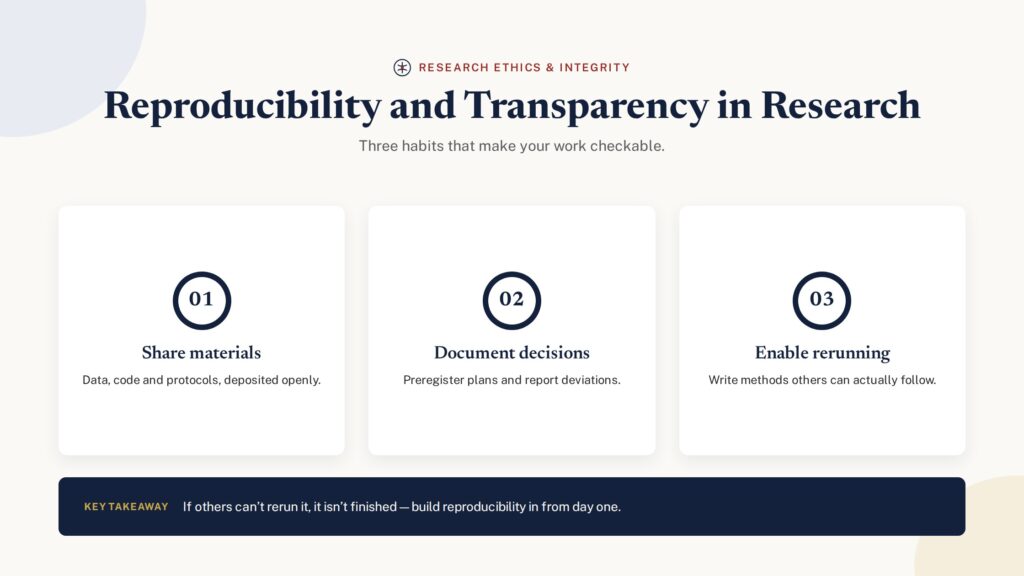
Reproducibility and Transparency in Research Publishing Explained
Reading time - 7 minutes
Introduction
Reproducibility and transparency are fundamental principles of credible research. They allow findings to be verified, methods to be evaluated, and results to be trusted. In recent years, concerns about irreproducible studies and opaque research practices have led journals, funders, and institutions to place renewed emphasis on transparent and reproducible research publishing.
This article explains what reproducibility and transparency mean, why they matter, the challenges involved, and how journals and researchers can promote trustworthy science.
What Is Reproducibility in Research?
Reproducibility refers to the ability of independent researchers to:
- Obtain the same results using the same data and methods
- Verify findings through repeated analysis
- Build upon existing work confidently
Reproducibility is a cornerstone of scientific progress.
What Is Transparency in Research Publishing?
Transparency involves:
- Clear reporting of methods
- Open sharing of data and materials where possible
- Honest disclosure of limitations and decisions
Transparent research allows others to understand how results were produced.
Why Reproducibility and Transparency Matter
These principles:
- Increase trust in published findings
- Enable verification and validation
- Reduce errors and questionable practices
- Support cumulative knowledge building
Without them, research credibility suffers.
The Reproducibility Challenge
Many fields have reported:
- Difficulty replicating published results
- Incomplete methodological reporting
- Restricted access to data or code
These challenges have prompted reforms in publishing standards.
Role of Journals in Promoting Reproducibility
Journals support reproducibility by:
- Requiring detailed methods sections
- Mandating data availability statements
- Encouraging code and protocol sharing
- Supporting registered reports
Editorial policies increasingly reflect these priorities.
Data Sharing and Transparency
Sharing data:
- Enables result verification
- Supports secondary analysis
- Increases research impact
However, ethical, legal, and privacy concerns must be addressed responsibly.
Code and Materials Transparency
For computational research, transparency includes:
- Sharing analysis code
- Documenting software versions
- Providing detailed workflows
This ensures results can be reproduced accurately.
Reporting Standards and Guidelines
Many journals adopt reporting guidelines to:
- Improve consistency
- Reduce ambiguity
- Enhance methodological clarity
Following these standards improves manuscript quality and acceptance chances.
Benefits for Researchers
Transparent and reproducible research:
- Builds credibility
- Improves peer review outcomes
- Increases citation potential
- Aligns with funder and journal requirements
Good practices benefit both authors and readers.
Challenges for Researchers
Common challenges include:
- Time and resource constraints
- Data sensitivity
- Lack of training
- Fear of scrutiny
Support and education help overcome these barriers.
Best Practices for Authors
Authors can promote reproducibility by:
- Documenting methods thoroughly
- Sharing data and code where possible
- Using version control
- Writing clear data availability statements
- Disclosing limitations honestly
Incremental improvements make a significant difference.
Reproducibility and Open Science
Reproducibility is closely linked to open science initiatives, which promote:
- Open access
- Open data
- Open methods
Together, they enhance research reliability.
The Future of Reproducible Publishing
Future developments include:
- Automated reproducibility checks
- Greater emphasis on methods review
- Integration of data and code with publications
Publishing is evolving toward greater accountability.
Conclusion
Reproducibility and transparency are not optional ideals—they are essential requirements for trustworthy research publishing. By adopting transparent practices and supporting reproducibility, researchers contribute to stronger, more reliable scholarship. Journals, institutions, and authors share responsibility for maintaining the integrity of the research record.
FAQs
Q1. Is all research expected to be fully reproducible?
Not always, but transparency should always be maximized.
Q2. Do journals reject papers for lack of reproducibility?
Increasingly, yes—especially when standards are ignored.
Q3. Does transparency increase criticism?
It may invite scrutiny, but it strengthens credibility.
Q4. Are reproducibility practices discipline‑specific?
Yes, but core principles apply across fields.