
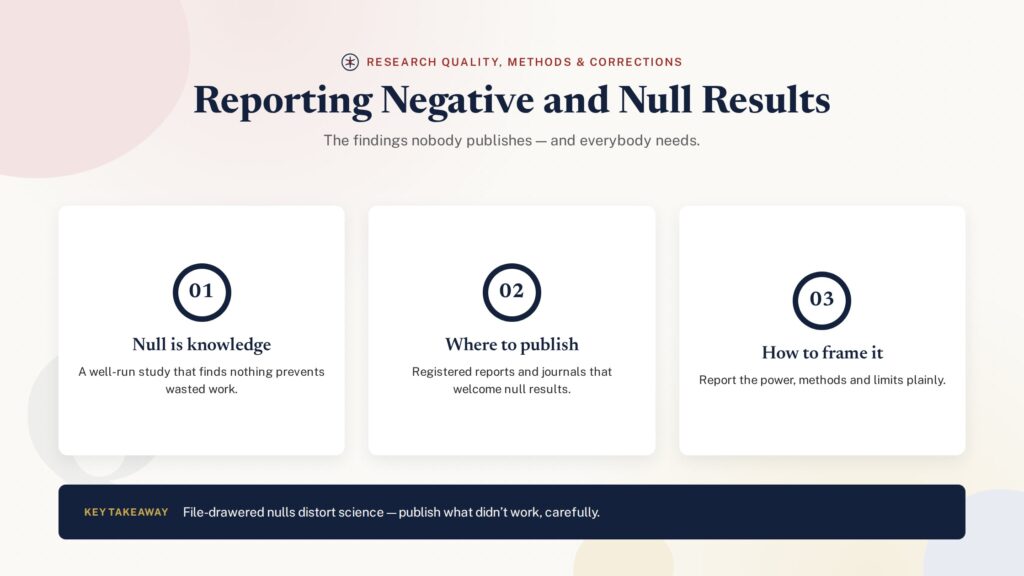
Reporting Negative and Null Results in Academic Publishing
Reading time - 7 minutes
Introduction
For decades, academic publishing favored positive, statistically significant results. This bias distorted the scholarly record and contributed to reproducibility problems. Today, journals increasingly recognize the value of negative and null results.
This article explains why negative results matter, how journals evaluate them, and how authors can publish such findings successfully.
What Are Negative and Null Results?
- Negative results: expected effects not observed
- Null results: no statistically significant relationship
Both provide valuable scientific information.
Why Negative Results Matter
They:
- Prevent duplication of failed approaches
- Improve theory refinement
- Reduce publication bias
- Strengthen evidence synthesis
Science advances through what doesn’t work, too.
Journal Attitudes Are Changing
Many journals now:
- Encourage transparent reporting
- Accept null findings with strong methods
- Promote registered reports
Quality matters more than outcomes.
How to Write Negative Results Effectively
Focus on:
- Rigorous methodology
- Clear hypotheses
- Transparent analysis
- Honest interpretation
Avoid defensive tone.
Common Challenges
Authors face:
- Reviewer bias
- Perceived lack of novelty
- Institutional pressure
Clear framing helps overcome resistance.
Conclusion
Negative and null results are essential for credible science. When reported transparently and rigorously, they contribute meaningfully to knowledge and research integrity.