
Special Issues vs Regular Issues: A Guide for Early‑Career Researchers
Reading time - 7 minutes
Introduction
Early‑career researchers often wonder whether submitting to special issues offers advantages over regular journal issues. While special issues can provide visibility, they also carry risks.
This article compares both options to help early‑career researchers make informed decisions.
What Are Special Issues?
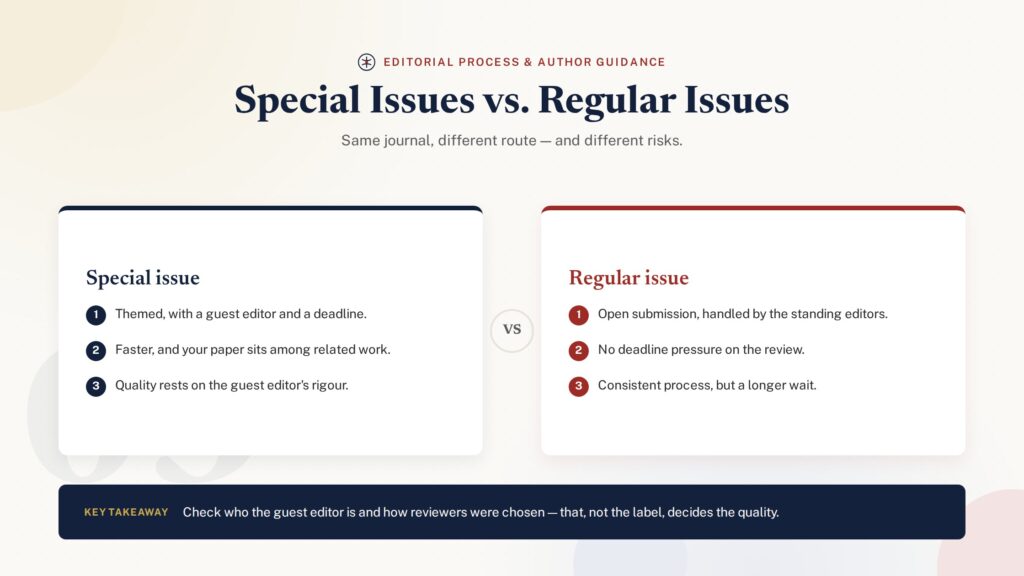
Special issues:
- Focus on a specific theme
- Are often guest‑edited
- Operate on fixed timelines
They attract concentrated scholarly attention.
Advantages of Special Issues for Early‑Career Researchers
Benefits include:
- Thematic visibility
- Networking opportunities
- Potentially faster timelines
Risks and Limitations
Potential drawbacks:
- Higher competition
- Editorial variability
- Delays if contributors are late
Regular Issues: Stability and Predictability
Regular issues offer:
- Established editorial processes
- Rolling submissions
- Broader scope
How to Decide
Consider:
- Research fit
- Career timelines
- Guest editor credibility
Conclusion
Both special and regular issues can benefit early‑career researchers when chosen strategically.
Related Posts:
- The Governance of Special Collections and Thematic Series in…
- Special Issues in Academic Journals: Opportunities and Risks Explained
- Breaking Down the "Preprint Hierarchy": Can Anyone Become a…
- The Ethics of Sponsored Supplements in Academic Journals:…
- Ghost Authorship vs. Guest Authorship: Why Both Violate…