
Post Publication Peer Review Explained: How PPPR Works in 2026
Reading time - 7 minutes
Introduction
Traditional peer review has long been the cornerstone of academic publishing. However, as research dissemination accelerates in the digital age, many scholars and publishers are recognizing that evaluation should not stop at publication. Post-publication peer review (PPPR) has emerged as an additional layer of scholarly scrutiny, allowing the academic community to evaluate, critique, and refine research after it becomes publicly available.
What Is Post-Publication Peer Review?
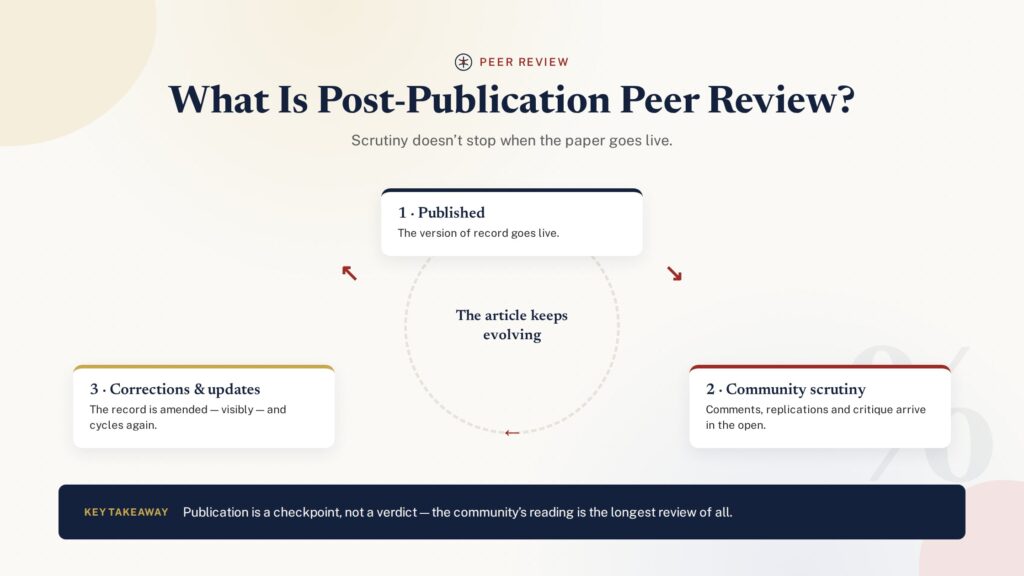
Post-publication peer review refers to the process by which published research is evaluated openly after it has appeared in a journal or repository. Unlike traditional peer review, which occurs before publication and involves a limited number of reviewers, PPPR invites broader scholarly engagement. This evaluation can take many forms, including formal commentary articles, online discussion platforms, journal-sponsored commentary sections, and independent review platforms.
The goal is not to replace traditional peer review but to complement it by enabling continuous quality assurance.
Why Is PPPR Gaining Importance?
Several factors have contributed to the rise of post-publication review:
- Speed of publication: Rapid dissemination models, including online-first articles and open repositories, sometimes leave limited time for exhaustive pre-publication review.
- Complex research outputs: Modern research often includes large datasets, code, multimedia supplements, and interdisciplinary methodologies that benefit from broader scrutiny.
- Transparency expectations: The academic community increasingly values openness, discussion, and accountability.
PPPR creates space for ongoing dialogue, allowing research findings to evolve through community engagement.
Benefits for Researchers
Post-publication review offers several advantages:
- Continuous feedback: Authors receive insights beyond the initial peer reviewers.
- Improved research robustness: Errors, ambiguities, or overlooked perspectives can be identified and addressed.
- Scholarly dialogue: Discussions can generate new collaborations and research directions.
- Increased visibility: Active discussion around an article often increases its academic and public reach.
For early-career researchers, engaging in post-publication commentary can also demonstrate critical thinking and subject expertise.
Challenges and Concerns
Despite its benefits, PPPR presents challenges:
- Quality control: Open commentary can vary in rigor and tone.
- Reputation risks: Public criticism may be uncomfortable for authors.
- Moderation requirements: Platforms must ensure discussions remain constructive and evidence-based.
Recognition gaps: Academic institutions may not formally credit post-publication contributions.
Publishers play a crucial role in designing structured systems that promote respectful, scholarly dialogue rather than unmoderated debate.
The Role of Publishers
Publishers are increasingly integrating PPPR features into journal platforms. These include:
- Comment sections linked to articles
- Invited expert responses
- Editorial follow-up notes
- Mechanisms for publishing formal corrections or updates
- Transparent linking of commentary to article versions
By providing moderated spaces and clear guidelines, publishers can foster constructive engagement while maintaining academic integrity.
PPPR and Research Integrity
Post-publication review contributes significantly to research integrity. It allows:
- Identification of overlooked errors
- Reassessment of conclusions when new data emerges
- Clarification of methodological details
- Community-driven verification of reproducibility
Importantly, PPPR does not automatically imply misconduct. Instead, it reinforces the idea that scientific knowledge evolves over time.
Future Outlook
As digital publishing infrastructures advance, post-publication review is likely to become more structured and integrated. Tools such as annotation systems, AI-assisted comment categorization, and transparent version histories may enhance usability.
In the long term, scholarly communication may shift from a static publication model to a dynamic knowledge ecosystem—where publication marks the beginning of structured dialogue rather than the end of evaluation.
For publishers and research institutions, embracing post-publication peer review is not simply a technological decision. It reflects a broader commitment to transparency, accountability, and the continuous refinement of knowledge.