
The Role of Copyediting and Technical Editing in Academic Publishing: Why Precision Shapes Credibility
Reading time - 7 minutes
Introduction
Academic publishing is built on intellectual rigor, but even the most groundbreaking research can lose impact if presented poorly. Copyediting and technical editing play a foundational role in ensuring that scholarly work is accurate, clear, consistent, and professionally presented. While often working behind the scenes, editors significantly influence how research is perceived, understood, and trusted.
Understanding the distinction between copyediting and technical editing helps authors and publishers appreciate the value these processes add to the scholarly communication ecosystem.
What Is Copyediting in Academic Publishing?
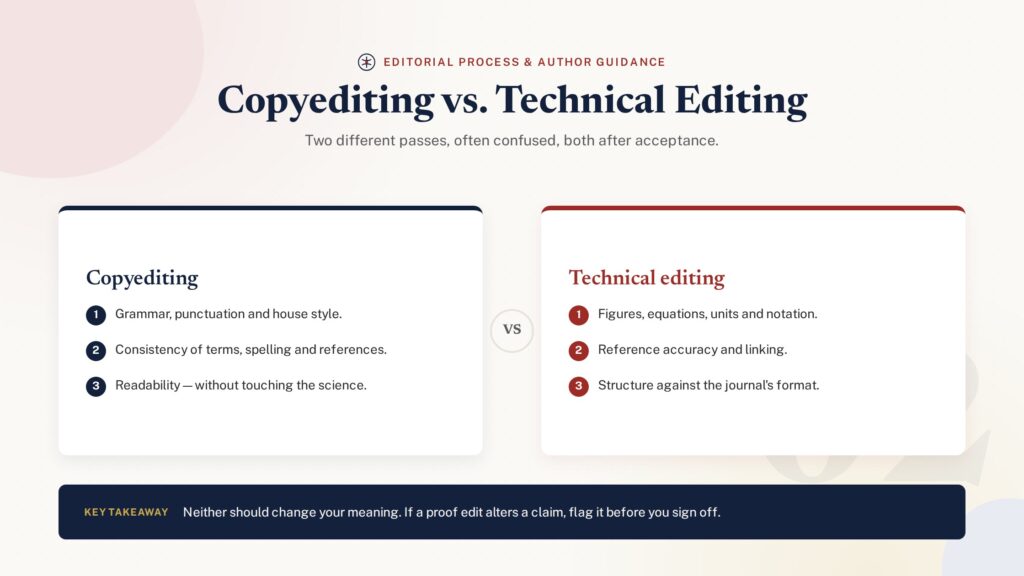
Copyediting refers to the detailed review of a manuscript to improve language, grammar, clarity, structure, and stylistic consistency—without altering the author’s intended meaning.
Key components include:
Grammar and Syntax Correction
Copyeditors correct errors in sentence construction, verb tense consistency, punctuation, and subject–verb agreement. In academic writing, even minor grammatical mistakes can undermine credibility. Precise grammar ensures that complex arguments remain understandable and authoritative.
Consistency in Style and Terminology
Academic journals follow specific style guides (APA, MLA, Chicago, Vancouver, etc.). Copyeditors ensure uniform citation formatting, heading structure, abbreviations, and terminology usage. Consistency enhances professionalism and prevents reader confusion.
Clarity and Readability Enhancement
Copyediting improves sentence flow and eliminates ambiguity. For example, overly long sentences may be divided, passive constructions refined, and vague expressions clarified. This ensures that the research message is communicated effectively to both specialists and interdisciplinary readers.
Reference Accuracy Checks
Copyeditors verify that in-text citations match the reference list and that formatting adheres to journal standards. This prevents referencing errors that could compromise academic integrity.
What Is Technical Editing?
Technical editing goes beyond language correction. It focuses on ensuring that the scientific or scholarly content is logically structured, technically accurate, and clearly presented.
Key responsibilities include:
Structural Coherence
Technical editors evaluate whether the manuscript follows a logical progression—from introduction to conclusion. They assess whether research questions align with methodology and whether results support conclusions.
Terminology and Discipline-Specific Accuracy
Technical editors ensure that field-specific terminology is used correctly and consistently. In specialized disciplines such as engineering or medicine, incorrect terminology can misrepresent findings.
Figures, Tables, and Data Presentation
Editors examine whether charts, tables, and figures accurately reflect the data discussed in the text. They check labeling clarity, unit consistency, and alignment between visuals and narrative explanations.
Compliance with Submission Standards
Technical editors ensure that manuscripts meet journal formatting requirements, including word limits, section organization, abstract structure, and ethical statement placement.
Why Copyediting and Technical Editing Matter
Enhancing Research Credibility
Well-edited manuscripts signal professionalism and rigor. Reviewers and editors are more likely to focus on scientific merit when language and formatting are flawless.
Reducing Reviewer Frustration
Poorly written manuscripts can lead to rejection even if the research is strong. Clear writing facilitates smoother peer review and reduces unnecessary revision cycles.
Supporting Non-Native English Authors
Many researchers publish in English as a second language. Professional editing services help ensure that language barriers do not obscure valuable scientific contributions.
Preventing Misinterpretation
Ambiguity in wording can lead to misinterpretation of results. Precision safeguards against misunderstanding and preserves research integrity.
The Publisher’s Responsibility
Book publishing agencies and academic publishers must integrate high-quality editing into their workflows. This includes:
- Hiring subject-matter-aware editors
- Providing detailed editing guidelines
- Using standardized quality checks
- Ensuring ethical editing practices
Editing should refine—not rewrite—an author’s intellectual contribution.
The Future of Editorial Precision
While AI-assisted grammar tools are emerging, human editorial expertise remains irreplaceable in nuanced academic contexts. The future lies in hybrid models where technology supports efficiency, and professional editors maintain scholarly standards.
Ultimately, copyediting and technical editing are not cosmetic enhancements—they are structural pillars that uphold the clarity, credibility, and impact of academic publishing.