
The Role of Graphical Abstracts in Academic Publishing: Enhancing Visibility and Research Comprehension
Reading time - 7 minutes
Introduction
In an era where researchers are inundated with thousands of new publications every week, capturing attention has become both a challenge and a necessity. While traditional abstracts provide concise textual summaries of research, a growing number of journals are encouraging—or even requiring—authors to submit graphical abstracts. These visual summaries are transforming how research is presented, discovered, and understood in academic publishing.
A graphical abstract is a single, concise visual representation of a study’s key message. Unlike figures embedded within a paper, it is designed to communicate the core contribution of the research at a glance. In digital platforms, search results, and social media feeds, graphical abstracts act as visual entry points that can significantly enhance engagement and accessibility.
Why Graphical Abstracts Matter in Modern Publishing
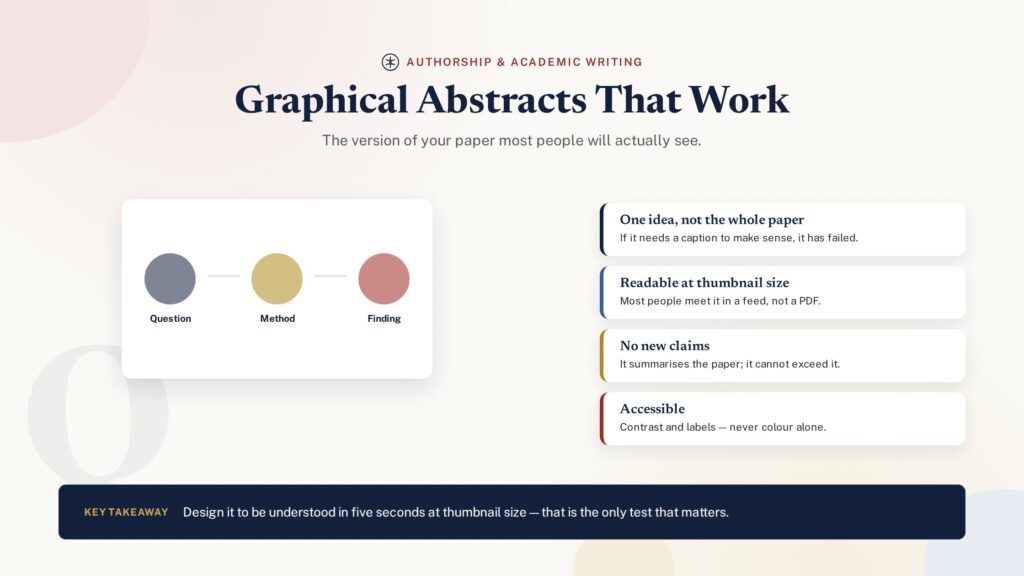
The primary purpose of a graphical abstract is clarity. Academic writing is often dense and technical, making it challenging for readers outside a narrow specialization to quickly grasp a study’s significance. A well-designed graphical abstract distills complex ideas into a structured visual format, allowing readers to understand the research question, methodology, and main findings within seconds.
This visual format aligns with how many people now consume information. Digital interfaces favor images, infographics, and concise visual summaries. When articles are shared on publisher websites, email alerts, or professional networking platforms, graphical abstracts increase click-through rates and visibility. In competitive publishing environments, this added exposure can help research reach broader audiences.
Beyond visibility, graphical abstracts also support interdisciplinary understanding. As research becomes more collaborative across fields, clear visual communication can bridge terminological and conceptual gaps. A scientist from one domain may not fully interpret technical language from another, but a schematic or conceptual diagram can often convey the main idea more intuitively.
Improving Research Discoverability
Discoverability is a key factor in research impact. Search engines, journal platforms, and indexing services increasingly prioritize metadata and digital presentation. While keywords and titles remain essential, graphical abstracts add a visual layer that enhances discoverability in digital ecosystems.
Many journal websites now display graphical abstracts alongside article titles in table-of-contents pages. This format allows readers to scan multiple articles quickly and identify those most relevant to their interests. In some cases, graphical abstracts are also used in promotional materials, conference displays, and digital newsletters, amplifying research dissemination beyond traditional journal readership.
Importantly, graphical abstracts also complement plain-language summaries. While textual summaries make research accessible to non-specialists, graphical abstracts provide a cognitive shortcut—translating dense content into visual logic.
Supporting Learning and Knowledge Retention
Visual communication is closely linked to memory and comprehension. Cognitive research consistently shows that individuals retain visual information more effectively than text alone. By combining minimal text with structured visuals, graphical abstracts enhance understanding and recall.
For students, early-career researchers, and policymakers, graphical abstracts can serve as efficient learning tools. They provide a high-level overview before deeper reading, helping readers decide whether to engage fully with the article. In educational settings, instructors increasingly use graphical abstracts to introduce research topics in a more digestible format.
Moreover, visual summaries encourage authors to reflect critically on their own work. Condensing an entire study into a single visual forces clarity of thought. Authors must identify the central message, eliminate peripheral details, and present the research logically—an exercise that often strengthens the coherence of the manuscript itself.
Design Principles for Effective Graphical Abstracts
While graphical abstracts offer many benefits, their effectiveness depends heavily on design quality. A poorly constructed visual can confuse rather than clarify.
An effective graphical abstract should:
- Focus on One Core Message: It should communicate the primary finding or contribution, not attempt to summarize every detail.
- Maintain Simplicity: Overcrowded visuals defeat the purpose. Clean layouts, clear icons, and minimal text are essential.
- Follow Logical Flow: The visual should guide the reader naturally—often from left to right or top to bottom—mirroring the structure of the study.
- Use Consistent Visual Elements: Uniform fonts, color schemes, and symbols improve readability and professionalism.
- Align with Journal Guidelines: Many journals provide specific technical requirements for dimensions, file formats, and resolution. Compliance ensures smooth production.
Authors who lack design expertise can use simple diagram tools, templates provided by publishers, or collaborate with graphic designers where resources permit. Increasingly, publishers are also offering support services to help authors create high-quality visuals.
Challenges and Ethical Considerations
Despite their advantages, graphical abstracts raise certain concerns. One challenge is the risk of oversimplification. Complex methodologies and nuanced findings cannot always be reduced to a single image without losing important context. Authors must ensure that visual summaries remain accurate and do not exaggerate claims.
There is also the issue of inequity. Researchers with access to design tools or institutional support may produce more visually appealing abstracts, potentially gaining a visibility advantage. Journals can address this by offering clear guidance and standardized templates to level the playing field.
Additionally, accessibility must be considered. Visual elements should be designed with color-blind–friendly palettes and readable fonts. Alternative text descriptions are essential for screen-reader compatibility, ensuring inclusivity for visually impaired readers.
The Future of Visual Communication in Research
Graphical abstracts represent a broader shift toward multimodal scholarly communication. As academic publishing becomes increasingly digital, static text is no longer the sole medium of knowledge exchange. Visuals, interactive figures, and multimedia elements are becoming integral components of research dissemination.
In the future, graphical abstracts may evolve into dynamic or interactive visual summaries embedded within journal platforms. Integration with data visualizations, animated workflows, or clickable elements could further enhance reader engagement.
For now, graphical abstracts offer a practical and impactful way to improve research communication. They do not replace traditional abstracts or full-text reading, but they complement them—serving as gateways to deeper scholarly engagement.
Conclusion
The role of graphical abstracts in academic publishing extends beyond aesthetics. They enhance visibility, improve comprehension, and support interdisciplinary communication in an increasingly digital research landscape. When designed thoughtfully and ethically, graphical abstracts help transform complex research into accessible knowledge—without compromising scholarly rigor.
As competition for reader attention grows, visual clarity is no longer optional. It is becoming a defining feature of effective academic communication.