
Bibliodiversity in Academic Publishing: Why Diversity of Voices, Languages, and Models Matters
Reading time - 7 minutes
Introduction
In conversations about academic publishing, discussions often revolve around impact factors, open access, peer review models, and technological innovation. Yet one crucial concept is gaining increasing attention across the global scholarly community: bibliodiversity. Borrowed from the idea of biodiversity in ecological systems, bibliodiversity refers to the diversity of publishing actors, languages, formats, disciplines, and knowledge systems within scholarly communication.
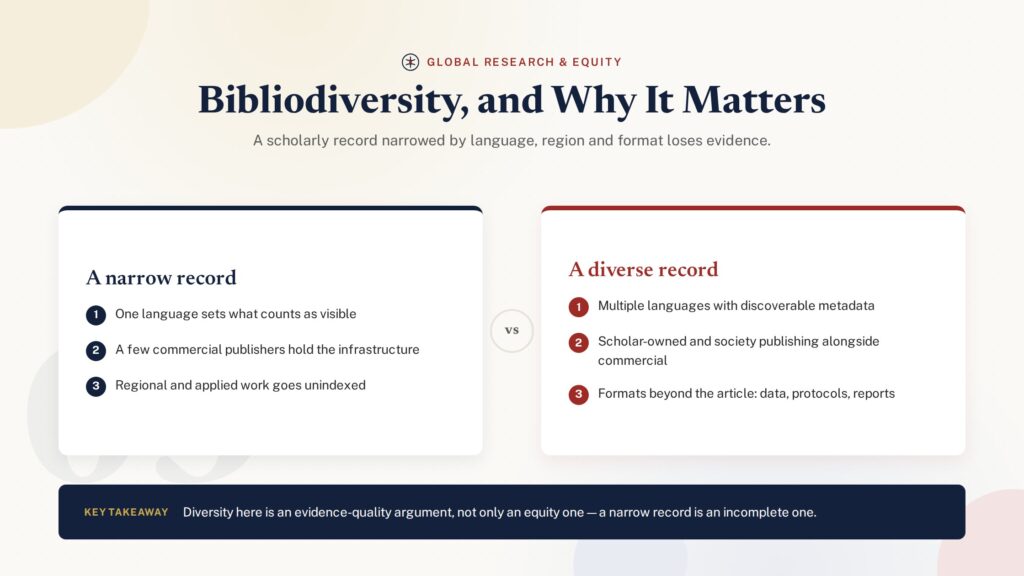
Bibliodiversity emphasizes that a healthy academic ecosystem depends not only on efficiency and standardization but also on plurality. When publishing becomes concentrated in a small number of dominant languages, commercial models, or geographic regions, knowledge production risks becoming homogenized. Supporting bibliodiversity ensures that multiple perspectives, cultures, and research traditions continue to thrive.
What Is Bibliodiversity?
Bibliodiversity encompasses several dimensions:
- Linguistic diversity – Publishing research in multiple languages, not only English.
- Geographic diversity – Supporting publishers and journals from different regions.
- Disciplinary diversity – Recognizing the needs of humanities, social sciences, and STEM fields alike.
- Publishing model diversity – Encouraging nonprofit, scholar-led, university press, and community-based publishing alongside commercial enterprises.
- Epistemic diversity – Valuing Indigenous knowledge systems, local research priorities, and alternative methodologies.
In essence, bibliodiversity resists the idea that there is a single optimal model for producing and disseminating scholarly knowledge.
Why Bibliodiversity Matters
The globalization of research has expanded collaboration across borders, but it has also amplified structural inequalities. English-language journals indexed in major databases often dominate research evaluation systems. Scholars in non-English-speaking regions may feel pressure to publish internationally rather than addressing local issues in local languages.
This dynamic can marginalize regionally relevant research, discourage scholarship on local challenges, and weaken domestic publishing infrastructures. Bibliodiversity helps counterbalance this trend by promoting equitable representation and ensuring that research ecosystems remain inclusive.
Just as ecological monocultures are vulnerable to collapse, overly centralized publishing systems can limit innovation and resilience. A diverse publishing landscape fosters experimentation, adaptability, and cultural richness.
Language and Knowledge Equity
English has become the lingua franca of global academia. While this facilitates international communication, it also creates barriers. Researchers who are not native English speakers often face additional financial and cognitive burdens, including translation costs and linguistic bias during review.
Supporting multilingual publishing strengthens knowledge equity. Local-language journals play a vital role in disseminating research relevant to policymakers, practitioners, educators, and communities. Public health findings, legal reforms, environmental studies, and educational research are often most impactful when accessible in local languages.
Encouraging bilingual abstracts, multilingual repositories, and translation initiatives can bridge global and local audiences without forcing scholars to choose between them.
The Role of Independent and Scholar-Led Publishers
Large commercial publishers dominate many high-impact journals, but independent and scholar-led initiatives are equally important. University presses, learned societies, and nonprofit platforms often prioritize disciplinary depth, community engagement, and long-term scholarly value over short-term profitability.
These publishers frequently support niche research areas, regional studies, and emerging fields that may not attract mass commercial attention. By sustaining smaller publishing entities, the academic community preserves intellectual diversity and prevents excessive market consolidation.
Funding agencies and institutions can promote bibliodiversity by allocating resources to community-based publishing infrastructures and open platforms.
Bibliodiversity and Research Assessment
Research evaluation systems significantly influence publishing behavior. When hiring, promotion, and funding decisions rely heavily on journal prestige metrics, scholars are incentivized to target a narrow set of high-impact journals. This can unintentionally undermine bibliodiversity by concentrating submissions in a limited publishing ecosystem.
Reforming research assessment criteria to value diverse outputs—such as regional journals, monographs, policy reports, and community-engaged research—can strengthen bibliodiversity. Initiatives advocating responsible metrics emphasize assessing research quality and societal impact rather than relying solely on journal-based indicators.
When institutions broaden recognition frameworks, scholars gain freedom to publish in venues that best serve their research goals and communities.
Digital Infrastructure and Inclusivity
Technological innovation has lowered barriers to publishing, but infrastructure disparities persist. Regions with limited digital resources may struggle to maintain sustainable publishing platforms. Investing in shared, open-source infrastructure can support smaller publishers and reduce dependency on expensive proprietary systems.
Collaborative platforms, interoperable metadata standards, and inclusive indexing services can ensure that diverse journals are discoverable and integrated into global knowledge networks. Without visibility, even high-quality regional research risks remaining invisible.
Strengthening digital inclusivity contributes directly to bibliodiversity by leveling the playing field.
Protecting Humanities and Social Sciences
Bibliodiversity is especially important in the humanities and social sciences, where monographs, local-language publications, and region-specific research remain central. Standardized publishing models designed primarily for STEM fields may not fully accommodate these disciplines’ needs.
Supporting varied formats—such as edited volumes, critical editions, and long-form scholarship—ensures that intellectual traditions across disciplines are preserved. Recognizing the unique communication patterns of different fields reinforces a pluralistic publishing environment.
Challenges to Achieving Bibliodiversity
Despite its importance, bibliodiversity faces several challenges:
- Concentration of publishing power among large multinational corporations
- Dominance of English-language indexing systems
- Metric-driven evaluation cultures
- Limited funding for small or regional publishers
- Uneven digital infrastructure across countries
Addressing these challenges requires coordinated action from publishers, institutions, funders, policymakers, and researchers.
A Shared Responsibility
Promoting bibliodiversity is not solely the responsibility of small publishers or marginalized communities. Established journals can diversify editorial boards, include multilingual policies, and expand geographic representation among reviewers and authors. Institutions can adjust promotion criteria. Funders can support inclusive dissemination strategies.
Researchers themselves also play a role by citing diverse sources, collaborating internationally, and considering publication venues that align with community impact rather than prestige alone.
Conclusion
Bibliodiversity is essential to the vitality, fairness, and resilience of academic publishing. A diverse scholarly ecosystem strengthens innovation, supports regional relevance, and ensures that multiple voices contribute to global knowledge production.
In an era of increasing standardization and consolidation, protecting diversity in languages, publishing models, disciplines, and knowledge systems is not a peripheral concern—it is central to the future of scholarship. By fostering bibliodiversity, the academic community affirms that knowledge thrives not in uniformity, but in plurality.