
Overlay Journals: A Disruptive Model for Scholarly Publishing
Reading time - 7 minutes
Introduction
As scholarly communication continues to evolve in the digital age, new publishing models are emerging that challenge traditional journal structures. Among the most innovative of these is the concept of overlay journals. Built on top of openly accessible research repositories, overlay journals provide peer review, editorial oversight, and formal certification without hosting the research content themselves. This model has the potential to reduce costs, accelerate dissemination, and redefine the role of journals in academic publishing.
Overlay journals represent a shift from content ownership to quality validation. Instead of serving primarily as content distributors, journals function as curators and evaluators of research that is already publicly available online.
What Are Overlay Journals?
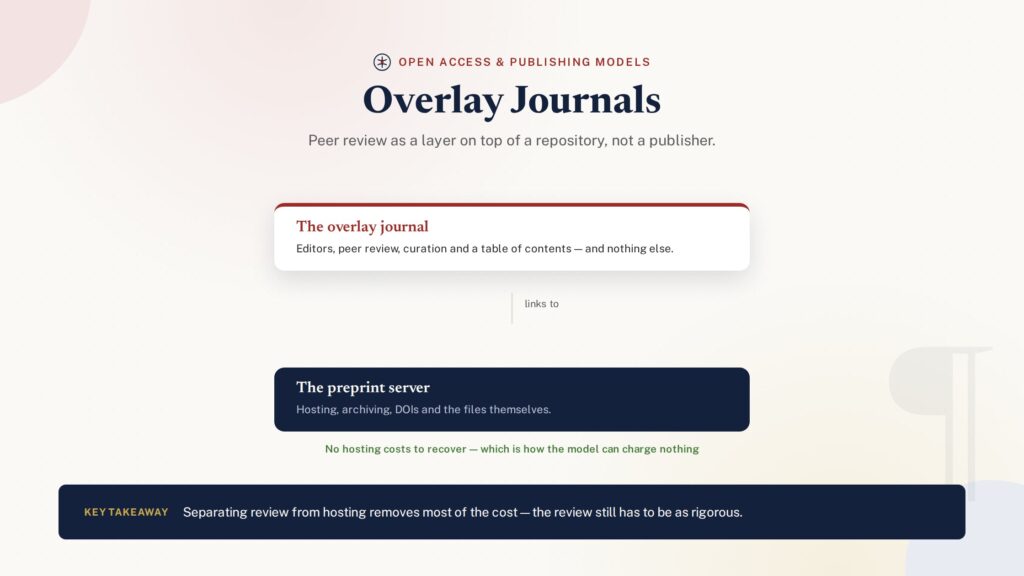
An overlay journal is a scholarly journal that conducts peer review and editorial assessment of articles hosted on external platforms, typically open repositories or preprint servers. Once an article passes review, the journal “overlays” its endorsement, linking to the repository-hosted version rather than republishing the full text on its own website.
In this model, the repository acts as the storage and access layer, while the journal provides certification, branding, and scholarly validation. The final, approved version remains openly accessible through the repository, often with clear labeling that indicates its peer-reviewed status.
Overlay journals do not duplicate infrastructure for hosting, archiving, or content delivery. Instead, they leverage existing systems to focus on what journals do best: ensuring quality and scholarly rigor.
How Overlay Journals Differ from Traditional Journals
Traditional journals typically manage the entire publication process—from submission and peer review to typesetting, hosting, and distribution. They maintain their own websites, archives, and digital infrastructure. Overlay journals, by contrast, separate evaluation from storage.
This distinction produces several key differences:
- Reduced infrastructure costs, since repositories handle hosting and preservation.
- Faster workflows, as articles may already be publicly available prior to formal review.
- Greater transparency, because earlier versions may remain accessible alongside reviewed versions.
- Flexible formats, allowing journals to focus on evaluation rather than formatting constraints.
By decoupling dissemination from certification, overlay journals question the assumption that journals must control content hosting to provide value.
Benefits of the Overlay Model
- Cost Efficiency
Operating a journal can be expensive. Infrastructure, website maintenance, archiving systems, and content management platforms require significant resources. Overlay journals reduce these expenses by relying on established repositories.
Lower operational costs may create opportunities for more sustainable funding models and reduce financial barriers for authors and institutions. - Acceleration of Scholarly Communication
Because articles can be deposited in repositories before or during review, knowledge becomes accessible earlier in the research lifecycle. Peer review then enhances credibility rather than controlling access.
This approach supports rapid knowledge sharing while preserving rigorous evaluation. - Transparency in Review and Revision
Many overlay journals support open review practices. Since repository versions are timestamped and publicly visible, readers can track revisions and editorial decisions more easily. This transparency can strengthen trust in the publication process. - Preservation and Stability
Repositories often have long-term preservation strategies and standardized metadata practices. Overlay journals benefit from these systems without duplicating preservation efforts.
Challenges Facing Overlay Journals
Despite their promise, overlay journals face important challenges.
Recognition and Prestige
Academic evaluation systems often rely on established journal brands. Overlay journals, especially newer ones, may struggle to gain recognition in hiring, promotion, or funding decisions. Building credibility requires time and consistent quality.
Technical Integration
Overlay models depend on seamless integration between journals and repositories. Metadata accuracy, version control, and persistent identifiers must be carefully managed to ensure clarity between pre-reviewed and certified versions.
Cultural Resistance
Many researchers are accustomed to traditional journal formats. Shifting perceptions—from journals as content owners to journals as evaluators—requires cultural adaptation within academic communities.
Overlay Journals and the Changing Role of Publishers
Overlay journals contribute to a broader redefinition of the publisher’s role. In a digital environment where storage and distribution are widely accessible, the value of scholarly publishing increasingly lies in quality assurance, editorial expertise, and community trust.
Rather than acting primarily as gatekeepers of access, journals may evolve into certifiers of reliability. Overlay models make this shift explicit: the article exists independently, and the journal’s contribution is validation.
This distinction aligns with digital research practices, where scholars frequently discover articles through search engines and repositories rather than through journal issue browsing.
Potential Impact on Equity and Access
By leveraging open repositories, overlay journals can support more inclusive access to knowledge. Readers do not encounter paywalls to access certified articles, and authors may face fewer financial barriers if operational costs are lower.
In regions where institutional budgets for subscriptions are limited, overlay models can contribute to a more equitable scholarly landscape. However, sustainable funding mechanisms remain essential to ensure long-term viability.
The Future of Overlay Publishing
Overlay journals are still relatively niche compared to traditional publishing models, but interest is growing. As digital repositories mature and researchers become more comfortable with open dissemination practices, overlay models may expand across disciplines.
The future of overlay publishing will likely depend on:
- Broader institutional recognition.
- Strong indexing and discoverability.
- Clear labeling of peer-reviewed status.
- Continued commitment to rigorous editorial standards.
If these elements are maintained, overlay journals could complement existing systems rather than replace them entirely.
Conclusion
Overlay journals challenge conventional assumptions about what a journal must be. By separating hosting from evaluation, they focus on scholarly validation rather than content control. This streamlined approach reduces infrastructure duplication, accelerates dissemination, and highlights the core function of academic publishing: certifying the quality of research.
While cultural and structural challenges remain, overlay journals represent a thoughtful experiment in reimagining scholarly communication for a digital era. As academia continues to adapt to technological change, models that emphasize efficiency, transparency, and accessibility are likely to play an increasingly important role in shaping the future of research publishing.