
The Role of Knowledge Graphs in Academic Publishing: Connecting Research Beyond Citations
Reading time - 7 minutes
Introduction
For centuries, scholarly communication has relied on citations to connect ideas. Citations signal influence, acknowledge prior work, and help readers trace intellectual lineages. Yet in an era of interdisciplinary research, large datasets, and machine-assisted discovery, citations alone may no longer be sufficient to represent the complex relationships between research outputs.
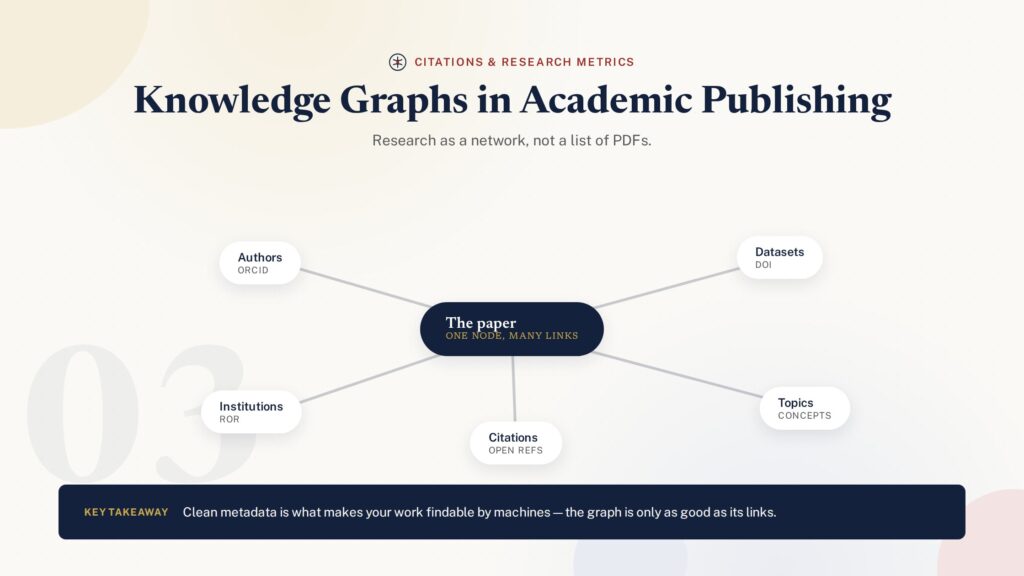
Enter knowledge graphs—structured networks that connect articles, authors, institutions, concepts, methods, datasets, and funding sources in machine-readable ways. While widely used in fields such as data science and artificial intelligence, knowledge graphs are emerging as a powerful infrastructure for academic publishing. Rather than merely linking papers through references, they map the deeper semantic relationships that shape the research ecosystem.
What Is a Knowledge Graph?
A knowledge graph organizes information as entities (such as researchers, articles, or institutions) and relationships (such as “authored by,” “funded by,” “uses method,” or “builds on theory”). Unlike traditional bibliographic databases, which primarily index metadata, knowledge graphs capture contextual meaning.
For example, instead of simply listing that Paper A cites Paper B, a knowledge graph can specify that Paper A:
- Applies the statistical method introduced in Paper B.
- Uses a dataset curated by Institution C.
- Extends a theoretical framework developed by Researcher D.
- Was funded under Grant Program E.
By structuring these relationships, knowledge graphs transform static publications into interconnected networks of scholarly information.
Beyond Citations: A Richer Scholarly Map
Citations are binary—they indicate that one work references another. However, they rarely clarify why the citation exists. Is it supportive? Critical? Methodological? Conceptual? Knowledge graphs enable more granular distinctions.
This richer mapping has several implications:
- Discoverability Across Disciplines
Interdisciplinary research often struggles with visibility because terminology varies across fields. Knowledge graphs can link concepts even when different vocabularies are used. For instance, research on “machine learning fairness” in computer science may connect to “algorithmic bias” studies in sociology through shared conceptual nodes. - Enhanced Literature Exploration
Instead of keyword searches that retrieve long lists of articles, researchers could navigate interactive networks showing how studies cluster around specific methods, datasets, or theories. This dynamic exploration may reveal connections that traditional indexing overlooks. - Tracking Methodological Lineages
Methods evolve over time. Knowledge graphs can trace how specific techniques spread across disciplines, highlighting methodological influence beyond citation counts.
Implications for Publishers
Academic publishers sit at the center of scholarly metadata. By investing in structured, machine-readable metadata and semantic tagging, publishers can help build and enrich knowledge graphs.
This shift requires more than technical upgrades. It involves:
- Standardizing metadata schemas.
- Embedding persistent identifiers for authors, institutions, grants, and datasets.
- Structuring abstracts and keywords for semantic clarity.
- Collaborating with indexing services and research infrastructures.
Publishers that embrace knowledge graph integration may enhance the value of their content ecosystems, offering readers advanced discovery tools and contextual insights that go beyond PDF downloads.
Supporting Research Evaluation Reform
Research assessment systems are increasingly criticized for overreliance on simplistic metrics such as journal impact factors or raw citation counts. Knowledge graphs offer alternative analytical possibilities.
Because they encode relationships, knowledge graphs can help evaluate:
- Collaboration networks across institutions or countries.
- Interdisciplinary knowledge transfer.
- Societal impact through links to policy documents or clinical guidelines.
- Method adoption across research communities.
Rather than measuring influence solely by citation volume, evaluators could examine how research contributes to broader knowledge ecosystems.
Enabling Machine-Assisted Research
Artificial intelligence tools depend on structured data. Knowledge graphs provide a foundation for advanced research support systems, including:
- Automated literature mapping.
- Identification of emerging research trends.
- Detection of underexplored conceptual intersections.
- Recommendation systems tailored to researchers’ interests.
As AI becomes more integrated into research workflows, well-structured knowledge graphs will play a critical role in ensuring that machine-assisted discovery is accurate, transparent, and contextually grounded.
Challenges in Implementation
Despite their promise, knowledge graphs face practical and conceptual challenges.
Data Quality and Standardization:
Inconsistent metadata, incomplete affiliations, and ambiguous author names limit the reliability of knowledge graphs. Robust identifier systems and standardized reporting practices are essential.
Resource Investment:
Building and maintaining semantic infrastructure requires financial and technical commitment. Smaller publishers may face barriers to adoption without collaborative frameworks.
Governance and Ownership:
Who controls scholarly knowledge graphs? Centralized models risk concentration of power, while decentralized models require strong coordination. Transparent governance structures are necessary to maintain trust.
Privacy Considerations:
Mapping relationships among researchers, funders, and institutions raises data privacy concerns. Clear policies must balance transparency with ethical safeguards.
Toward a Networked Future of Scholarship
Academic publishing is gradually shifting from static dissemination to dynamic knowledge ecosystems. Articles are no longer isolated outputs; they are nodes in complex networks of data, methods, funding, and collaboration.
Knowledge graphs embody this networked vision. They make visible the intricate architecture of research—how ideas evolve, how disciplines intersect, and how innovation spreads. By structuring scholarly relationships semantically, they enhance discoverability, support fairer evaluation, and enable intelligent research tools.
Importantly, knowledge graphs do not replace traditional publishing. Peer review, editorial oversight, and rigorous scholarship remain central. Instead, knowledge graphs complement these processes by organizing and contextualizing the outputs they produce.
As research continues to grow in volume and complexity, the ability to navigate connections becomes as important as generating new knowledge itself. In this evolving landscape, knowledge graphs may serve as the connective tissue of scholarly communication—linking ideas not just through citations, but through meaningful, structured relationships that reflect how science and scholarship truly advance.
The future of academic publishing may not simply be digital. It may be relational—built on networks that illuminate how knowledge is created, shared, and transformed across the global research community.