
Crossmark and Version Transparency in Academic Publishing: Ensuring Readers Access the Most Reliable Research
Reading time - 7 minutes
Introduction
In an era of rapid digital dissemination, research articles no longer exist as static, unchangeable records. Corrections are issued, datasets are updated, supplementary files are revised, and, in some cases, papers are retracted or replaced. While these post-publication changes are essential for maintaining accuracy, they can also create confusion. How can readers be certain they are consulting the most current and reliable version of a scholarly work?
This challenge has led to the development of structured version transparency systems in academic publishing, most notably through Crossmark, a service provided by Crossref. By embedding clear status indicators into digital articles, publishers can signal whether a document is current, corrected, or superseded—thereby strengthening trust in the scholarly record.
The Problem of Version Confusion
In print-based publishing, the “version of record” was relatively straightforward: once printed, the article remained fixed. Corrections appeared in later issues, and readers had to manually connect them to the original piece.
Digital publishing has transformed this model. Articles may appear online ahead of print, undergo metadata updates, receive minor corrections, or be amended in response to discovered errors. Pre-publication versions, accepted manuscripts, and final versions of record may circulate simultaneously across institutional repositories, personal websites, and indexing platforms.
Without clear signaling mechanisms, readers may unknowingly cite outdated or corrected versions. This undermines research integrity and can perpetuate inaccuracies in subsequent scholarship.
What Is Crossmark?
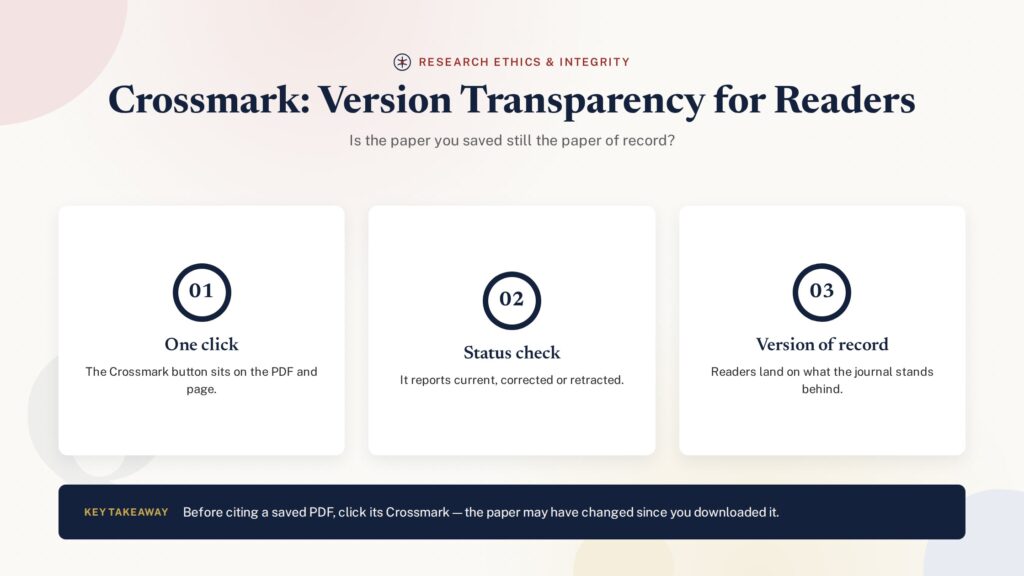
Crossmark is a tool that allows publishers to display the current status of a scholarly document directly within its digital interface. When readers click the Crossmark logo embedded in a PDF or HTML article, they can access real-time information about:
- Whether the document is current
- Whether it has been corrected, updated, or retracted
- Links to correction notices or retraction statements
- Additional publication metadata
The system works through persistent identifiers, particularly Digital Object Identifiers (DOIs). Because DOIs are maintained through Crossref, publishers can update the record without altering the original citation link.
This approach preserves citation stability while enhancing transparency.
Why Version Transparency Matters
Version transparency serves multiple stakeholders within the academic ecosystem:
For Researchers
Accurate citations depend on consulting the correct version of a paper. Version indicators reduce the risk of propagating errors and strengthen scholarly reliability.
For Publishers
Transparent correction practices demonstrate editorial responsibility. Rather than hiding errors, publishers openly document and contextualize changes.
For Institutions and Funders
Reliable version control supports compliance with integrity standards and reinforces confidence in research outputs.
For the Public
In fields such as health, climate science, and policy research, outdated or retracted findings can have serious real-world implications. Clear status indicators protect public trust.
In short, version transparency is not merely a technical feature—it is an ethical commitment to accountability.
Corrections, Updates, and Retractions
Post-publication changes generally fall into several categories:
- Minor corrections (e.g., typographical errors)
- Errata or corrigenda (substantive but limited errors)
- Addenda (additional information that enhances clarity)
- Retractions (withdrawal due to significant flaws or misconduct)
- Expressions of concern (temporary notices pending investigation)
Without standardized signaling systems, readers must search manually for these notices. Crossmark centralizes this information in a consistent, accessible format.
Importantly, transparency does not equate to instability. A clearly corrected article can retain credibility precisely because its revisions are visible and traceable.
Version of Record vs. Dynamic Scholarship
The rise of living documents, dynamic datasets, and iterative digital publications raises important questions: Should research remain fixed once published? Or should it evolve as new data emerge?
Most journals still maintain a definitive “version of record” to preserve citation stability. However, digital infrastructures now allow layered updates that maintain both permanence and flexibility. Through persistent identifiers and version tracking systems, publishers can balance archival integrity with necessary revision.
Crossmark does not replace the version of record; rather, it contextualizes it within an evolving research lifecycle.
Implementation Challenges
Despite its advantages, version transparency requires coordinated infrastructure and consistent policy enforcement.
Technical Integration
Publishers must integrate Crossmark metadata into their workflows and ensure DOI records are updated promptly.
Editorial Consistency
Clear policies are needed to determine when a correction warrants a notice, an update, or a retraction.
Author Communication
Authors should understand how post-publication changes are handled and how these affect citation and reputation.
Smaller publishers may face resource constraints in implementing comprehensive version tracking systems. However, standardized services reduce barriers by offering scalable solutions.
Beyond Corrections: Expanding Transparency
Crossmark can also provide additional publication metadata, such as:
- Funding information
- Peer review models
- Publication history dates
- Licensing details
By embedding this information in a single, accessible interface, publishers enhance the discoverability and contextual richness of scholarly content.
As research ecosystems become increasingly interconnected—spanning preprints, institutional repositories, and open data platforms—version transparency tools will likely expand in scope and sophistication.
Building a Culture of Accountability
Ultimately, version transparency is as much cultural as technological. Academic publishing is moving away from the illusion of infallibility toward a model that acknowledges research as an iterative process.
Errors are inevitable in complex scholarly work. What distinguishes responsible publishing is not the absence of mistakes, but the clarity and speed with which they are addressed.
By adopting tools like Crossmark and maintaining rigorous update policies, publishers reinforce a crucial message: scholarship is trustworthy not because it never changes, but because its changes are visible, documented, and traceable.
The Future of Version Transparency
As artificial intelligence tools, data-driven research, and collaborative global scholarship continue to evolve, version control will become even more critical. Automated metadata updates, real-time correction tracking, and interoperable version histories may soon become standard features across publishing platforms.
In a digital age where information spreads instantly and widely, ensuring that readers can verify the current status of a scholarly document is not optional—it is foundational to research integrity.
Version transparency systems such as those supported by Crossref offer a practical and principled solution. By embedding accountability directly into the scholarly record, academic publishing strengthens its most valuable asset: trust.