
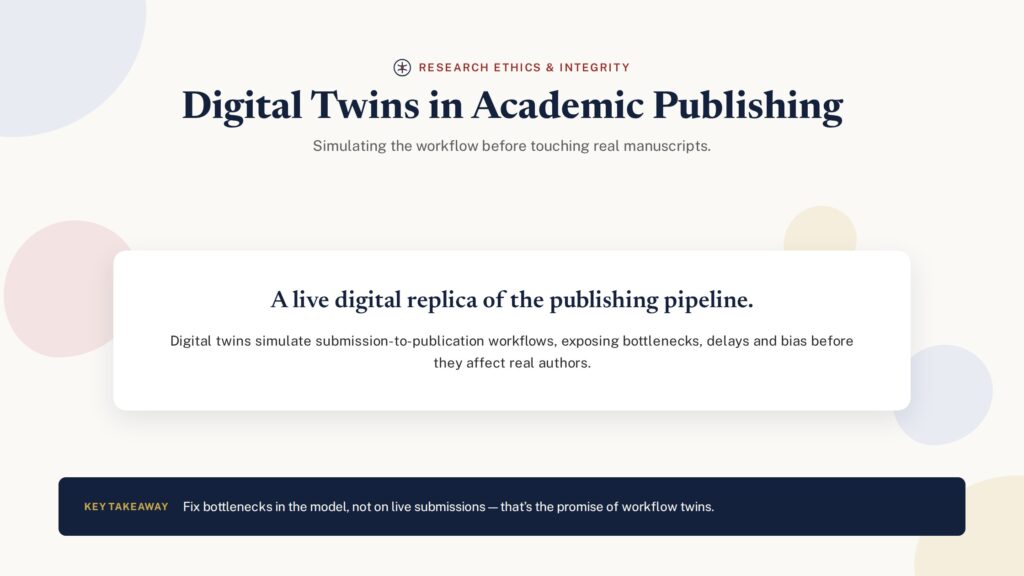
Digital Twins in Academic Publishing: Simulating Research Workflows for Greater Efficiency and Transparency
Reading time - 7 minutes
Introduction
As scholarly communication grows increasingly complex, academic publishing faces mounting operational challenges. Rising submission volumes, expanding compliance requirements, technological integration demands, and global collaboration pressures have pushed editorial systems to their limits. While innovation has focused heavily on peer review models, open science policies, and AI integration, a quieter transformation may be emerging from an unexpected direction: digital twin technology.
Originally developed in engineering and manufacturing, digital twins are virtual replicas of physical systems used to simulate performance, predict outcomes, and optimize processes. Applied to academic publishing, digital twins could model editorial workflows, peer review pipelines, and production cycles—offering data-driven insights before changes are implemented in real-world systems.
What Is a Digital Twin in Publishing?
A digital twin in academic publishing is a dynamic, data-driven simulation of a journal’s operational ecosystem. It mirrors real-time processes such as:
- Manuscript submission and triage
- Editorial assignment and decision timelines
- Peer reviewer invitation cycles
- Revision rounds and acceptance rates
- Production workflows and publication timelines
Rather than merely collecting metrics, a digital twin enables scenario modeling. Editors and publishers can test hypothetical changes—such as adjusting reviewer reminder intervals or modifying desk rejection criteria—within a simulated environment before applying them to actual submissions.
This predictive capacity distinguishes digital twins from traditional analytics dashboards.
Why Academic Publishing Needs Simulation Models
Editorial workflows are intricate systems influenced by multiple variables: reviewer availability, subject-area demand, geographic diversity, editorial board workload, and production capacity. Small adjustments can create unintended consequences.
For example:
- Increasing submission volume without expanding reviewer pools may extend turnaround times.
- Accelerating desk screening could reduce reviewer fatigue but risk overlooking innovative research.
- Introducing new compliance checks might enhance quality but slow processing.
A digital twin allows publishers to simulate these trade-offs in advance. Instead of reacting to bottlenecks after they occur, editorial teams can forecast outcomes and optimize decisions proactively.
In high-volume publishing environments, such predictive insight can translate into measurable efficiency gains and improved author satisfaction.
Core Components of a Publishing Digital Twin
To function effectively, a digital twin requires structured data inputs from multiple systems:
- Submission Metadata
Historical patterns of manuscript volume by discipline, region, and time of year. - Peer Review Metrics
Reviewer acceptance rates, response times, average review duration, and revision cycles. - Editorial Decision Data
Desk rejection ratios, acceptance rates, and time-to-first-decision metrics. - Production Timelines
Copyediting duration, typesetting time, and publication scheduling intervals.
When integrated into a simulation model, these data streams enable publishers to test operational scenarios. For instance, what would happen if reviewer reminders were automated earlier? How would expanding the editorial board affect turnaround times?
These questions can be explored virtually without disrupting live workflows.
Benefits for Editors and Publishers
The adoption of digital twins in academic publishing offers several potential advantages:
- Reduced Turnaround Times
Simulation can identify hidden bottlenecks and optimize task sequencing. - Improved Reviewer Allocation
Models can predict reviewer fatigue and suggest redistribution strategies. - Evidence-Based Policy Changes
Editorial guidelines and workflow modifications can be tested before implementation. - Enhanced Transparency
Data-backed forecasting allows publishers to communicate realistic timeline expectations to authors. - Resource Optimization
Publishers can allocate staff and technological investments more strategically.
In a competitive publishing landscape, where efficiency and author experience are critical, such tools may become strategic assets.
Ethical and Governance Considerations
As with any data-driven system, digital twins raise important ethical considerations.
First, predictive models must avoid reinforcing existing biases. If historical data reflect regional disparities in acceptance rates or review delays, simulations may inadvertently perpetuate inequities.
Second, transparency about how workflow simulations inform decision-making is essential. Authors should not be subject to opaque algorithmic optimizations that prioritize speed over fairness.
Third, data privacy safeguards must be robust. Manuscript data, reviewer identities, and editorial communications contain sensitive information that requires secure handling.
Careful governance frameworks are necessary to ensure that efficiency does not override academic integrity.
Integration with Emerging Technologies
Digital twins could complement other technological innovations in publishing. For example:
- Machine learning tools might enhance predictive accuracy.
- Workflow automation systems could implement optimized scheduling derived from simulations.
- Real-time dashboards could visualize performance against simulated benchmarks.
Rather than replacing human editorial oversight, digital twins function as decision-support systems. Editors retain authority while benefiting from predictive insight.
In this sense, the technology aligns with broader trends toward hybrid human–machine collaboration in scholarly communication.
Potential Challenges in Implementation
Despite their promise, digital twins require substantial technical infrastructure. Smaller publishers may lack the resources or expertise to develop comprehensive simulation models.
Data standardization also poses a challenge. Publishing systems often operate across fragmented platforms—submission systems, production tools, and archiving services. Integrating these into a unified modeling framework demands interoperability and consistent metadata standards.
Additionally, overreliance on predictive models could risk narrowing editorial flexibility. Academic publishing thrives on intellectual nuance and contextual judgment, which cannot be fully reduced to operational variables.
A balanced approach combines simulation insights with human discretion.
A Strategic Shift Toward Predictive Publishing
The adoption of digital twins represents a shift from descriptive analytics to predictive governance. Instead of asking, “What happened?” publishers can ask, “What will happen if we change this?”
Such foresight is particularly valuable in an era of increasing submission volumes, evolving open science mandates, and heightened scrutiny of editorial transparency.
As academic publishing continues to modernize, operational resilience will become as important as scholarly credibility. Digital twins offer a way to strengthen that resilience—by transforming workflows from reactive systems into adaptive, data-informed ecosystems.
Looking Ahead
While still emerging in the publishing sector, digital twin technology may soon play a central role in editorial strategy. Early adopters could pioneer more efficient, transparent, and responsive systems that enhance both author experience and institutional trust.
Academic publishing has long focused on improving research quality and accessibility. The next frontier may lie in optimizing the systems that support those goals.
By simulating the complexities of editorial workflows before implementing change, digital twins offer a powerful new lens for understanding and improving scholarly communication—one that prioritizes foresight, balance, and sustainable growth in an increasingly demanding research environment.