
Carbon Footprint of Academic Publishing: Measuring and Reducing the Environmental Impact of Scholarly Communication
Reading time - 7 minutes
Introduction
Academic publishing is often viewed as an intellectual enterprise removed from environmental concerns. Yet behind every manuscript submission, peer review cycle, server upload, and printed issue lies a measurable carbon footprint. As universities, funders, and research institutions adopt sustainability goals, scholarly publishing must also examine its environmental impact.
From energy-intensive data centers to international editorial meetings and print distribution, the publishing ecosystem contributes to greenhouse gas emissions in ways that are rarely quantified. Understanding and reducing this footprint is emerging as a new frontier in responsible scholarly communication.
The Hidden Environmental Costs of Publishing
Traditional print publishing clearly carries environmental costs—paper production, printing, shipping, and physical storage all consume resources. However, the transition to digital publishing has not eliminated environmental impact; it has transformed it.
Digital publishing depends on:
- Cloud-based manuscript submission systems
- Peer review management platforms
- Online hosting servers
- Data storage infrastructure
- Video and multimedia content hosting
- Email communications and automated notifications
These services rely on large-scale data centers that consume substantial electricity. While many providers are shifting toward renewable energy sources, the overall demand for digital infrastructure continues to grow.
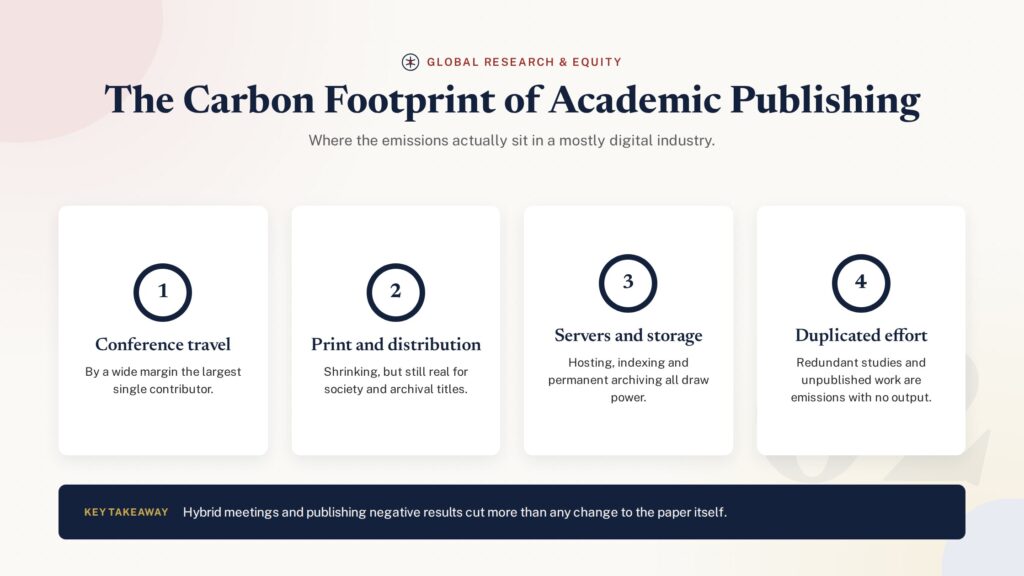
Moreover, academic publishing is globally interconnected. Conferences, editorial board meetings, and author collaborations often involve international travel, which significantly contributes to carbon emissions.
Measuring the Carbon Footprint
One of the primary challenges is measurement. Unlike industries with tangible production lines, publishing involves distributed digital processes. Calculating emissions requires assessing:
- Energy consumption of hosting platforms
- Server cooling and maintenance costs
- Printing and distribution logistics
- Staff commuting and office operations
- Travel associated with conferences and editorial activities
Carbon accounting frameworks, widely used in corporate sustainability reporting, can be adapted to publishing. Scope 1, Scope 2, and Scope 3 emissions categories provide structured methods for analysis.
- Scope 1: Direct emissions from owned facilities
- Scope 2: Indirect emissions from purchased energy
- Scope 3: Emissions from supply chains, travel, and outsourced services
For publishers, Scope 3 emissions—particularly travel and supply chain activities—may represent the largest share.
Print vs. Digital: A Complex Comparison
At first glance, digital publishing appears more environmentally friendly than print. Eliminating paper reduces deforestation and physical distribution emissions. However, digital platforms operate continuously, requiring persistent energy consumption.
The sustainability comparison depends on scale and usage patterns. A widely accessed digital article may consume less energy per reader than a printed journal shipped globally. Conversely, long-term server storage and redundant backups add cumulative energy costs.
Hybrid models, which offer limited print runs alongside digital access, must carefully evaluate demand to avoid unnecessary overproduction.
Sustainable Editorial Practices
Beyond infrastructure, editorial practices can influence environmental impact.
- Reducing Travel Through Virtual Collaboration
The widespread adoption of virtual meetings has demonstrated that editorial discussions and peer review training sessions can be conducted effectively online. Maintaining hybrid or fully virtual models reduces travel-related emissions. - Optimizing Server Efficiency
Publishers can partner with hosting providers that utilize renewable energy or energy-efficient data centers. Transparent reporting from technology vendors should be part of procurement criteria. - Encouraging Sustainable Printing Policies
Where print remains necessary, sustainable paper sourcing, eco-friendly inks, and print-on-demand models reduce waste. - Streamlining Workflows
Efficient editorial processes reduce unnecessary system usage and repetitive communications, indirectly lowering energy consumption.
Institutional and Funder Expectations
Universities and research funders increasingly integrate environmental sustainability into strategic planning. Academic publishing cannot remain isolated from these expectations.
Some institutions now require sustainability reporting in vendor assessments. Publishers that demonstrate proactive carbon reduction strategies may gain competitive advantage in partnerships and contracts.
Furthermore, researchers themselves are becoming more environmentally conscious. Transparent sustainability commitments can strengthen trust within the academic community.
Balancing Open Access and Sustainability
Open access has expanded global reach, increasing digital downloads and platform usage. While this enhances knowledge dissemination, it also raises questions about energy consumption.
Sustainability does not conflict with openness. Instead, publishers must align digital accessibility with efficient infrastructure. Optimized file formats, lightweight webpage design, and server efficiency contribute to reducing environmental impact without limiting access.
In the long term, sustainable digital architecture will be essential to maintaining both environmental responsibility and equitable dissemination.
The Role of Transparency
Just as transparency strengthens research integrity, it can also advance environmental accountability. Publishers may consider:
- Publishing annual sustainability reports
- Setting measurable emission reduction targets
- Partnering with environmental certification bodies
- Disclosing renewable energy usage
Public reporting encourages continuous improvement and signals commitment to broader societal goals.
Challenges in Implementation
Despite growing awareness, several barriers exist:
- Lack of standardized carbon measurement methods for publishing
- Limited access to detailed energy consumption data from technology providers
- Financial constraints in transitioning to greener infrastructure
- Balancing cost efficiency with sustainability investments
Smaller publishers may face particular challenges in conducting comprehensive carbon audits. Collaborative initiatives and shared sustainability frameworks could help distribute expertise and resources across the industry.
Toward Environmentally Responsible Scholarship
Academic publishing serves as the backbone of global knowledge exchange. As climate change intensifies, every sector—including scholarly communication—must evaluate its environmental responsibilities.
Reducing the carbon footprint of publishing does not compromise academic rigor or innovation. Instead, it reflects a holistic understanding of responsibility: producing reliable knowledge while minimizing harm to the planet.
Future-oriented publishers will likely integrate sustainability into strategic planning alongside ethics, accessibility, and technological advancement. Energy-efficient digital platforms, reduced travel emissions, and sustainable print policies can collectively reshape the environmental profile of scholarly communication.
In the decades ahead, responsible publishing may be defined not only by research quality and transparency but also by environmental stewardship. By measuring impact, setting targets, and embracing sustainable practices, academic publishing can align intellectual progress with planetary responsibility—ensuring that the pursuit of knowledge contributes to a more sustainable future rather than undermining it.