
Open Citation Networks in Academic Publishing: Breaking Reference Silos for a More Connected Research Ecosystem
Reading time - 7 minutes
Introduction
Citations are the connective tissue of scholarship. They trace intellectual influence, situate new findings within existing knowledge, and enable readers to follow ideas across time and disciplines. Yet for many years, citation data has been locked behind proprietary databases, fragmented across platforms, and inconsistently accessible. As academic publishing evolves toward greater transparency, open citation networks are emerging as a transformative force.
Opening citation data is not simply a technical upgrade—it represents a structural shift in how knowledge is mapped, evaluated, and discovered. By breaking reference silos, publishers and research communities can foster a more equitable and interconnected scholarly ecosystem.
What Are Open Citation Networks?
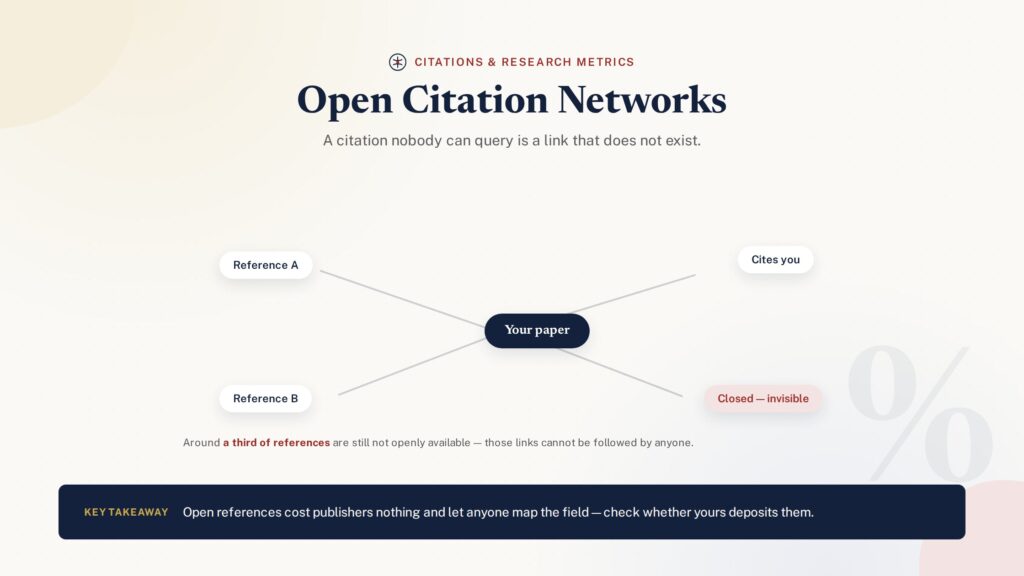
An open citation network is a system in which citation metadata—information about which article cites which source—is freely available for reuse, analysis, and redistribution. Instead of being restricted to subscription-only databases, citation links become part of an open scholarly infrastructure.
Organizations such as Crossref play a central role in collecting and disseminating citation metadata through Digital Object Identifiers (DOIs). The Initiative for Open Citations (I4OC) has further accelerated the movement by encouraging publishers to make their reference lists openly accessible.
Open citations allow researchers, institutions, and developers to build tools that analyze citation patterns without facing paywalls or restrictive licensing agreements.
Why Citation Openness Matters
Citations influence nearly every aspect of academic evaluation. They underpin journal rankings, author metrics, institutional benchmarking, and funding decisions. When citation data is closed, transparency suffers.
Open citation networks offer several advantages:
- Transparency in Research Evaluation
If citation data is openly accessible, stakeholders can independently verify metrics rather than relying on opaque calculations from proprietary databases. - Broader Inclusion
Smaller or regional journals often remain underrepresented in commercial citation indexes. Open citation networks can reduce this imbalance by enabling comprehensive indexing regardless of publisher size. - Innovation in Discovery Tools
Developers can build new platforms for visualizing research influence, mapping interdisciplinary connections, or identifying emerging research clusters. - Accountability in Scholarly Metrics
Open data enables scrutiny of citation manipulation practices and strengthens trust in bibliometric indicators.
In short, open citations democratize access to the structural backbone of scholarly communication.
From Closed Silos to Shared Infrastructure
Historically, major citation databases have operated under subscription models. Institutions pay significant fees to access citation tracking services, limiting availability to well-funded universities.
The transition to open citation networks shifts citation data from proprietary assets to shared infrastructure. This aligns with broader movements in open science, where transparency and accessibility are increasingly valued.
When publishers deposit reference lists with open metadata standards, they contribute to a cumulative network that benefits the entire research community. Each open reference strengthens the overall connectivity of the system.
Implications for Publishers
For publishers, participating in open citation initiatives involves both technical and strategic considerations.
Technical Requirements
Publishers must ensure accurate metadata formatting, consistent DOI registration, and timely submission of reference lists. Metadata quality becomes critical, as errors can propagate across systems.
Strategic Positioning
Supporting open citation networks signals commitment to transparency and collaborative infrastructure. It also aligns publishers with funder expectations that increasingly favor openness.
Concerns sometimes arise about competitive disadvantage. However, citation data primarily reflects relationships between works rather than proprietary content. Making references open does not compromise copyright over full-text articles.
Rethinking Research Metrics
Open citation networks could fundamentally reshape research assessment. When citation data is freely accessible, institutions and researchers can develop customized evaluation frameworks rather than relying solely on commercial metrics.
For example, interdisciplinary impact may be better captured through network analysis rather than traditional journal-based indicators. Emerging research fields may be identified earlier through open mapping of citation clusters.
Moreover, open citation data can help identify citation inequities—such as geographic or gender imbalances—enabling evidence-based discussions about inclusivity in scholarly recognition.
Challenges and Limitations
Despite clear benefits, several challenges remain:
- Incomplete Participation: Not all publishers have opened their reference data, leading to partial networks.
- Metadata Quality Issues: Inaccurate or inconsistent references can undermine reliability.
- Sustainability Concerns: Maintaining open infrastructure requires long-term funding and governance structures.
- Metric Misuse Risks: Even open data can be misinterpreted or overemphasized in performance evaluations.
Building robust open citation networks requires collective commitment from publishers, infrastructure providers, and research institutions.
Interoperability and Global Collaboration
Open citation networks thrive on interoperability—standardized formats that allow systems to communicate seamlessly. Persistent identifiers such as DOIs provide stable anchors for linking articles across platforms.
Global participation is equally important. When citation data includes contributions from diverse regions and languages, the resulting network better reflects the full landscape of scholarly activity.
In this sense, open citations are not merely a technical reform; they are a step toward bibliodiversity and global inclusivity in research visibility.
Ethical Dimensions of Citation Openness
Transparency in citation data also supports ethical scholarship. Open networks can help detect citation cartels, excessive self-citation, and other manipulative practices. By making citation patterns visible, the community gains tools to uphold integrity.
At the same time, responsible use of citation data remains essential. Metrics derived from open networks should complement—not replace—qualitative assessment of research quality.
Balanced evaluation frameworks that combine open data with contextual judgment are more likely to promote fairness and rigor.
Looking Ahead
As academic publishing continues to evolve, infrastructure decisions will shape the future of knowledge dissemination. Open citation networks represent one of the most foundational shifts underway.
By transforming references from closed assets into shared public goods, publishers contribute to a more transparent, inclusive, and innovative research ecosystem. Open citations empower independent analysis, encourage equitable representation, and stimulate new discovery tools.
The strength of scholarship lies not only in individual articles but in the connections between them. When those connections are openly accessible, the scholarly landscape becomes clearer, more navigable, and more democratic.
In the years ahead, the success of academic publishing may depend less on controlling information and more on cultivating shared infrastructures that amplify collective knowledge. Open citation networks embody that vision—where references are no longer silos, but bridges linking ideas across disciplines, institutions, and generations.