
Interactive and Executable Articles: Transforming Static Papers into Dynamic Research Experiences
Reading time - 7 minutes
Introduction
For centuries, scholarly publishing has relied on a stable format: static text accompanied by tables, figures, and references. While digital platforms have improved distribution and discoverability, the core structure of research articles remains largely unchanged. Yet modern research is increasingly computational, data-driven, and interactive. This shift raises an important question: should scholarly articles remain static documents, or evolve into dynamic, executable research environments?
Interactive and executable articles represent a new frontier in academic publishing. By embedding code, datasets, visualizations, and computational workflows directly within publications, these formats transform reading from passive consumption into active exploration.
What Are Interactive and Executable Articles?
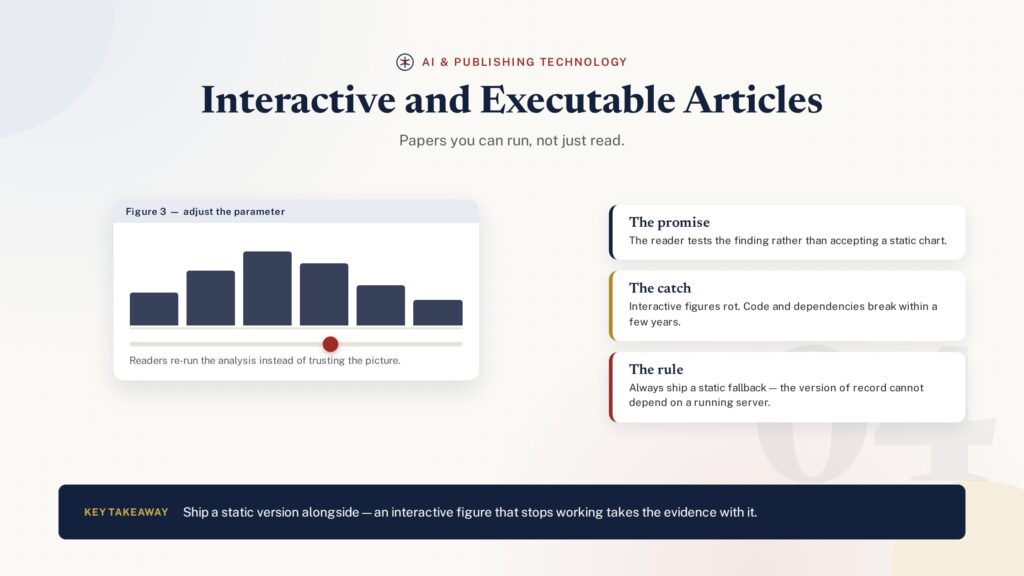
An interactive article allows readers to engage with figures, manipulate parameters, explore datasets, or navigate layered content. An executable article goes further: it enables readers to run embedded code, reproduce analyses, and observe how results change under different conditions.
Instead of merely describing a statistical model, for example, authors can provide an embedded computational notebook where readers adjust variables and instantly see updated outputs. This approach bridges the gap between narrative explanation and practical demonstration.
Technologies such as Jupyter Notebook and R Markdown have already made executable research workflows common during the research phase. Integrating similar capabilities into final publications extends that transparency to readers.
Why Static Articles Are No Longer Enough
Traditional PDFs excel at presenting finalized conclusions. However, they have limitations:
- Figures are fixed snapshots rather than exploratory tools.
- Methods sections summarize computational steps without full reproducibility.
- Supplementary materials are often separated from the main narrative.
- Readers cannot test alternative assumptions or parameter changes.
In computational fields, reproducibility depends not just on description but on execution. Even minor variations in code versions or parameters can alter results.
Interactive formats address this challenge by embedding reproducibility directly into the publication itself.
Enhancing Transparency and Trust
Executable articles strengthen research transparency in several ways:
- Immediate Reproducibility
Readers can verify results in real time rather than reconstruct workflows independently. - Parameter Exploration
Users can test how robust findings are under different conditions, deepening understanding of methodological assumptions. - Educational Value
Students and early-career researchers gain hands-on insight into analytical processes rather than reading abstract summaries. - Error Detection
Interactive environments make inconsistencies or bugs more visible, encouraging higher standards of quality control.
In a research ecosystem increasingly focused on rigor and openness, interactive publishing aligns with broader transparency goals.
Technical and Infrastructure Challenges
Despite its promise, interactive publishing introduces technical complexity. Journals must consider:
- Hosting computational environments securely
- Managing software dependencies
- Ensuring long-term compatibility
- Preserving executable content over time
Unlike static PDFs, interactive articles rely on evolving software stacks. A notebook that runs flawlessly today may break in five years if underlying libraries change.
To address this, some publishers explore containerization technologies that preserve computational environments. Cloud-based solutions allow readers to execute code without local installation, but these models require sustainable funding and maintenance strategies.
Editorial and Peer Review Implications
Interactive articles also reshape peer review. Reviewers may need to assess not only narrative clarity and methodological soundness but also:
- Code functionality
- Interface usability
- Computational efficiency
- Data integrity
This demands interdisciplinary reviewer expertise. Editorial teams must develop new evaluation criteria and workflows tailored to executable content.
Structured review checklists can support consistency. For example, reviewers might confirm that code executes without errors, results match described outputs, and documentation explains dependencies clearly.
Accessibility and Inclusivity Considerations
While interactive articles enhance engagement, they must remain accessible. Not all readers have high-speed internet or advanced technical skills. Publishers should ensure:
- Alternative static versions are available
- Clear instructions guide user interaction
- Interfaces follow accessibility best practices
- File sizes remain manageable
Interactive publishing should expand participation, not create new barriers.
Applications Across Disciplines
Although computational sciences may adopt interactive articles first, the model has broader relevance.
In environmental research, readers could adjust climate variables to visualize projected impacts. In economics, interactive dashboards might display model sensitivity. In social sciences, survey datasets could be explored dynamically. In digital humanities, readers might navigate annotated texts or interactive maps.
Even qualitative disciplines can benefit from layered multimedia, allowing readers to access interview excerpts, audio recordings, or archival materials directly within articles.
The key principle is adaptability: tailoring interactivity to disciplinary norms without compromising scholarly integrity.
Preservation and Citation
A central concern is how to cite and preserve dynamic content. Static articles provide fixed reference points. Executable articles, by contrast, may evolve as dependencies update.
Versioning becomes essential. Each interactive release should have a persistent identifier and archived snapshot, ensuring future readers can access the exact version cited. Clear citation guidelines must distinguish between static versions and evolving updates.
Long-term preservation strategies must also account for technological obsolescence. Publishers may need partnerships with digital preservation initiatives capable of maintaining executable environments.
Balancing Innovation with Stability
Not every article requires interactivity. The goal is not to replace traditional publishing entirely but to expand available formats.
A balanced model might include:
- Standard static articles for narrative-focused research
- Optional interactive supplements for computational work
- Fully executable formats for methods-intensive disciplines
Flexibility allows publishers to experiment without overwhelming authors or readers.
The Future of Scholarly Reading
Interactive and executable articles challenge the notion of reading as a one-way experience. Instead, they invite participation. Readers become explorers, testers, and collaborators in understanding research findings.
As computational research continues to grow, static documents may feel increasingly insufficient for conveying complex workflows. By embedding interactivity directly into publications, academic publishing can better reflect how knowledge is generated in the digital age.
The evolution toward dynamic scholarship does not diminish the value of careful writing or theoretical insight. Rather, it enhances them—connecting explanation with demonstration in real time.
In the years ahead, the most impactful research articles may not simply be read. They will be explored, executed, and experienced.