
Generative AI–Assisted Language Editing in Academic Publishing: Opportunities, Risks, and Policy Directions
Reading time - 7 minutes
Introduction
Academic publishing has long relied on language editing to improve clarity, coherence, and readability. For researchers writing in a second or third language, editorial assistance can be essential for communicating complex ideas effectively. In recent years, generative artificial intelligence (AI) tools have entered this space, offering automated grammar correction, stylistic refinement, summarization, and even structural suggestions.
While debates around AI-generated research content continue, a more nuanced and rapidly expanding area deserves attention: the use of generative AI for language editing support. Unlike full manuscript generation, AI-assisted editing occupies a gray zone between legitimate writing assistance and potential overreach. As adoption accelerates, publishers, institutions, and researchers must carefully define responsible boundaries.
The Rise of AI-Assisted Language Support
Tools such as ChatGPT and Grammarly are increasingly integrated into researchers’ workflows. These platforms can:
- Correct grammar and syntax
- Improve sentence clarity
- Suggest alternative phrasing
- Enhance logical flow
- Adjust tone for academic conventions
- Identify redundancy or ambiguity
For many scholars—particularly those in multilingual research environments—such tools reduce barriers to publication. Language polish, historically tied to access to professional editing services, is becoming more widely available.
However, this convenience introduces important ethical and editorial questions.
Distinguishing Editing from Authorship
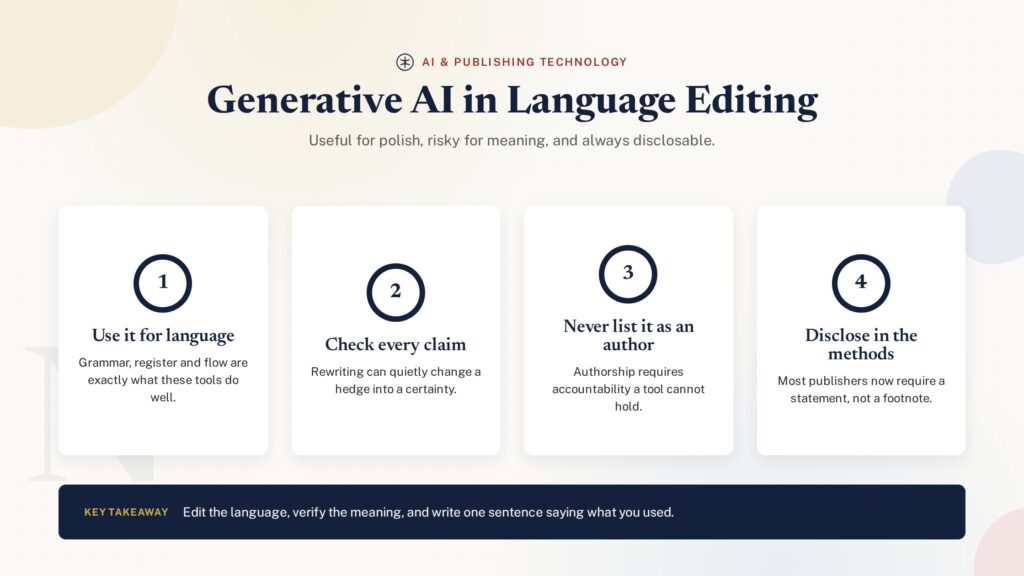
One central issue is defining the boundary between language editing and substantive intellectual contribution. Traditional editing services focus on correcting grammar, formatting, and clarity without altering the underlying scientific argument. Generative AI, however, can restructure paragraphs, propose new transitions, or rephrase arguments in ways that influence meaning.
If an AI system significantly reframes a discussion section or suggests interpretive language, does this cross into intellectual authorship? Most current policies suggest that AI tools cannot qualify as authors, but they differ in how disclosure should be handled.
Clear distinctions are essential:
- Language refinement (grammar, clarity, style)
- Structural reorganization (paragraph sequencing, logical flow)
- Content generation (new arguments, interpretations, or data synthesis)
The first category aligns most closely with conventional editing. The latter two require careful oversight and transparency.
Equity and Access Considerations
AI-assisted editing has the potential to reduce global inequities in academic publishing. Historically, researchers from under-resourced institutions have faced disadvantages due to language barriers and limited access to paid editorial services. Automated tools can partially level this playing field.
At the same time, disparities persist. Premium AI subscriptions, faster processing tools, and integrated institutional licenses may not be universally accessible. Moreover, overreliance on AI-generated phrasing could inadvertently standardize academic voice, reducing linguistic diversity in scholarly writing.
Balancing equity with authenticity requires thoughtful guidance rather than blanket prohibition.
Transparency and Disclosure Policies
Many journals now require disclosure of AI use in manuscript preparation. However, policies vary widely in specificity. Some mandate disclosure only when AI contributes to content generation, while others require reporting any AI-assisted editing.
A practical disclosure framework might consider:
- Whether AI was used solely for grammar correction
- Whether it assisted in rewriting substantial sections
- Whether it influenced interpretation or framing
Standardized disclosure statements can reduce ambiguity. Transparency does not imply misconduct; rather, it fosters trust and allows editors to understand how the manuscript was prepared.
Importantly, disclosure requirements should be proportionate. Requiring detailed reporting for minor grammar corrections could create unnecessary administrative burden.
Risks to Research Integrity
Despite benefits, generative AI editing carries risks:
- Hallucinated Revisions
AI tools may introduce subtle factual inaccuracies while rephrasing sentences. Authors must carefully review every suggestion to ensure scientific accuracy. - Loss of Authorial Voice
Extensive rewriting may dilute the researcher’s distinctive perspective, potentially homogenizing scholarly communication. - Confidentiality Concerns
Uploading unpublished manuscripts to third-party platforms may expose sensitive data or intellectual property, depending on platform policies. - Undisclosed Substantive Changes
If AI-generated edits significantly alter interpretation, failure to disclose this could raise ethical concerns.
Ultimately, responsibility remains with the human author. AI tools are assistive technologies, not accountable agents.
The Role of Publishers and Institutions
Publishers play a critical role in shaping responsible AI editing practices. Clear, consistent policies reduce confusion and prevent uneven enforcement across journals.
Institutions can complement these efforts by:
- Providing training on ethical AI use
- Offering institutionally approved AI tools with secure data handling
- Educating researchers about risks and limitations
- Integrating AI literacy into graduate training
Rather than banning AI outright, institutions can cultivate informed, critical engagement.
Peer Review Implications
AI-assisted language editing may improve readability, potentially reducing reviewer frustration associated with poorly written manuscripts. Clearer writing allows reviewers to focus on scientific merit rather than grammatical issues.
However, if AI subtly enhances argumentative structure beyond language clarity, peer reviewers may evaluate polished narratives without recognizing the extent of machine assistance. Transparent disclosure helps contextualize such improvements.
Reviewers themselves may also use AI tools to refine feedback. Establishing norms for responsible reviewer-side AI use is equally important.
Preserving Human Accountability
The defining principle in AI-assisted language editing should be accountability. Authors must retain full responsibility for:
- Accuracy of content
- Interpretation of findings
- Ethical compliance
- Disclosure of AI use
Generative AI does not absolve researchers of scholarly responsibility. Instead, it introduces a new layer of oversight requiring deliberate governance.
Policy Directions for the Future
As AI tools evolve, publishing policies must remain adaptive. Key considerations include:
- Developing standardized disclosure language
- Differentiating editing assistance from content generation
- Protecting manuscript confidentiality
- Encouraging ethical AI literacy
- Ensuring equitable access to responsible tools
Collaborative policy development across publishers, academic societies, and research institutions can prevent fragmentation and confusion.
Conclusion
Generative AI–assisted language editing represents a significant shift in academic writing practices. Used responsibly, it can enhance clarity, reduce inequities, and improve communication quality. Misused or poorly regulated, it risks blurring authorship boundaries and introducing integrity concerns.
Academic publishing has navigated technological transformations before—from word processors to digital submission platforms. The challenge now is not whether AI will influence scholarly writing, but how thoughtfully the academic community integrates it.
By prioritizing transparency, accountability, and equitable access, publishers and researchers can harness AI editing tools as supportive instruments—enhancing scholarly communication without compromising integrity.