
The Governance of Special Collections and Thematic Series in Academic Publishing: Strategy, Ethics, and Long-Term Impact
Reading time - 7 minutes
Introduction
Special collections and thematic series have become increasingly visible features of academic publishing. Whether focused on emerging technologies, global health crises, interdisciplinary intersections, or region-specific scholarship, these curated clusters of articles offer journals a way to spotlight timely topics and build intellectual momentum. However, while special issues are widely discussed, the governance of ongoing thematic series and curated collections receives far less attention.
As journals expand beyond traditional issue-based publishing models, it is essential to examine how special collections are conceptualized, managed, and evaluated. Strong governance ensures that these initiatives enhance scholarly value rather than introduce bias, fragmentation, or strategic inconsistency.
Beyond the Special Issue: Understanding Thematic Series
A special issue is typically time-bound and curated around a specific topic. A thematic series, by contrast, may remain open over months or years, continuously accepting submissions related to a defined theme. In digital publishing environments, articles in a thematic series are often grouped virtually rather than physically within a single issue.
Major publishers such as Elsevier and Springer Nature increasingly support thematic collections that operate alongside regular journal workflows. These collections can respond quickly to emerging research areas without waiting for formal issue assembly.
While strategically powerful, thematic series raise important governance questions: Who defines the theme? How are guest editors selected? How is quality monitored over time? And how does the series align with the journal’s broader scope?
Strategic Purpose and Editorial Alignment
Thematic collections can serve multiple purposes:
- Highlighting rapidly evolving research areas
- Attracting submissions from new scholarly communities
- Strengthening interdisciplinary dialogue
- Increasing journal visibility in niche domains
However, without careful alignment, they risk diluting editorial focus. A journal must ensure that each thematic series reflects its aims and scope. Opportunistic topic selection—driven solely by trending keywords—may generate short-term submission volume but undermine long-term identity.
Editorial boards should evaluate whether a proposed theme:
- Addresses a genuine research gap.
- Aligns with the journal’s mission.
- Has sufficient scholarly depth to sustain multiple contributions.
- Avoids redundancy with past collections.
Strategic coherence prevents fragmentation and protects the journal’s intellectual reputation.
Guest Editor Selection and Accountability
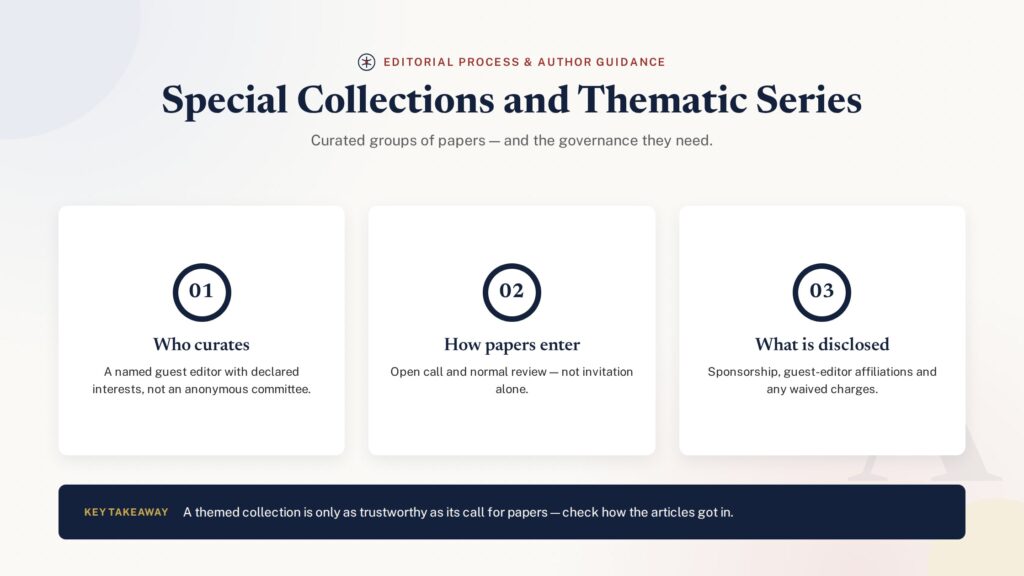
Many thematic series rely on guest editors to curate submissions and manage peer review. While this approach introduces subject-matter expertise, it also creates governance risks.
Transparent selection criteria for guest editors are essential. Journals should consider:
- Demonstrated expertise in the thematic area
- Editorial experience or training
- Conflict-of-interest disclosures
- Geographic and institutional diversity
Clear contractual agreements can define responsibilities, timelines, and ethical expectations. Guest editors should operate under the journal’s established editorial policies rather than creating parallel standards.
Regular oversight by the journal’s chief editor or editorial board ensures consistency in review quality and decision-making. Governance structures must prevent the perception that thematic series are “independent silos” operating outside core editorial scrutiny.
Quality Assurance Across Time
Unlike one-time special issues, thematic series may span extended periods. Over time, editorial enthusiasm may wane, guest editors may step down, and research trends may shift.
To maintain quality and relevance, journals can implement:
- Periodic review of the series’ performance and scope
- Sunset clauses that close underperforming or outdated themes
- Rotational guest editorship to introduce fresh perspectives
- Annual impact evaluations assessing citation patterns and submission quality
Without structured review, thematic series risk becoming dormant repositories rather than active scholarly conversations.
Ethical Considerations and Equity
Thematic collections may unintentionally reinforce inequities if not carefully managed. For example, invitation-only calls or tightly networked editorial teams can limit participation to established scholars, excluding early-career researchers or underrepresented groups.
Open calls for papers, transparent submission guidelines, and diverse editorial representation can mitigate these risks. Governance frameworks should explicitly promote inclusivity while maintaining scholarly rigor.
Additionally, journals must avoid creating perceptions that thematic series offer easier acceptance pathways. Review standards must remain consistent with regular submissions. Clear communication about peer review processes protects credibility.
Impact on Journal Metrics and Reputation
Thematic collections often generate concentrated citation activity, especially when focused on trending topics. While this can enhance journal visibility, it also requires careful metric interpretation.
Citation spikes tied to a single thematic area may not reflect sustained journal-wide influence. Editorial boards should assess whether collections contribute to long-term intellectual growth rather than short-term metric boosts.
Moreover, overreliance on thematic series can shift a journal’s identity from a generalist platform to a patchwork of topic clusters. Maintaining balance between regular submissions and curated collections preserves structural integrity.
Digital Curation and Discoverability
In digital environments, thematic series are often curated through online landing pages, keyword tagging, and cross-linking. Effective metadata and discoverability strategies are essential to maximize impact.
Dynamic curation allows journals to:
- Update collections with newly accepted articles
- Feature related multimedia or commentary pieces
- Link thematic series across journal portfolios
However, digital flexibility must not replace editorial discipline. Each addition to a thematic collection should undergo rigorous evaluation to ensure conceptual coherence.
Long-Term Intellectual Legacy
Well-governed thematic series can leave lasting scholarly legacies. They may define research agendas, consolidate emerging fields, and foster interdisciplinary networks. Some thematic collections evolve into standalone journals or permanent research communities.
The key lies in thoughtful design. Rather than treating thematic series as marketing tools, journals should view them as intellectual investments. Clear governance policies, transparent editorial oversight, and periodic evaluation safeguard both quality and credibility.
Conclusion
The growth of thematic collections reflects the adaptability of modern academic publishing. As digital platforms enable flexible curation, journals can respond rapidly to emerging scholarly conversations. Yet with this flexibility comes responsibility.
Effective governance of thematic series requires strategic alignment, transparent guest editor selection, consistent peer review standards, and ongoing performance evaluation. When managed thoughtfully, these collections can enrich journals, stimulate innovation, and strengthen scholarly communities.
In an era of evolving publishing models, thematic series represent both opportunity and risk. By embedding robust governance practices, academic publishing can ensure that curated collections serve not just immediate visibility goals but enduring intellectual advancement.
Related Posts:
- Breaking Down the "Preprint Hierarchy": Can Anyone Become a…
- How Blockchain Is Impacting Scholarly Publishing:…
- Special Issues in Academic Journals: Opportunities and Risks Explained
- A Preprint Revolution for the Human Brain: Can Neuroscientists…
- Revolutionary Emerging Technologies in Academic Publishing: A…