
The Role of Research Assessment Reform in Academic Publishing: Moving Beyond Publication Counts and Impact Metrics
Reading time - 7 minutes
Introduction
For decades, academic publishing has been deeply intertwined with research assessment systems. Hiring committees, tenure boards, and funding agencies have often relied on publication counts, journal prestige, and citation metrics as proxies for research quality. While these indicators offer convenience and comparability, they have also shaped researcher behavior in ways that may not always align with the broader goals of scholarship.
As global conversations around research culture intensify, reforming how research is assessed is becoming central to the future of academic publishing. A shift away from narrow metrics toward more holistic evaluation models has implications not only for researchers, but also for journals, publishers, and the entire scholarly ecosystem.
The Metric-Centered Era
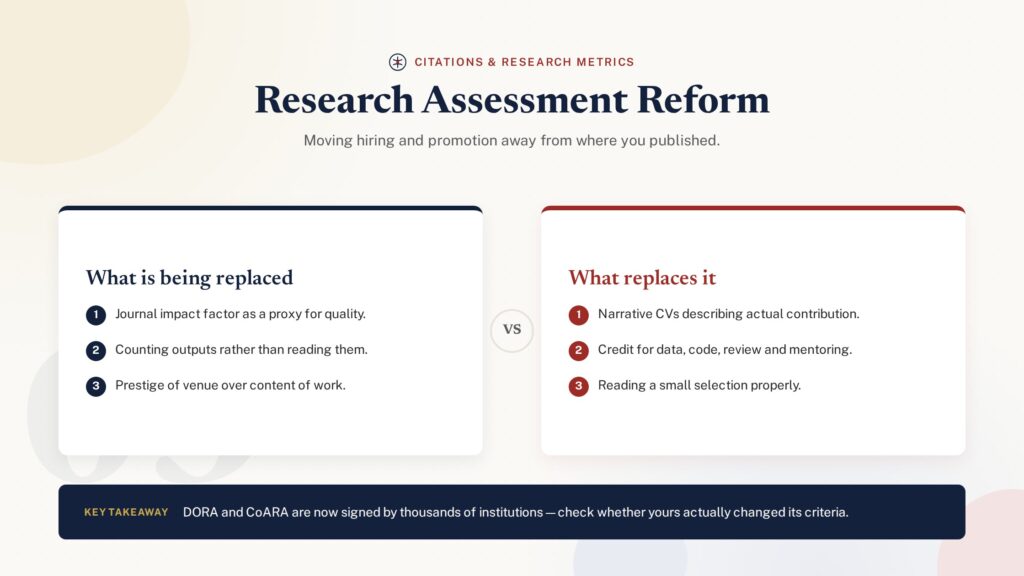
The rise of journal-based metrics—particularly the Impact Factor—transformed academic publishing into a competitive hierarchy. Publishing in high-impact journals became synonymous with research excellence. Over time, institutional incentives reinforced this emphasis, linking career advancement and funding decisions to where research was published rather than what it contributed.
In 2012, the launch of the San Francisco Declaration on Research Assessment marked a turning point. The declaration called for ending the use of journal-based metrics in research evaluation and encouraged assessment based on the intrinsic merit of individual works. Since then, numerous institutions and funders have endorsed similar principles.
Complementing this movement, the Leiden Manifesto proposed ten principles for responsible research metrics, emphasizing transparency, contextualization, and qualitative judgment.
These initiatives signal a broader recognition: the way research is evaluated influences how it is conducted and published.
Consequences of Narrow Evaluation Systems
When publication quantity and journal prestige dominate evaluation, several systemic effects emerge:
- Publication pressure: Researchers may prioritize frequent output over thoughtful, long-term projects.
- Risk aversion: Innovative or interdisciplinary work may be discouraged if it does not align with established high-impact venues.
- Salami slicing: Findings may be divided into multiple smaller papers to increase publication counts.
- Neglect of non-traditional outputs: Contributions such as software, policy briefs, replication studies, and community engagement may receive less recognition.
These dynamics affect journal strategies as well. Editors may prioritize submissions likely to generate citations, reinforcing disciplinary hierarchies and limiting diversity in research topics.
Reforming assessment systems therefore has direct consequences for publishing practices.
Principles of Research Assessment Reform
Emerging frameworks for reform share several common principles:
- Quality Over Quantity
Evaluation should focus on the depth, rigor, and societal relevance of selected works rather than sheer publication volume. - Contextualized Metrics
Citation counts and usage statistics may inform evaluation, but they should be interpreted within disciplinary and methodological contexts. - Recognition of Diverse Outputs
Software, datasets, public engagement activities, and collaborative contributions should be acknowledged alongside traditional articles. - Narrative CVs and Portfolio Approaches
Some institutions now request narrative descriptions of research contributions, allowing scholars to explain the significance of their work beyond numerical indicators.
These shifts encourage a more nuanced understanding of impact—one that includes educational influence, policy relevance, and community engagement.
Implications for Academic Publishing
If assessment reform gains widespread adoption, academic publishing will inevitably adapt.
Broadening Editorial Scope
Journals may expand their acceptance of replication studies, negative results, and interdisciplinary research when such outputs are no longer disadvantaged in evaluation systems.
Reducing Prestige Pressure
If hiring and funding decisions move away from journal branding, the competitive concentration around a small set of elite titles may ease. This could promote a more distributed publishing ecosystem.
Supporting Transparent Evaluation Practices
Publishers may collaborate with institutions to provide richer metadata about research contributions, enabling more holistic assessment.
Encouraging Responsible Metrics
Rather than promoting journal-level metrics alone, publishers can highlight article-level engagement, qualitative endorsements, and societal impact narratives.
In this evolving landscape, journals become partners in responsible evaluation rather than mere vehicles for prestige.
Global Policy Developments
In Europe, the European Commission has supported initiatives aimed at reforming research assessment through coalition-based agreements. These efforts seek to align funding criteria with principles of openness, diversity, and responsible metrics.
National research agencies in various countries are also revisiting evaluation frameworks. Some now require applicants to highlight a limited number of key outputs, emphasizing depth and contribution over quantity.
Such policy shifts reinforce the need for publishers to ensure that their platforms accommodate diverse forms of scholarship and provide clear documentation of research contributions.
Challenges in Implementation
Reforming research assessment is complex. Metrics offer simplicity and comparability; qualitative evaluation requires time and expertise. Institutions must invest in training evaluators and developing clear guidelines to ensure fairness and consistency.
There is also resistance rooted in tradition. Prestige hierarchies are deeply embedded in academic culture. Transitioning to new evaluation models demands coordinated change across universities, funders, and publishers.
Moreover, responsible metrics must avoid unintended consequences. For example, replacing citation counts with alternative indicators without careful oversight may simply substitute one narrow metric for another.
Toward a Healthier Research Culture
At its core, research assessment reform is about aligning incentives with scholarly values. If the purpose of academic publishing is to advance knowledge, inform society, and foster critical inquiry, evaluation systems should reinforce—not distort—those goals.
A publishing environment shaped by responsible assessment principles may encourage:
- Thoughtful, long-term research projects
- Interdisciplinary collaboration
- Transparent reporting practices
- Engagement with societal stakeholders
- Recognition of mentorship and team science
When evaluation emphasizes meaningful contribution rather than numerical performance, researchers may feel less pressure to prioritize visibility over validity.
A Shared Responsibility
Transforming research assessment is not solely the responsibility of universities or funders. Publishers, editors, and scholarly societies play influential roles in shaping research culture.
By supporting responsible metrics, diversifying accepted outputs, and communicating clearly about evaluation practices, publishers can help create a more balanced ecosystem.
The future of academic publishing is inseparable from the future of research evaluation. Moving beyond publication counts and journal prestige is not merely a technical adjustment—it represents a cultural shift toward valuing scholarship in its full complexity.
As reform efforts continue to gain momentum globally, academic publishing has an opportunity to align its practices with principles of fairness, inclusivity, and intellectual rigor. In doing so, the scholarly community can foster an environment where research quality—not metric performance—defines academic success.