
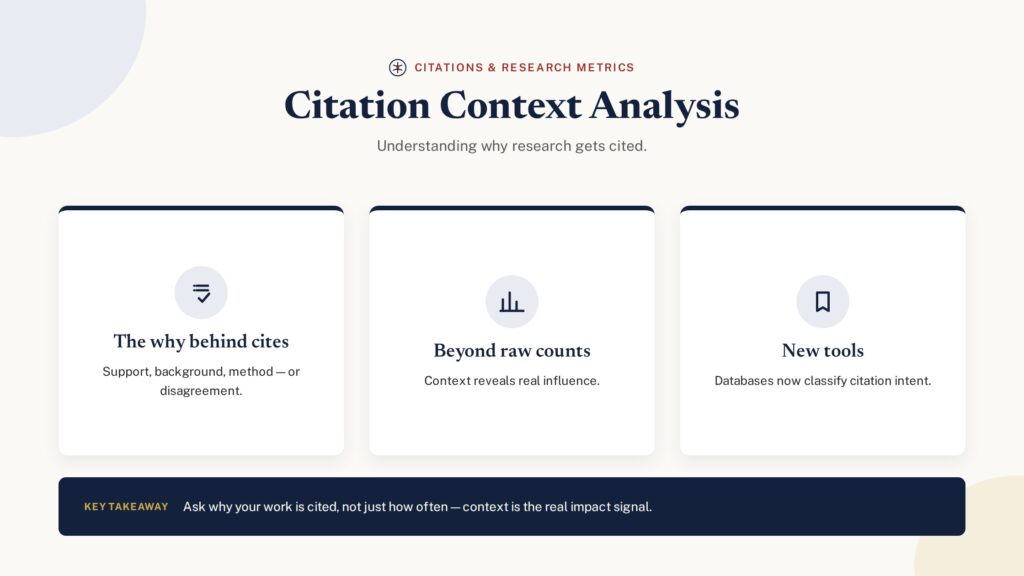
Citation Context Analysis in Academic Publishing: Understanding Why Research Is Cited, Not Just How Often
Reading time - 7 minutes
Introduction
For decades, citation counts have served as a dominant indicator of scholarly influence. Articles with higher citation numbers are often interpreted as more impactful, shaping hiring decisions, funding allocations, and journal reputations. Yet citation quantity alone reveals little about why a study is cited. Is it foundational? Methodological? Controversial? Criticized?
As research evaluation evolves, citation context analysis is emerging as a promising approach to move beyond raw counts and toward a more nuanced understanding of scholarly impact. By examining the textual and semantic context in which citations appear, academic publishing can better assess the true role a study plays within the research ecosystem.
The Limits of Citation Counts
Traditional bibliometrics treat citations as uniform endorsements. However, not all citations carry equal meaning. A paper might be cited:
- To acknowledge a theoretical foundation
- To adopt or adapt a method
- To provide supporting evidence
- To contrast with conflicting findings
- To critique flawed methodology
A highly cited article may attract attention due to controversy rather than quality. Conversely, a methodologically rigorous paper may receive fewer citations but serve as a silent backbone for numerous applied studies.
Citation context analysis addresses this limitation by distinguishing between citation functions and sentiment.
What Is Citation Context Analysis?
Citation context analysis examines the surrounding text where a citation appears. Instead of simply counting references, it analyzes phrases, sentences, and sections to classify how the cited work is used.
This approach often leverages natural language processing to identify patterns such as:
- Affirmative or supportive language
- Neutral background referencing
- Methodological application
- Critical or disputing language
- Conceptual extension
For example, a sentence stating “We build upon the framework established by Smith (2018)” suggests foundational influence. In contrast, “Contrary to the conclusions drawn by Smith (2018)” signals disagreement.
By categorizing these contexts, publishers and evaluators can generate richer impact profiles for individual articles.
Advancing Responsible Research Evaluation
The movement toward responsible research evaluation emphasizes multidimensional assessment over simplistic metrics. Citation context analysis aligns with this shift by adding qualitative depth to quantitative data.
Rather than asking, “How many times was this paper cited?” evaluators can ask:
- How often is it cited as a foundational reference?
- How frequently is it used for methodological guidance?
- Is it primarily cited in critical discussions?
- Does it bridge distinct research communities?
Such distinctions reduce the risk of overvaluing citation volume alone and encourage a more balanced understanding of scholarly contribution.
Implications for Journals and Publishers
Integrating citation context analysis into publishing platforms could transform how journals present article impact. Instead of displaying only citation counts, journals might include contextual breakdowns showing the distribution of citation types.
For example, a publication indexed in Scopus or Web of Science could eventually incorporate contextual metrics alongside traditional bibliometrics.
Publishers might also use contextual data internally to identify emerging debates or methodological influence within their portfolios. This could inform editorial strategy, special issue planning, and topic development.
Identifying Controversy and Debate
Citation context analysis is particularly valuable in identifying controversial research. Papers that receive high levels of critical citations may signal ongoing disputes or methodological concerns.
Distinguishing between supportive and critical citations helps prevent misinterpretation of impact. A study frequently cited for errors should not be equated with one widely cited for excellence.
This nuance also supports post-publication oversight by highlighting research that generates significant critique, allowing editors to monitor potential integrity issues more proactively.
Enhancing Literature Reviews and Meta-Research
For researchers conducting systematic reviews or meta-research, contextual citation data can streamline literature analysis. Instead of manually reviewing hundreds of articles to determine citation function, automated tools could identify studies most often cited as foundational or methodological anchors.
This capability strengthens evidence synthesis and accelerates scholarly mapping. It also complements existing bibliometric tools such as Google Scholar by adding interpretive layers beyond citation counts.
Technical and Methodological Challenges
Despite its promise, citation context analysis faces several challenges.
- Standardization of Classification
Different disciplines use varied writing conventions. What signals criticism in one field may appear neutral in another. Developing standardized classification models requires interdisciplinary collaboration. - Access to Full Texts
Context analysis depends on access to full-text content, not just metadata. Restricted access models may limit the comprehensiveness of analysis. - Algorithmic Bias
Automated text classification tools may misinterpret nuanced academic language. Transparent model development and validation are essential to prevent misleading results. - Integration into Evaluation Systems
Adopting contextual metrics requires institutional acceptance. Universities and funding bodies must be willing to incorporate richer data into evaluation frameworks.
Addressing these challenges will require cooperation among publishers, technologists, bibliometricians, and policy stakeholders.
Shifting the Culture of Impact
The broader value of citation context analysis lies not only in metrics but in cultural change. When researchers know that citation quality—not just quantity—matters, scholarly writing may become more precise and intentional.
Authors might clarify whether they are endorsing, extending, or critiquing prior work. Reviewers and editors may encourage clearer citation practices to enhance interpretability.
This cultural shift fosters intellectual transparency and reduces the ambiguity that often surrounds reference lists.
Looking Ahead
As academic publishing continues to evolve, impact measurement must evolve alongside it. Citation context analysis offers a pathway toward a more sophisticated understanding of influence—one that reflects the complexity of scholarly dialogue.
By analyzing how research is cited, rather than merely how often, the scholarly community can better distinguish foundational contributions from peripheral mentions, constructive debate from controversy, and genuine influence from statistical noise.
In an era increasingly focused on research integrity, transparency, and responsible evaluation, citation context analysis represents a meaningful step forward. It reframes citations not as simple numerical tokens but as indicators of intellectual relationships—capturing the dynamic conversations that drive knowledge forward.
Ultimately, academic publishing thrives on dialogue. Understanding the context of that dialogue is essential to appreciating the true impact of research in a connected and rapidly evolving scholarly world.
Related Posts:
- Breaking Down the "Preprint Hierarchy": Can Anyone Become a…
- Research Metrics Explained: Beyond Impact Factor in Academic…
- Research Metrics Explained: Beyond Impact Factor in Academic…
- The Role of Research Assessment Reform in Academic Publishing:…
- Negative Citations in Academic Publishing: When Being Cited…