
Digital Identity Verification in Academic Publishing: Combating Fraud, Paper Mills, and Author Impersonation
Reading time - 7 minutes
Introduction
As academic publishing becomes increasingly digital and global, questions of identity have moved to the forefront of research integrity. Manuscript submission systems operate online, editorial decisions are communicated virtually, and peer review often takes place across continents. While this digital transformation has accelerated scholarly communication, it has also created vulnerabilities—particularly in verifying who authors and reviewers truly are.
From fabricated reviewer accounts to paper mill operations and author impersonation, identity-related misconduct presents growing challenges for journals and publishers. In response, digital identity verification is emerging as a critical infrastructure component in modern academic publishing.
The Expanding Identity Problem
Academic publishing relies on trust. Editors trust that authors are who they claim to be. Reviewers trust that manuscripts are legitimate scholarly contributions. Institutions trust that publications accurately reflect their affiliated researchers’ work.
However, recent years have seen rising instances of identity manipulation:
- Fake reviewer profiles created to submit favorable reviews
- Unauthorized use of real researchers’ names
- Paper mill submissions under fabricated author identities
- Ghostwritten manuscripts submitted under legitimate affiliations
In some cases, researchers have discovered publications falsely attributed to them. In others, journals have retracted articles after uncovering peer review manipulation schemes. These cases reveal that identity verification is not merely administrative—it is foundational to research integrity.
Beyond Email Verification
Historically, journals relied on institutional email addresses as a proxy for identity verification. While helpful, email-based verification has limitations. Accounts can be spoofed, and not all researchers have stable institutional affiliations—particularly independent scholars or those in resource-limited settings.
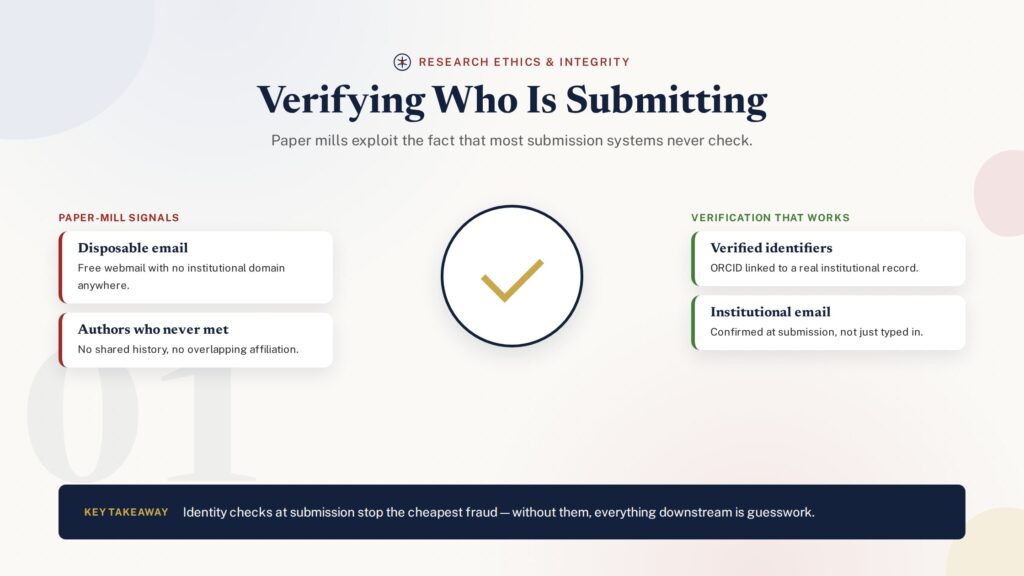
Modern identity verification requires more robust systems. Persistent digital identifiers help ensure continuity across affiliations and career stages. For example, ORCID provides researchers with unique identifiers that connect publications, funding, and institutional affiliations. Unlike email addresses, ORCID IDs remain constant throughout a researcher’s career.
Integrating ORCID authentication directly into submission systems—rather than allowing manual entry—adds an additional layer of verification. Authenticated logins confirm that the individual controlling the account is the rightful owner of the identifier.
Reviewer Identity and Peer Review Integrity
Reviewer fraud has become a significant concern in academic publishing. In some documented cases, authors suggested fake reviewers with fabricated email addresses that they controlled, enabling them to submit favorable reviews of their own work.
To address this risk, journals are increasingly:
- Verifying reviewer identities through institutional affiliations
- Cross-checking reviewer databases
- Using authenticated identifier systems
- Limiting reliance on author-suggested reviewers
Some publishers now require reviewers to link verified digital identifiers or confirm affiliations through institutional systems. These measures not only prevent misconduct but also protect legitimate reviewers from identity misuse.
Combating Paper Mills Through Identity Checks
Paper mills—organizations that produce fraudulent manuscripts for profit—often exploit weaknesses in submission systems. They may create multiple author identities, fabricate affiliations, or reuse manipulated data under different names.
Digital identity verification can help detect suspicious patterns, such as:
- Repeated submissions from unverified or newly created accounts
- Inconsistent affiliation histories
- Unusual clusters of co-authorship across unrelated institutions
- Identical contact information across multiple author profiles
When combined with plagiarism detection tools and data integrity checks, identity verification becomes part of a broader fraud prevention strategy.
Balancing Security and Accessibility
While stronger verification systems enhance integrity, they must be implemented carefully to avoid creating unnecessary barriers. Not all researchers have equal access to institutional infrastructure. Early-career researchers, independent scholars, and those in developing regions may lack stable institutional credentials.
An inclusive identity framework should:
- Allow multiple verification pathways
- Support global accessibility
- Avoid discriminatory barriers
- Protect personal data privacy
Identity verification must strengthen trust without excluding legitimate contributors.
Privacy and Data Protection Considerations
Collecting and verifying identity data raises important privacy concerns. Publishers must comply with data protection regulations and ensure that sensitive personal information is securely managed.
Key considerations include:
- Minimizing collection of unnecessary personal data
- Ensuring secure storage and encryption
- Being transparent about how identity data is used
- Providing mechanisms for correction and deletion
Trust in identity systems depends not only on accuracy but also on responsible data governance.
Institutional Collaboration and Shared Infrastructure
Identity verification cannot be managed by individual journals alone. Collaborative infrastructure across publishers, institutions, and funding bodies is essential. Shared standards and interoperable systems reduce duplication and enhance reliability.
Integration with institutional directories, funding databases, and global identifier systems strengthens verification processes while maintaining efficiency.
Cross-publisher collaboration may also help detect serial misconduct. When identity-related red flags are visible across platforms, coordinated responses become more effective.
The Future of Identity in Scholarly Communication
As artificial intelligence tools make content generation easier and global submission rates continue to rise, identity assurance will become even more critical. Advanced authentication technologies—such as multi-factor verification and cryptographic credentials—may eventually become standard in high-risk contexts.
However, technology alone cannot solve integrity challenges. Editorial oversight, transparent policies, and community vigilance remain essential.
Ultimately, digital identity verification is about preserving the credibility of scholarly communication. Every article represents not only research findings but also accountability—linking intellectual contributions to real individuals and institutions.
In a system built on trust, identity is the foundation. By investing in robust, ethical, and inclusive identity verification frameworks, academic publishing can strengthen its defenses against fraud while safeguarding the openness and accessibility that drive global knowledge exchange.
As scholarly communication continues to evolve, ensuring that contributors are authentically represented will remain central to maintaining integrity, protecting reputations, and sustaining confidence in the academic record.