
Editorial Use of Social Media Evidence in Academic Publishing: Monitoring Impact, Managing Controversy, and Protecting Research Integrity
Reading time - 7 minutes
Introduction
Academic publishing no longer operates in isolation from the public sphere. Research findings circulate rapidly across social media platforms, where they are interpreted, amplified, critiqued, and sometimes distorted within hours of publication. For editors and publishers, this raises a new and complex question: how should social media evidence be used in editorial decision-making?
From identifying post-publication concerns to tracking emerging controversies, social media has become an informal layer of scholarly discourse. Yet relying on it without clear standards can introduce bias, reputational risk, and ethical uncertainty. As digital conversations increasingly shape research visibility and scrutiny, journals must develop thoughtful policies for engaging with social media signals responsibly.
Social Media as an Early Warning System
Platforms such as X, LinkedIn, and Reddit host active communities of researchers who discuss newly published papers. Methodological flaws, statistical anomalies, and ethical concerns are often identified informally through public threads before formal letters to the editor are submitted.
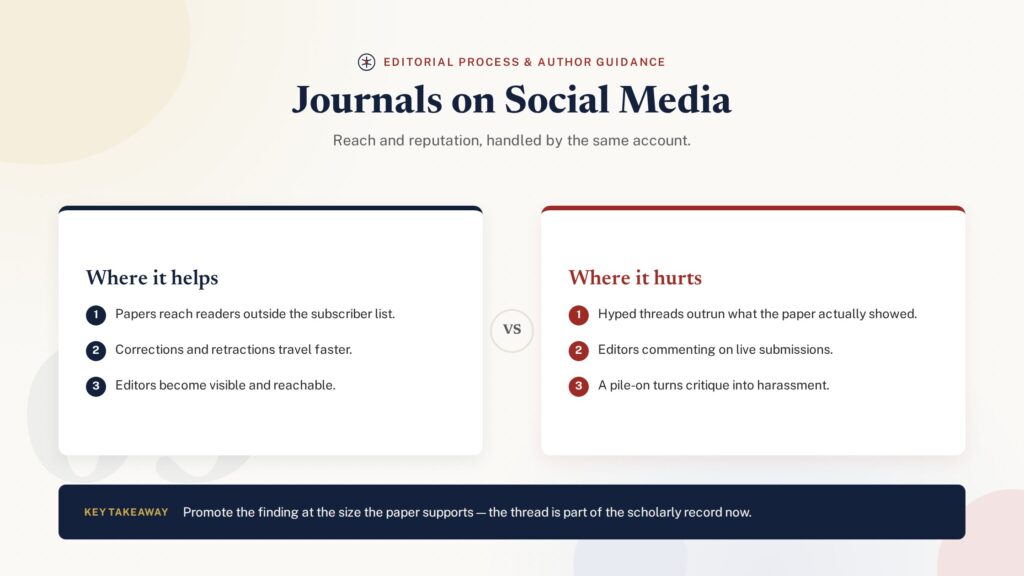
In some cases, post-publication critiques that begin online have led to formal corrections or retractions. Editors may encounter tagged posts, viral threads, or media inquiries referencing social commentary about an article. Ignoring such signals may appear dismissive, while reacting hastily risks validating unverified claims.
When used carefully, social media can function as a rapid alert system. However, it should never replace structured editorial processes or formal investigation mechanisms.
Distinguishing Signal from Noise
A central challenge lies in differentiating legitimate scholarly critique from online noise. Social media discussions can include:
- Constructive methodological analysis
- Professional disagreement
- Misinterpretation of findings
- Personal attacks on authors
- Coordinated campaigns driven by non-scientific agendas
Editors must avoid equating virality with validity. A widely shared criticism is not necessarily well-founded, and a poorly understood but methodologically sound study may face disproportionate backlash.
Clear internal protocols are essential. When editors become aware of significant online critique, they might:
- Conduct an internal assessment of the claims raised.
- Consult subject-matter experts for independent evaluation.
- Invite authors to respond formally.
- Determine whether further investigation is warranted.
This approach ensures that social media commentary is treated as a starting point for review—not as evidence in itself.
Protecting Authors from Harassment
Another pressing concern is author safety. In controversial fields—public health, climate science, social policy—researchers may face online harassment following publication. Journals have an ethical responsibility to consider how their public communication strategies might amplify risk.
Editorial policies should clarify that:
- Social media criticism does not automatically imply misconduct.
- Authors will be informed before any formal action is initiated.
- Investigations will follow established procedures, independent of public pressure.
Publishers may also provide guidance to authors on navigating online scrutiny, including media training or crisis communication support when appropriate.
Balancing transparency with protection is crucial. Editorial independence must not be compromised by online pressure campaigns, whether supportive or hostile.
Monitoring Impact Without Overreach
Beyond controversy management, social media provides insight into research reach and engagement. Editors and publishers often track online mentions to understand how articles circulate beyond academic citations.
While such monitoring can inform outreach strategies, it should not influence editorial acceptance decisions. A study’s potential for social media visibility is not equivalent to scholarly merit. Overemphasizing “shareability” risks prioritizing sensational topics over rigorous but less attention-grabbing research.
To avoid distortion, journals should separate:
- Impact monitoring (post-publication analytics)
- Editorial evaluation (pre-publication quality assessment)
Maintaining this boundary preserves scholarly standards while still recognizing evolving communication channels.
Ethical Use of Screenshots and Public Commentary
When social media discussions raise substantial concerns, editors may collect screenshots or archive public posts as part of preliminary assessment. However, ethical considerations apply.
Public posts are technically accessible, but republishing or referencing them requires discretion. Editors should avoid publicly naming critics without consent and should focus on substantive claims rather than individuals.
If social commentary leads to a formal editorial notice—such as an expression of concern—language should refer to the nature of the issues raised rather than to specific online users. The goal is to address the research record, not to amplify personal disputes.
Developing Transparent Policies
Given the increasing role of online discourse, journals should articulate transparent policies addressing:
- How social media alerts are handled
- Whether editors proactively monitor platforms
- How authors are notified of concerns
- The threshold for initiating formal review
- Communication strategies during investigations
Clarity reduces uncertainty for authors and readers alike. It also reinforces that editorial decisions remain grounded in evidence-based evaluation, not digital popularity.
Risks of Algorithmic Amplification
Social media platforms are driven by algorithms that amplify emotionally charged or polarizing content. This dynamic can distort the perception of controversy. A small but vocal group may appear larger due to engagement patterns.
Editors must remain aware of these dynamics. A trending discussion may reflect algorithmic amplification rather than broad scholarly consensus. Consulting disciplinary experts and editorial board members can contextualize online reactions within the field’s norms.
Integrating Informal and Formal Scholarly Dialogue
Social media represents an informal extension of scholarly debate. Historically, academic critique unfolded slowly through letters, conferences, and journal exchanges. Today, it unfolds in real time.
Rather than viewing social media as a threat, journals can see it as a complementary space for early discussion—provided that formal review remains the ultimate arbiter of record changes. Some publishers encourage structured follow-up mechanisms, inviting critics to submit formal commentary when online threads raise substantive concerns.
This integration ensures that informal dialogue strengthens rather than destabilizes the scholarly record.
Looking Ahead
The boundary between academic publishing and public discourse is increasingly porous. Editors cannot ignore the influence of social media, but neither can they allow it to dictate editorial outcomes.
Responsible engagement requires clear policies, procedural fairness, author protection, and critical evaluation of online claims. By treating social media as a source of information—rather than a decision-making authority—publishers can harness its benefits while safeguarding research integrity.
In an era where scholarship travels at the speed of a tweet, editorial judgment must remain steady, evidence-based, and independent. Thoughtful governance of social media evidence ensures that academic publishing adapts to digital realities without compromising its core mission: maintaining a trustworthy and rigorous scholarly record.