
Data Fabrication Detection in Academic Publishing: Statistical Red Flags, Forensic Tools, and Editorial Responsibilities
Reading time - 7 minutes
Introduction
Academic publishing depends fundamentally on trust—trust that researchers have conducted studies ethically, reported results accurately, and presented data truthfully. While most scholars adhere to rigorous standards, instances of data fabrication continue to challenge the credibility of the scholarly record. As research outputs grow in volume and complexity, journals face increasing pressure to detect manipulated or invented data before publication.
Data fabrication detection is no longer an occasional corrective measure; it is becoming an essential component of research integrity infrastructure. By combining statistical screening, forensic analysis, and clear editorial protocols, publishers can strengthen safeguards without undermining legitimate scholarship.
What Is Data Fabrication?
Data fabrication refers to the intentional creation of false data or results that were never actually collected. Unlike data falsification—which involves manipulating existing data—fabrication involves inventing observations entirely. Both constitute serious research misconduct.
Fabrication can take many forms:
- Creating fictional participant responses in surveys
- Generating synthetic laboratory measurements
- Altering timestamps to simulate longitudinal data
- Inventing experimental replicates
- Copying and modifying datasets from previous publications
Because fabricated data may be designed to appear plausible, detection requires more than surface-level review.
Why Detection Is Becoming More Complex
Modern research methods generate large datasets, often involving complex statistical models. Reviewers may not have access to raw data or may lack the time to examine it in depth. Additionally, sophisticated statistical software allows fabricated datasets to mimic realistic distributions.
The rise of collaborative, multi-site research adds further complexity. Editors must evaluate submissions that involve numerous contributors across institutions, making verification more difficult.
As publishing workflows become faster and more automated, ensuring robust data integrity checks becomes both more challenging and more urgent.
Statistical Red Flags
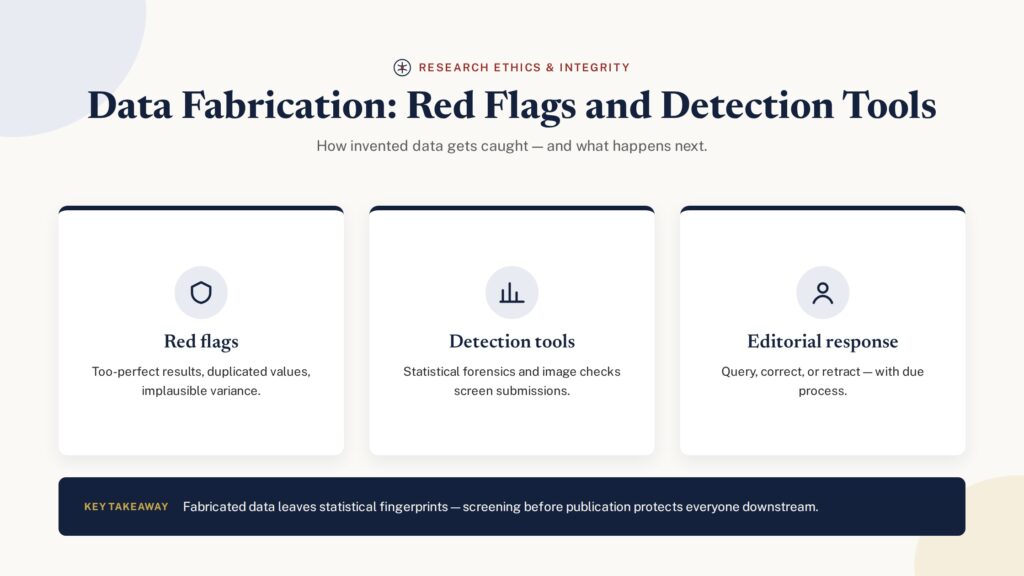
One of the primary tools for detecting fabricated data is statistical anomaly analysis. Certain patterns can signal potential irregularities:
- Unnatural Uniformity
Real-world data typically contain noise and variation. Excessively smooth distributions or perfect symmetry may raise concerns. - Digit Preference Patterns
Humans tend to favor certain numbers when inventing data. An overrepresentation of round numbers (e.g., 5, 10, 50) or specific terminal digits can signal fabrication. - Benford’s Law Deviations
Benford’s Law predicts the frequency distribution of leading digits in naturally occurring datasets. Significant deviations may suggest artificial manipulation, particularly in large numerical datasets. - Improbable Effect Sizes
Results that consistently produce highly significant findings with minimal variance across multiple experiments may warrant closer examination.
Statistical flags do not prove misconduct; they signal the need for further inquiry. Editorial responses must be careful, evidence-based, and procedurally fair.
Forensic Tools and Technologies
Beyond statistical screening, publishers increasingly rely on forensic techniques:
- Image analysis software to detect duplicated or manipulated figures
- Metadata examination to identify inconsistencies in file creation dates
- Raw data audits to verify consistency between datasets and reported results
- Cross-publication comparisons to identify repeated patterns across papers
Technological tools can assist editors, but they must be integrated into structured workflows. Automated alerts should trigger human review rather than automatic rejection.
Importantly, tools should be applied consistently across submissions to avoid selective scrutiny.
The Role of Data Availability
Transparent data policies significantly enhance detection capacity. When journals require authors to deposit raw data in trusted repositories, the opportunity for independent verification increases.
Open datasets allow reviewers and readers to:
- Recalculate statistical analyses
- Verify sample sizes
- Confirm reported outcomes
- Detect anomalies overlooked during peer review
While not all data can be openly shared due to privacy or security constraints, controlled access mechanisms can still facilitate integrity checks.
Mandatory data sharing does not eliminate fabrication risk, but it increases the likelihood of detection and promotes a culture of accountability.
Editorial Protocols and Due Process
When potential fabrication is suspected, journals must follow structured procedures. Accusations of misconduct carry serious reputational consequences, and fairness is essential.
Best practices include:
- Initial Assessment – Confirm that statistical anomalies are significant and not attributable to methodological design.
- Author Inquiry – Contact corresponding authors for clarification and request raw data where necessary.
- Institutional Notification – If concerns persist, refer the case to the author’s institution for formal investigation.
- Confidentiality and Documentation – Maintain clear records and avoid public statements until investigations conclude.
Editorial teams must avoid conducting full misconduct investigations independently. Institutions are responsible for determining intent and culpability.
Balancing Vigilance with Trust
Excessive suspicion can undermine the collaborative ethos of scholarly publishing. Most researchers act in good faith, and detection systems should not create an atmosphere of presumption of guilt.
Instead, publishers should frame data verification as a standard quality assurance practice—similar to plagiarism screening or statistical review. Routine checks normalize transparency and reduce stigma.
Educational initiatives can also reduce risk. Training authors in proper data management, documentation, and ethical reporting strengthens prevention efforts.
Prevention Through Research Culture
Fabrication often emerges from systemic pressures—publish-or-perish environments, funding competition, and career advancement incentives tied to positive results. While detection mechanisms are necessary, long-term solutions require cultural change.
Encouraging replication studies, valuing null results, and reforming research assessment criteria reduce incentives for misconduct. Publishers, funders, and institutions share responsibility for aligning reward systems with integrity.
The Future of Integrity Safeguards
As research becomes increasingly data-intensive, integrity monitoring must evolve accordingly. Emerging technologies such as automated statistical screening and blockchain-based timestamping may further enhance transparency.
However, no tool can replace ethical commitment. Ultimately, preventing fabrication depends on fostering environments where integrity is prioritized over performance metrics.
Data fabrication detection is not merely about identifying wrongdoing; it is about protecting the credibility of science itself. By combining statistical vigilance, transparent policies, and fair editorial processes, academic publishing can strengthen trust in the scholarly record while upholding justice for researchers.
In an era of expanding data complexity, safeguarding authenticity is essential. The future of credible scholarship depends not only on innovation but also on unwavering commitment to truth.