
Author Name Disambiguation in Academic Publishing: Ensuring Accurate Attribution in a Global Research Ecosystem
Reading time - 7 minutes
Introduction
In an increasingly interconnected scholarly world, accurate attribution of research has become both more important and more complicated. As publication volumes grow and international collaboration expands, distinguishing between researchers with similar—or identical—names presents a persistent challenge. Author name disambiguation is no longer a technical afterthought; it is a foundational requirement for fair recognition, reliable metrics, and research integrity.
Without robust disambiguation systems, citations may be misattributed, academic profiles fragmented, and performance assessments distorted. In a research environment where careers, funding, and institutional rankings depend on publication records, the accuracy of author identity matters deeply.
The Scope of the Problem
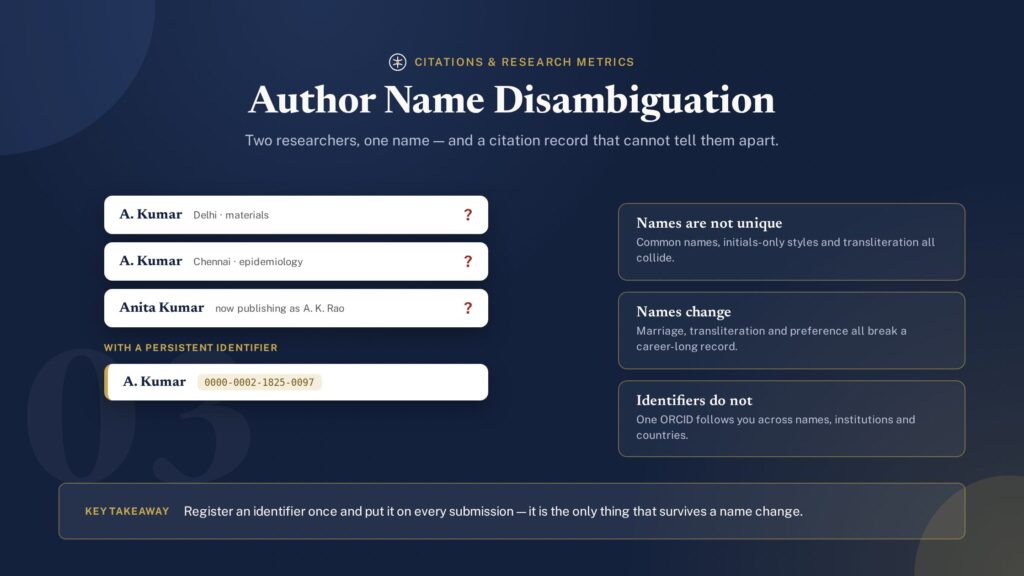
Common surnames, variations in transliteration, cultural naming conventions, name changes due to marriage or personal choice, and inconsistent use of initials all contribute to ambiguity. For example, a researcher publishing as “J. Wang” or “A. Kumar” may share their name with dozens—or even hundreds—of other scholars across disciplines.
Globalization intensifies the issue. As more researchers publish in international journals, variations in spelling or formatting can create multiple digital identities for the same individual. Conversely, different individuals may be mistakenly merged into a single profile in indexing systems.
This confusion affects:
- Citation counts and h-index calculations
- Institutional reporting and performance reviews
- Grant evaluations
- Systematic reviews and bibliometric analyses
- Public trust in scholarly records
Accurate attribution is essential not only for individual fairness but also for reliable research evaluation.
Unique Identifiers: A Structural Solution
Persistent digital identifiers have emerged as a key response to author ambiguity. Platforms such as ORCID provide researchers with unique alphanumeric identifiers that remain stable regardless of name changes, institutional affiliations, or publication venues.
By linking publications, grants, peer review activities, and affiliations to a persistent identifier, these systems reduce ambiguity across databases. Integration with indexing services such as Scopus and Web of Science further strengthens consistency in citation tracking.
However, adoption alone is not sufficient. Authors must actively maintain their profiles, and publishers must integrate identifier collection into submission workflows. Institutional mandates requiring identifier use at submission can significantly improve coverage and data accuracy.
Beyond Identifiers: Algorithmic and Metadata Approaches
While unique identifiers help prevent confusion, historical records and legacy data still require disambiguation. Bibliographic databases rely on algorithmic approaches that analyze:
- Co-author networks
- Institutional affiliations
- Subject areas and keywords
- Citation patterns
- Email domains
Machine learning models can cluster publications likely to belong to the same author. However, these systems are not infallible. False merges and erroneous splits remain common, especially in multidisciplinary research where scholars publish across diverse topics.
Improving metadata quality at the point of submission is therefore critical. Structured affiliation data, standardized name formatting, and clear contributor roles enhance downstream disambiguation efforts.
Equity and Cultural Considerations
Author name disambiguation also intersects with cultural equity. Western-centric naming conventions have historically shaped many indexing systems, leading to difficulties in representing non-Western name structures accurately.
Some cultures place family names first; others use single names or patronymic systems. Diacritical marks may be omitted in certain databases, creating further inconsistencies. Simplifying names to fit standardized formats may unintentionally erase important aspects of identity.
Publishing platforms must respect cultural naming diversity while maintaining technical clarity. Flexible metadata fields and culturally aware formatting guidelines can help reconcile these objectives.
Implications for Research Evaluation
Research assessment exercises, institutional rankings, and funding decisions often rely on bibliometric indicators. When author records are incomplete or merged incorrectly, evaluation outcomes may be skewed.
For early-career researchers in particular, fragmented records can reduce apparent productivity and citation impact. Conversely, accidental aggregation of multiple scholars’ works under one profile can inflate metrics artificially.
Transparent disambiguation processes and correction mechanisms are therefore essential. Authors should have straightforward pathways to request profile updates in indexing systems. Publishers and databases must prioritize responsiveness to such corrections.
Collaboration Across Stakeholders
Addressing author name ambiguity requires coordinated effort across the scholarly ecosystem:
- Publishers must integrate identifier collection and enforce consistent metadata standards.
- Institutions should educate researchers about maintaining digital profiles.
- Indexing databases must refine algorithms and provide transparent correction tools.
- Researchers themselves should actively monitor and curate their publication records.
Cross-platform interoperability is equally important. Seamless data exchange between submission systems, repositories, and indexing services reduces duplication and inconsistency.
The Rise of Researcher Profile Platforms
Academic social networking platforms and institutional repositories increasingly function as public-facing research profiles. While these systems enhance visibility, they also introduce potential inconsistencies if not synchronized with authoritative identifiers.
Automated import features can reduce manual data entry but may propagate errors if source metadata is inaccurate. Regular auditing of profiles ensures reliability and prevents long-term discrepancies.
Looking Ahead: Toward Persistent Scholarly Identity
As research becomes more collaborative and interdisciplinary, accurate identity tracking grows more complex. Multi-author papers involving dozens—or even hundreds—of contributors highlight the necessity of precise attribution systems.
Future developments may include enhanced biometric verification, blockchain-based identity records, or globally standardized metadata frameworks. Regardless of the technological pathway, the goal remains consistent: ensuring that scholarly contributions are attributed correctly, transparently, and equitably.
Author name disambiguation may appear technical, but its consequences are profoundly human. Careers depend on recognition. Institutions rely on accurate data. Policymakers use bibliometrics to guide funding priorities. Ensuring clarity in author identity strengthens the credibility and fairness of the entire research enterprise.
In an era defined by digital scholarship and global collaboration, persistent and precise author identification is not optional—it is foundational. By investing in robust disambiguation systems and shared responsibility across stakeholders, academic publishing can safeguard the integrity of scholarly attribution and support a more accurate, equitable research ecosystem.