
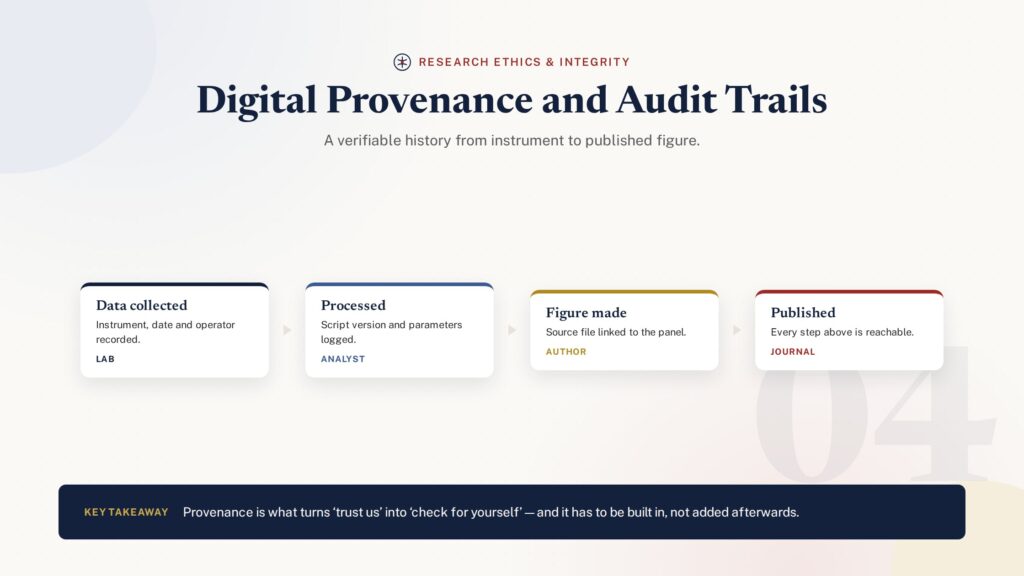
Digital Provenance and Audit Trails in Academic Publishing: Building Trust Through Verifiable Research Histories
Reading time - 7 minutes
Introduction
As academic publishing becomes increasingly digital, the scholarly record is no longer a static archive of finalized articles. Manuscripts move through multiple drafts, peer review stages, revisions, metadata updates, and post-publication corrections. While transparency initiatives have strengthened parts of this process, one dimension remains underexplored: digital provenance.
Digital provenance refers to the documented history of a research output—who created it, how it was modified, when changes occurred, and under what authority. In an era of AI-assisted writing, large-scale collaborations, and growing concerns about research fraud, verifiable audit trails may become central to maintaining trust in scholarly communication.
What Is Digital Provenance?
Digital provenance is the structured recording of an object’s lifecycle. In academic publishing, this includes:
- Manuscript submission timestamps
- Authorship changes and contributor updates
- Peer review milestones
- Editorial decisions and revisions
- Metadata modifications
- Post-publication corrections or updates
Unlike basic version tracking, provenance systems capture the context of change. They document not just what was altered, but why, by whom, and under which policy framework.
In effect, digital provenance transforms the scholarly article from a static endpoint into a transparent, traceable process.
Why Provenance Matters Now
Several developments make provenance tracking increasingly relevant:
- AI-Assisted Content Creation
With generative tools entering research workflows, questions arise about authorship integrity, originality, and undisclosed modifications. Provenance systems can log key stages in document development, offering verifiable timelines. - Paper Mills and Fraudulent Submissions
Fraudulent publishing networks often manipulate authorship records and submission histories. Structured audit trails can detect irregular patterns, such as sudden author changes or suspicious revision timelines. - Complex Multi-Author Collaborations
Large international projects may involve dozens or even hundreds of contributors. Clear provenance records help resolve disputes over contributions, decision-making authority, and revision responsibility. - Increasing Regulatory and Ethical Scrutiny
Research funders, institutions, and oversight bodies are demanding greater accountability. Provenance data can provide documentary evidence in investigations or audits.
In short, digital provenance supports both integrity and governance.
How Provenance Systems Work
Modern manuscript management platforms already capture fragments of provenance data. However, these records are often siloed within internal systems and not structured for external verification.
Emerging approaches integrate provenance frameworks using persistent identifiers such as ORCID for contributor tracking and Crossref for metadata versioning. By linking contributor identities to submission events and document versions, publishers can create structured, interoperable records.
In more advanced models, cryptographic timestamping technologies may be used to verify that certain actions occurred at specific times without subsequent alteration. While not universally adopted, these technologies demonstrate the potential for tamper-resistant documentation.
Beyond Version Control
Academic publishing has made progress in version transparency, but provenance goes further. Version control indicates that a document has changed. Provenance explains the pathway of those changes.
For example:
- Why was an author added or removed during revision?
- Who approved a methodological correction?
- When was an image replaced, and under what justification?
- Did metadata updates align with editorial policy?
Answering these questions requires contextual documentation, not simply archived files.
Provenance also helps distinguish legitimate evolution of research from problematic alterations.
Benefits for Publishers and Editors
For publishers, implementing structured provenance systems offers multiple advantages:
Enhanced Trust: Transparent histories reinforce credibility with readers, institutions, and oversight bodies.
Risk Mitigation: Clear documentation supports investigations into disputes, misconduct, or policy violations.
Operational Efficiency: Automated logging reduces reliance on manual record-keeping and improves internal accountability.
Regulatory Alignment: As compliance frameworks evolve, having structured audit trails simplifies reporting obligations.
Editors, in particular, benefit from documented decision chains that clarify how conclusions were reached and who participated in critical judgments.
Author and Reviewer Implications
Provenance tracking also affects authors and reviewers.
For authors, it provides:
- Documented evidence of submission timelines
- Clear records of requested revisions
- Protection against unauthorized changes
For reviewers, provenance systems can:
- Confirm review completion dates
- Protect anonymity where required
- Provide evidence of contribution in disputes
However, implementation must balance transparency with confidentiality. Peer review anonymity policies, where applicable, must be preserved while maintaining secure internal documentation.
Ethical and Privacy Considerations
While digital provenance strengthens accountability, it raises privacy questions. Recording detailed activity logs may involve personal data, including timestamps and communication records.
Publishers must:
- Clearly disclose what information is recorded
- Establish retention policies
- Ensure secure storage and controlled access
- Align practices with data protection regulations
Transparency about provenance policies is essential to maintain community trust.
Additionally, provenance systems should avoid becoming surveillance tools. Their purpose is integrity and accountability—not punitive monitoring.
Technical and Financial Challenges
Implementing robust provenance infrastructure is not trivial. Challenges include:
- Integrating legacy manuscript management systems
- Ensuring interoperability across publishers
- Standardizing metadata formats
- Managing storage and security costs
Smaller publishers may face resource constraints. Collaborative industry initiatives could develop shared standards and open-source tools to reduce duplication and cost barriers.
A Cultural Shift Toward Process Transparency
Historically, academic publishing emphasized the final article as the primary object of record. Provenance systems reflect a cultural shift: recognizing the process of knowledge production as equally important.
This shift aligns with broader movements toward transparency, accountability, and responsible research governance. Just as financial audits track institutional transactions, scholarly provenance can document intellectual workflows.
In the long term, verifiable research histories may become as fundamental as citation indexing.
The Future of Verifiable Scholarship
As digital ecosystems mature, readers may increasingly expect to access structured research histories alongside published articles. This does not mean overwhelming users with technical logs. Instead, it involves offering accessible summaries supported by secure backend documentation.
In a publishing landscape shaped by automation, AI assistance, global collaboration, and rising integrity concerns, digital provenance provides a stabilizing framework. It reinforces the legitimacy of scholarly outputs by making their development traceable and verifiable.
Trust in academic publishing depends not only on rigorous peer review but also on confidence in the integrity of editorial processes. By investing in digital provenance and audit trails, publishers can strengthen that trust—ensuring that the scholarly record remains credible, accountable, and resilient in an increasingly complex research environment.