
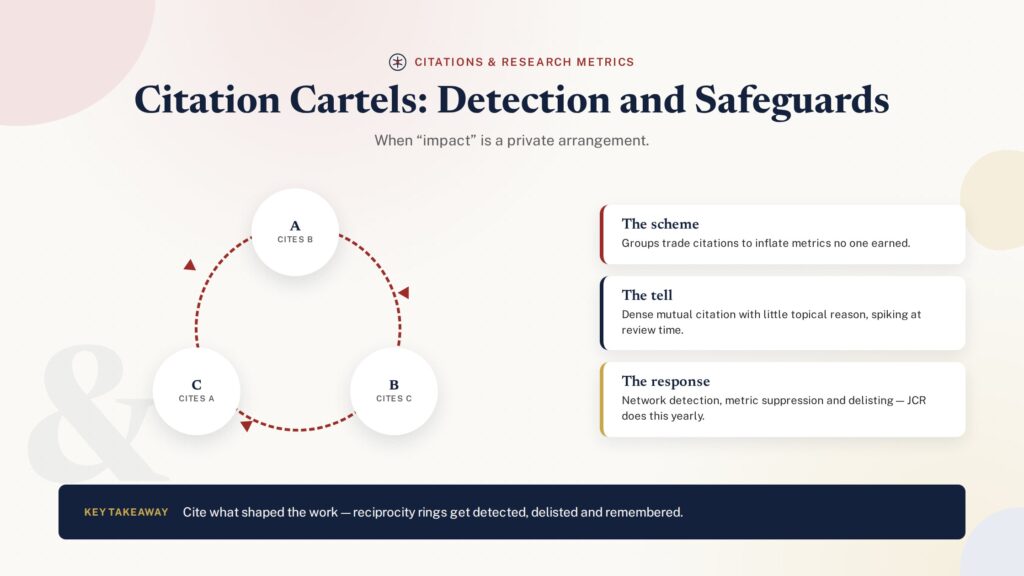
Citation Cartels in Academic Publishing: Detection, Risks, and Safeguards for Research Integrity
Reading time - 7 minutes
Introduction
Citations are the currency of academic recognition. They influence journal rankings, researcher reputations, funding decisions, and institutional assessments. Yet when citation practices are manipulated for strategic gain rather than scholarly relevance, the integrity of the entire system is at risk. One of the most concerning forms of manipulation is the emergence of citation cartels—networks of authors, editors, or journals that systematically cite one another to inflate metrics.
While much attention has been devoted to predatory journals and fraudulent peer review, citation cartels represent a subtler, often harder-to-detect challenge. Addressing this issue requires a nuanced understanding of how citation ecosystems function and how they can be distorted.
What Is a Citation Cartel?
A citation cartel refers to a coordinated group—sometimes informal, sometimes highly structured—that engages in reciprocal or excessive citation practices to boost citation counts artificially. These networks may involve:
- Groups of authors citing one another disproportionately
- Editors encouraging or coercing authors to cite specific journals
- Journals forming informal alliances to exchange citations
- Reviewers requesting unnecessary citations to their own work
Unlike legitimate citation patterns that reflect intellectual influence, cartel behavior is primarily strategic. The goal is not to advance knowledge but to manipulate metrics.
Why Citation Cartels Matter
Citation counts feed directly into journal-level indicators such as the Journal Impact Factor and broader indexing systems like Scopus and Web of Science. Inflated citations can:
- Artificially elevate a journal’s ranking
- Enhance perceived prestige
- Influence author submission decisions
- Affect promotion and tenure evaluations
When citation metrics are distorted, trust in research assessment frameworks weakens. Institutions may allocate resources based on misleading indicators, and researchers may be incentivized to prioritize strategic citation over scholarly relevance.
Forms of Citation Manipulation
Citation cartels can take several forms:
- Journal-to-Journal Citation Rings
Two or more journals systematically cite each other’s articles to increase citation metrics. While some cross-citation is natural in specialized fields, unusually high reciprocal citation rates may signal manipulation. - Editor-Driven Citation Pressure
Editors may encourage authors to add citations from the same journal during revision. While suggesting relevant literature is appropriate, coercive practices that lack scholarly justification cross ethical boundaries. - Reviewer Self-Citation Demands
Reviewers sometimes request citations to their own work. If such suggestions are not directly relevant to the manuscript, they may represent attempts to inflate personal citation counts. - Author Collaboration Networks
Groups of researchers may form informal networks where they preferentially cite one another, regardless of relevance.
Distinguishing between natural scholarly communities and intentional manipulation is challenging, making detection particularly complex.
Detecting Citation Cartels
Advances in bibliometric analysis have improved the ability to identify suspicious patterns. Analytical tools can examine:
- Abnormally high reciprocal citation rates
- Citation concentration within small author clusters
- Sudden spikes in journal-to-journal citations
- Unusual self-citation patterns
Network analysis methods allow researchers to visualize citation relationships and identify clusters that deviate from expected disciplinary norms.
Indexing services and analytics providers increasingly monitor these patterns. In some cases, journals have been temporarily suspended from indexing databases due to citation irregularities.
However, detection alone is not sufficient. Clear standards are needed to determine when patterns constitute misconduct rather than disciplinary specialization.
Ethical Gray Areas
Not all high citation clustering is unethical. Specialized research communities often cite each other frequently due to shared topics, methodologies, or regional focus. Early-stage fields may have limited literature pools, naturally concentrating citations.
The challenge lies in distinguishing legitimate intellectual communities from intentional metric manipulation. Transparency and documentation are essential. Editors should justify citation suggestions, and reviewers should explain why recommended references are directly relevant.
Safeguards and Best Practices
Preventing citation cartels requires systemic and cultural changes within academic publishing.
- Clear Editorial Policies
Journals should explicitly prohibit coercive citation practices and define acceptable reviewer conduct. Transparent guidelines reduce ambiguity. - Independent Monitoring
Publishers and indexing bodies should conduct routine audits of citation patterns. Independent oversight enhances accountability. - Reviewer Training
Training programs can clarify ethical expectations regarding citation suggestions, emphasizing relevance over self-promotion. - Decoupling Evaluation from Single Metrics
Overreliance on indicators like the Journal Impact Factor incentivizes manipulation. Broader assessment frameworks that incorporate qualitative evaluation reduce pressure to game metrics. - Transparent Corrections
If citation manipulation is identified, corrective measures—such as publishing notices or adjusting indexing status—should be transparent and proportionate.
The Role of Research Assessment Reform
Citation cartels thrive in environments where quantitative metrics dominate evaluation systems. Efforts to reform research assessment practices aim to shift emphasis from metric-driven evaluation to holistic appraisal of research quality and societal impact.
Institutions that reduce dependence on narrow citation-based indicators contribute to minimizing incentives for cartel behavior. A diversified evaluation ecosystem weakens the perceived rewards of citation manipulation.
Cultural Dimensions
Academic culture often equates high citation counts with prestige and success. Changing this mindset requires collective reflection. Researchers must prioritize intellectual honesty over competitive advantage.
Editors play a critical role in modeling ethical citation behavior. Transparent communication about citation expectations fosters trust among authors and reviewers.
Looking Ahead
Citation cartels represent a quiet but significant threat to research integrity. Unlike overt fraud, their operations often blend into normal scholarly activity, making vigilance essential.
As bibliometric tools become more sophisticated, detection capabilities will improve. Yet technological monitoring alone cannot resolve the issue. Sustainable solutions depend on cultural change, transparent governance, and responsible research assessment practices.
Ultimately, citations should reflect intellectual influence—not strategic alliances. Protecting the credibility of scholarly metrics requires coordinated action from publishers, indexing services, institutions, and researchers alike.
By recognizing and addressing citation cartels proactively, academic publishing can preserve the trust that underpins scholarly communication and ensure that citation metrics remain meaningful indicators of genuine research impact.