
Registered Replication Reports in Academic Publishing: Strengthening Evidence Through Coordinated, Multi-Site Verification
Reading time - 7 minutes
Introduction
Concerns about reproducibility have reshaped conversations across scholarly disciplines. While individual replication studies and registered reports have gained traction, a more coordinated and powerful model is emerging: Registered Replication Reports (RRRs). By combining pre-registered protocols with multi-site collaboration and journal commitment to publication regardless of outcome, RRRs represent a structural innovation in how academic publishing validates evidence.
In a research ecosystem often driven by novelty and positive results, Registered Replication Reports re-center attention on verification, methodological rigor, and collective scrutiny. They may not produce flashy headlines—but they strengthen the foundations upon which knowledge is built.
What Are Registered Replication Reports?
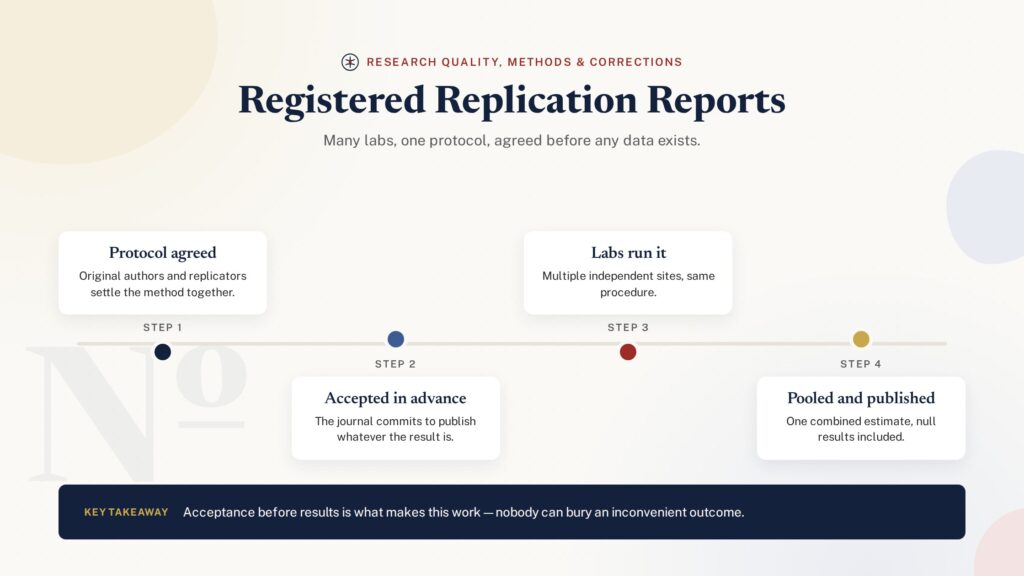
Registered Replication Reports are large-scale, pre-registered, multi-laboratory replication studies conducted under a standardized protocol and published regardless of whether the findings confirm or contradict the original result.
Unlike traditional replications—often conducted independently and sometimes published only if they yield notable outcomes—RRRs are:
- Pre-registered: Methods and analysis plans are peer-reviewed and approved before data collection begins.
- Collaborative: Multiple independent research teams implement the same protocol across different sites.
- Publication-guaranteed: Journals commit to publishing results regardless of outcome, provided the protocol is followed.
This model reduces selective reporting, enhances statistical power, and increases confidence in findings.
Why RRRs Matter Now
Many disciplines have faced what is commonly referred to as a “replication crisis,” where high-profile findings fail to reproduce consistently. While debates about terminology continue, the broader issue is clear: scientific reliability depends not only on innovation but also on confirmation.
Individual replication attempts may lack sufficient statistical power or may inadvertently introduce methodological variation. Registered Replication Reports address these weaknesses by standardizing procedures and aggregating data across multiple laboratories.
The result is a more robust assessment of whether an effect replicates across contexts, populations, and researchers.
Structural Advantages of RRRs
- Increased Statistical Power
Pooling data from multiple sites allows researchers to detect small but meaningful effects with greater precision. Larger aggregated sample sizes reduce uncertainty and provide clearer estimates of effect magnitude. - Reduced Researcher Bias
Because the protocol is pre-registered and peer-reviewed before data collection, opportunities for selective analysis or post hoc hypothesis adjustment are minimized. - Cross-Context Validation
Multi-site collaboration tests whether findings generalize beyond a single laboratory environment. If results replicate across diverse contexts, confidence increases. If they do not, valuable boundary conditions emerge. - Guaranteed Publication
By securing in-principle acceptance before data collection, RRRs counter publication bias against null findings. This protects researchers from career risk when participating in replication efforts.
Editorial and Logistical Considerations
Implementing Registered Replication Reports requires thoughtful coordination. Journals must establish clear editorial workflows for:
- Reviewing and approving protocols prior to data collection
- Coordinating communication among participating sites
- Managing multi-author contributions
- Ensuring consistent data reporting standards
Editorial teams may designate dedicated replication editors or methodological reviewers to oversee protocol design. Clear governance structures are essential to prevent ambiguity about authorship, data ownership, and conflict resolution.
Additionally, publishers must accommodate complex metadata structures to reflect collaborative authorship accurately.
Incentivizing Participation
One of the central challenges is motivating researchers to invest time in replication rather than novel studies. Academic reward systems often prioritize first discoveries over confirmatory work.
Registered Replication Reports help shift this culture by offering:
- Guaranteed publication
- Visibility through coordinated publication events
- Recognition of methodological rigor
- Opportunities for early-career researchers to collaborate internationally
Institutions and funders can further encourage participation by recognizing replication contributions in evaluation frameworks.
Ethical Dimensions
RRRs also carry ethical implications. By rigorously testing influential findings—especially those with policy, clinical, or social impact—replication protects public trust in research.
However, careful communication is essential. When replication results differ from original findings, discourse must remain respectful and constructive. Replication is not an accusation; it is a normal and necessary part of scientific progress.
Clear editorial framing can emphasize that differing results reflect contextual variation or methodological nuance rather than personal failure.
Data Coordination and Transparency
Coordinated replication efforts depend on standardized data management practices. Participating laboratories must adhere strictly to shared protocols, document deviations transparently, and upload data in agreed formats.
Pre-registration platforms and shared repositories facilitate coordination. Transparent documentation ensures that aggregated analyses accurately reflect contributions from each site.
Such openness strengthens the credibility of outcomes and allows secondary analysis where appropriate.
Challenges and Limitations
Despite their promise, Registered Replication Reports face practical obstacles:
- Coordinating international teams can be time-consuming.
- Funding large, multi-site studies may be complex.
- Some research domains may lack sufficient laboratories to conduct coordinated replication.
- Highly context-specific studies may not lend themselves to standardized protocols.
Moreover, RRRs are not intended to replace exploratory research. Innovation remains vital. The challenge is balancing discovery with verification.
Cultural Transformation in Publishing
The rise of Registered Replication Reports signals a broader cultural shift. Academic publishing is increasingly recognizing that credibility depends not only on breakthrough findings but also on reproducible evidence.
RRRs promote collective responsibility. Instead of viewing replication as secondary work, they position it as a collaborative, high-status endeavor supported by editorial commitment.
Over time, widespread adoption of coordinated replication models could recalibrate incentives across disciplines. Journals might dedicate regular space to replication portfolios. Funding agencies might establish dedicated replication grants. Institutions might formally reward replication leadership.
Looking Forward
Registered Replication Reports represent a maturation of scholarly publishing. They integrate methodological rigor, collaborative design, and editorial foresight into a single framework that prioritizes reliability.
In an era of rapid dissemination and global visibility, the stakes of inaccurate findings are higher than ever. Coordinated replication offers a proactive solution: test influential claims thoroughly before they shape policy, practice, or public understanding.
By embedding verification directly into publishing workflows, Registered Replication Reports reinforce the core principle that science advances not only through bold ideas but also through careful confirmation.
If novelty drives discovery, replication secures its foundation. In strengthening that foundation, academic publishing affirms its commitment to durable, trustworthy knowledge.