
Whistleblowing Mechanisms in Academic Publishing: Protecting Integrity Through Safe and Structured Reporting
Reading time - 7 minutes
Introduction
Academic publishing relies on trust—trust in authors, reviewers, editors, and institutions. While formal safeguards such as peer review and plagiarism screening help uphold standards, many integrity breaches come to light not through automated systems but through individuals who raise concerns. Whistleblowers—whether anonymous reviewers, editorial staff, or external researchers—play a critical role in safeguarding the scholarly record.
Yet whistleblowing in academic publishing remains fraught with risks. Fear of retaliation, reputational damage, and career consequences can discourage individuals from reporting misconduct. As research ecosystems grow more complex, journals and publishers must develop clear, fair, and protective mechanisms for handling integrity concerns. Establishing robust whistleblowing systems is no longer optional—it is foundational to maintaining credibility.
The Role of Whistleblowers in Scholarly Integrity
Whistleblowers may identify a range of concerns, including:
- Suspected data manipulation
- Undisclosed conflicts of interest
- Authorship disputes
- Peer review fraud
- Image irregularities
- Ethical approval inconsistencies
In some cases, concerns originate internally from editorial staff who notice irregular patterns. In others, external researchers may detect inconsistencies after publication. Whistleblowers often operate without formal authority but with deep commitment to protecting research standards.
Their contributions frequently complement guidance from organizations such as Committee on Publication Ethics (COPE), which provides frameworks for handling misconduct. However, even the best guidelines cannot function effectively without individuals willing to speak up.
Barriers to Reporting
Despite their importance, whistleblowers face significant obstacles. Academic cultures often emphasize collegiality and hierarchy. Raising concerns about a senior researcher, a prominent editor, or a well-funded research group can carry professional risks.
Common barriers include:
- Fear of retaliation or blacklisting
- Concern about legal exposure
- Lack of clarity about reporting channels
- Doubts about confidentiality
- Perception that complaints will be ignored
In cross-border publishing environments, jurisdictional differences in whistleblower protections further complicate matters. Without structured mechanisms, reports may be handled inconsistently or inadequately.
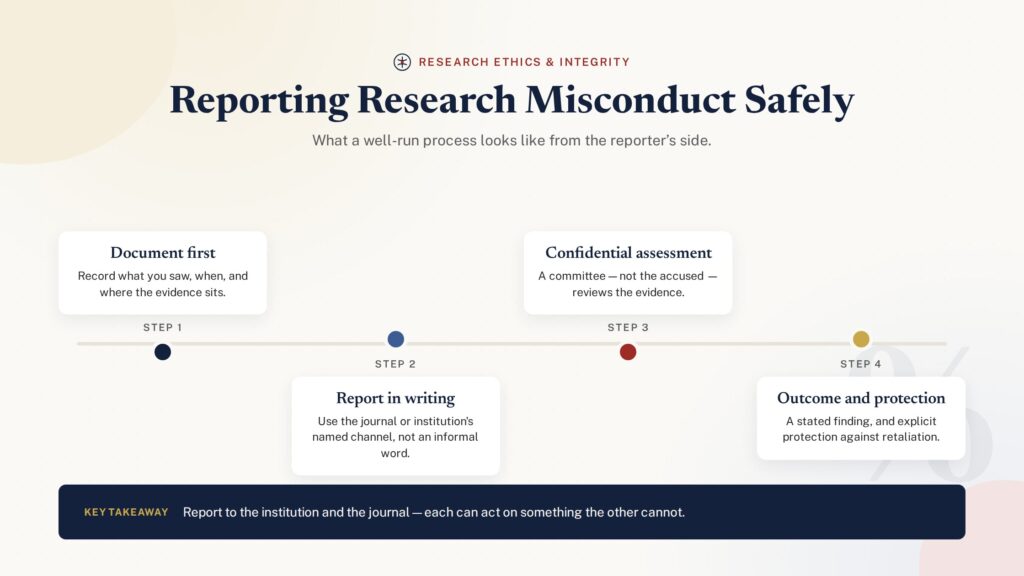
Designing Safe Reporting Channels
Effective whistleblowing systems in academic publishing should include several core elements:
- Clear Reporting Pathways
Journals should prominently publish information on how concerns can be submitted—whether via dedicated email addresses, secure web forms, or third-party reporting platforms. Transparency reduces uncertainty and signals institutional readiness. - Confidentiality and Anonymity Options
While anonymous reporting can complicate investigations, it remains essential in high-risk contexts. Systems should allow reporters to choose their level of disclosure, with safeguards against unauthorized identification. - Independent Oversight
To avoid conflicts of interest, especially in cases involving editorial leadership, publishers may designate independent ethics committees or external advisors to review complaints. - Defined Timelines and Procedures
Ambiguity breeds mistrust. Journals should outline investigation steps, estimated response times, and communication protocols. Even if full transparency is not possible, structured updates reassure reporters that concerns are taken seriously.
Balancing Protection and Due Process
Whistleblowing mechanisms must balance two ethical imperatives: protecting those who report concerns and ensuring fairness for those accused. Premature public allegations can cause irreversible reputational harm.
Responsible systems emphasize:
- Preliminary fact-checking before formal investigation
- Neutral language in comunications
- Opportunities for authors to respond
- Documentation of decision-making processes
This dual commitment protects both research integrity and individual rights.
Legal and Institutional Considerations
Whistleblowing intersects with employment law, defamation risk, and institutional policy. Large publishers may operate across multiple legal jurisdictions, each with distinct regulatory frameworks.
Collaboration with legal advisors ensures that reporting mechanisms comply with applicable laws while preserving editorial independence. Institutions affiliated with authors may also have internal research integrity offices, requiring coordinated communication.
In some cases, publishers must decide whether to involve external bodies, such as funding agencies or regulatory authorities. Clear escalation policies help prevent confusion or overreach.
Cultural Change in Publishing
Beyond formal systems, fostering a culture that values integrity over reputation is essential. When journals publicly affirm their commitment to ethical accountability, they reduce stigma associated with reporting concerns.
Training for editors and staff can strengthen confidence in handling sensitive cases. Open dialogue about integrity challenges normalizes responsible reporting as part of professional duty rather than personal attack.
Importantly, whistleblowing should not be framed solely as reactive. Encouraging internal dialogue about ethical standards can prevent misconduct before it escalates.
Technology and Secure Reporting
Digital platforms offer opportunities to strengthen whistleblowing systems. Secure submission portals with encrypted communication can protect reporter identity. Audit trails ensure transparency in how reports are handled.
However, technology alone is insufficient. Systems must be accompanied by trained personnel capable of conducting fair investigations and making evidence-based decisions.
Automation can assist with documentation, but judgment and discretion remain central to resolving complex ethical concerns.
Preventing Misuse of Whistleblowing Channels
Any reporting system may be vulnerable to malicious or bad-faith complaints. Safeguards should include careful screening, documentation of evidence, and proportionate response strategies.
A structured triage process can differentiate between substantive allegations and unsubstantiated grievances. Maintaining professionalism and neutrality at every stage preserves credibility.
Toward a Safer Integrity Ecosystem
Whistleblowing mechanisms are not merely administrative tools; they are indicators of institutional maturity. Journals that establish clear, protective systems demonstrate commitment to accountability and transparency.
In an era of increasing scrutiny—ranging from public trust debates to intensified competition for funding—academic publishing cannot rely solely on traditional peer review. Ethical oversight must extend throughout the publication lifecycle.
By investing in safe reporting channels, independent oversight, and procedural clarity, publishers strengthen the foundations of scholarly trust. Whistleblowers, when supported rather than silenced, become allies in protecting the integrity of research.
Ultimately, academic publishing thrives when concerns can be raised without fear. A culture that values responsible reporting over reputational defensiveness ensures that scholarship remains credible, self-correcting, and worthy of public confidence.