
Blockchain-Based Peer Review Records in Academic Publishing: Ensuring Trust, Traceability, and Accountability
Reading time - 7 minutes
Introduction
As academic publishing continues to evolve in response to concerns around transparency, trust, and integrity, one emerging concept is the use of blockchain technology to record and verify peer review activities. While blockchain has already been explored in areas such as data provenance and decentralized publishing, its application specifically to peer review records offers a new frontier for addressing long-standing challenges in the scholarly communication ecosystem.
The Problem with Traditional Peer Review Records
Peer review remains the backbone of academic quality control, yet its documentation is often fragmented, opaque, and vulnerable to manipulation. Editorial decisions, reviewer reports, and revision histories are typically stored within journal management systems that are neither standardized nor publicly accessible. This creates several issues:
- Lack of transparency: Authors and institutions have limited visibility into how decisions are made.
- Disputes and appeals: Without immutable records, disagreements over review timelines or content can be difficult to resolve.
- Reviewer accountability: Anonymous systems can sometimes enable low-quality or biased reviews without consequences.
- Recognition gaps: Reviewers receive little verifiable credit for their contributions.
These challenges highlight the need for a system that can securely record peer review activities while maintaining appropriate confidentiality.
What Blockchain Brings to Peer Review
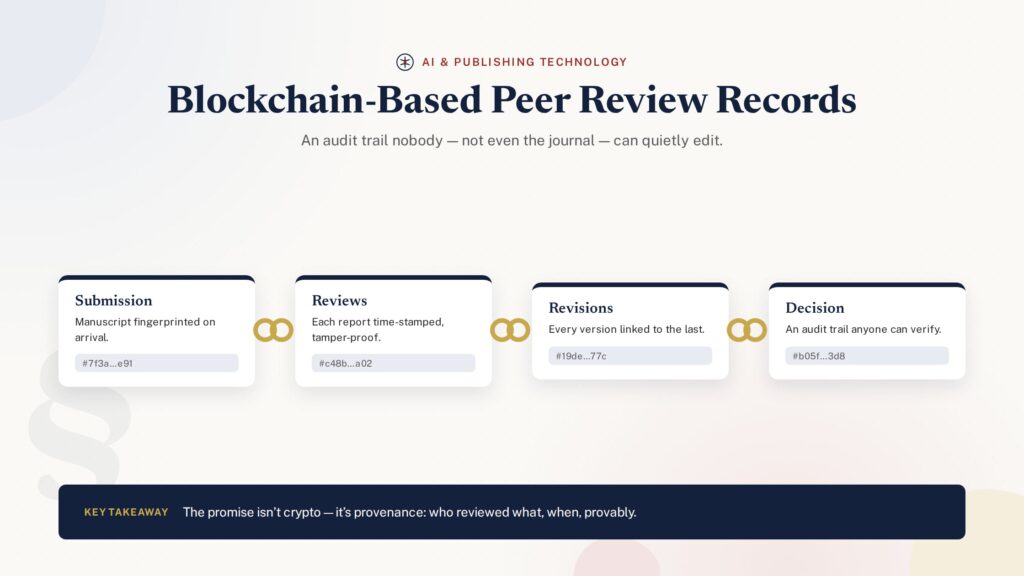
Blockchain is a distributed ledger technology that records transactions in a secure, immutable, and time-stamped manner. When applied to peer review, it can create a tamper-proof record of key events in the editorial process, such as:
- Submission timestamps
- Reviewer invitations and acceptances
- Review completion dates
- Editorial decisions
- Revision submissions
Each of these actions can be logged as a “block” in the chain, ensuring that the entire review history is transparent, verifiable, and resistant to alteration.
Importantly, blockchain does not require that the content of reviews be publicly disclosed. Instead, it can store cryptographic hashes—unique digital fingerprints—of documents, allowing verification without exposing sensitive information.
Enhancing Trust and Integrity
One of the most significant advantages of blockchain-based peer review records is the enhancement of trust across stakeholders. Authors can be confident that their submissions are handled fairly and that timelines are accurately recorded. Editors gain protection against accusations of bias or misconduct, as their decisions are backed by immutable logs. Publishers benefit from increased credibility in an era where research integrity is under intense scrutiny.
Moreover, blockchain can help deter unethical practices such as:
- Review manipulation: Fabricated or ghost reviews become harder to insert into a verifiable chain.
- Undisclosed delays: Time-stamped records reveal bottlenecks in the review process.
- Editorial bias: Patterns in decision-making can be audited over time.
By making the process auditable, blockchain introduces a level of accountability that traditional systems struggle to achieve.
Recognizing and Rewarding Reviewers
Another promising application lies in reviewer recognition. Blockchain can provide verifiable proof of review activity without compromising anonymity. Reviewers could receive digital tokens or certificates linked to their contributions, which can be used for:
- Academic CVs and promotion dossiers
- Grant applications
- Institutional evaluations
Such a system aligns with broader efforts to formally acknowledge peer review as a scholarly output. It also opens the door to incentive models where high-quality reviewing is rewarded, potentially addressing reviewer fatigue and engagement issues.
Integration with Existing Systems
Despite its potential, blockchain is not a replacement for existing editorial management platforms. Instead, it should be viewed as a complementary layer that enhances record-keeping and verification. Integration challenges include:
- Technical complexity: Implementing blockchain requires infrastructure and expertise that many publishers currently lack.
- Interoperability: Different journals and publishers must adopt compatible standards for blockchain records to be meaningful across the ecosystem.
- Scalability: High submission volumes could strain blockchain networks if not properly optimized.
To address these issues, pilot projects and collaborative initiatives are essential. Industry-wide standards will play a critical role in ensuring that blockchain solutions are practical and widely adopted.
Ethical and Privacy Considerations
While blockchain promotes transparency, it also raises important ethical questions. Peer review often relies on confidentiality to ensure candid feedback. Any system that records review activity must carefully balance openness with privacy.
Key considerations include:
- Anonymity preservation: Reviewer identities must remain protected unless explicitly disclosed.
- Data governance: Clear policies are needed بشأن who can access blockchain records and under what conditions.
- Right to correction: Immutable records may conflict with the need to correct errors in the review process. Mechanisms for appending corrections without deleting original entries must be established.
Addressing these concerns requires thoughtful governance frameworks that align with existing ethical standards in academic publishing.
Future Outlook
The adoption of blockchain-based peer review records is still in its early stages, but the momentum is growing. As the academic community continues to prioritize transparency, reproducibility, and accountability, such systems may become an integral part of the publishing infrastructure.
In the future, we may see:
- Cross-publisher blockchain networks enabling unified review histories
- Integration with researcher identifiers for seamless attribution
- Smart contracts automating reviewer incentives and editorial workflows
- Real-time auditing tools for institutions and funders
These developments could fundamentally reshape how peer review is conducted, recorded, and valued.
Conclusion
Blockchain-based peer review records offer a compelling solution to many of the transparency and trust issues facing academic publishing today. By creating secure, immutable, and verifiable logs of the review process, this approach enhances accountability while preserving necessary confidentiality.
However, successful implementation will depend on collaboration, standardization, and careful attention to ethical considerations. If these challenges are addressed, blockchain has the potential to transform peer review from a largely opaque process into one that is both trustworthy and traceable—strengthening the foundation of scholarly communication for years to come.