
Retraction Stigma and Researcher Rehabilitation in Academic Publishing: Balancing Accountability with Fair Recovery
Reading time - 7 minutes
Introduction
Retractions are one of the most visible mechanisms for correcting the scholarly record. When a paper is withdrawn due to error, misconduct, or irreproducibility, it signals that the system is working to preserve research integrity. However, while retractions protect the literature, they often leave a lasting mark on the researchers involved—sometimes regardless of the severity or intent behind the issue. This has led to a growing conversation around retraction stigma and the need for structured pathways for researcher rehabilitation.
As academic publishing evolves toward greater transparency and accountability, it must also confront an important question: how can the system hold researchers responsible without permanently damaging careers, especially in cases of honest mistakes?
Understanding Retraction Stigma
Retraction stigma refers to the reputational damage and professional consequences faced by researchers whose work has been retracted. In many cases, a retraction—whether due to misconduct or genuine error—is perceived uniformly as a sign of failure or wrongdoing. This perception can lead to:
- Loss of funding opportunities
- Difficulty securing future publications
- Damage to institutional reputation
- Reduced collaboration prospects
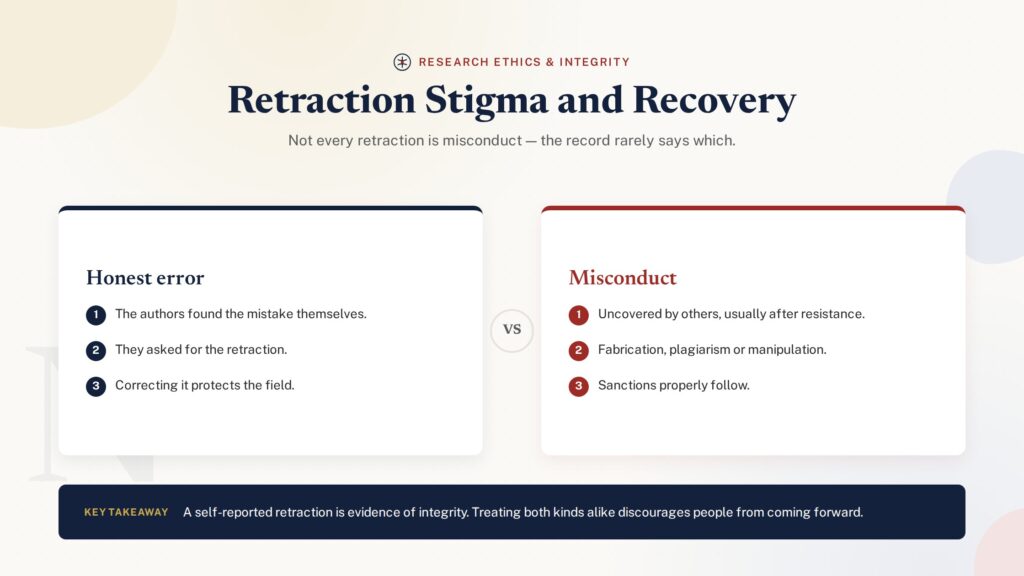
The problem lies in the lack of nuance. Not all retractions are equal. Some arise from deliberate misconduct such as data fabrication, while others result from methodological errors, flawed assumptions, or post-publication discoveries that invalidate findings.
When the academic community treats all retractions as equivalent, it discourages transparency. Researchers may become hesitant to report errors or request corrections, fearing long-term career consequences.
Differentiating Types of Retractions
A key step in addressing stigma is distinguishing between types of retractions. Broadly, they can be categorized as:
- Misconduct-related retractions – involving plagiarism, falsification, or unethical practices
- Error-based retractions – stemming from honest mistakes in data, analysis, or interpretation
- Publisher-initiated retractions – due to technical or procedural issues
Without clear labeling and communication, readers and institutions may assume the worst. Journals can play a critical role by ensuring retraction notices are detailed, transparent, and specific about the reasons involved.
The Case for Researcher Rehabilitation
In many professions, individuals are given opportunities to recover from mistakes, learn, and rebuild trust. Academic publishing, however, has historically lacked formal mechanisms for rehabilitation. This creates a system where:
- Early-career researchers may face disproportionate consequences
- Honest errors are penalized similarly to intentional misconduct
- There is little incentive to proactively correct the record
A more balanced approach would recognize that science is inherently iterative and that errors—when addressed responsibly—can contribute to progress.
Building a Framework for Fair Recovery
To reduce stigma while maintaining accountability, academic publishing can adopt structured rehabilitation pathways. These may include:
- Transparent Retraction Classification
Journals should clearly distinguish between misconduct and honest error in retraction notices. Standardized categories can help institutions and readers interpret retractions more fairly. - Correction-Friendly Culture
Encouraging corrections, amendments, and partial retractions can reduce the need for full retractions. When researchers feel safe reporting issues early, the impact on the scholarly record—and their reputation—can be minimized. - Time-Bound Impact Assessment
Institutions and funding bodies could adopt policies where the impact of a retraction diminishes over time, especially in cases of non-malicious error. This allows researchers to demonstrate growth and improved practices. - Mandatory Training and Compliance Programs
For cases involving questionable practices, structured training in research ethics, data management, and methodology can serve as a pathway to rebuilding trust. - Narrative CVs and Contextual Evaluation
Instead of relying solely on publication records, evaluators can consider broader contributions, including transparency, collaboration, and corrective actions taken after a retraction.
The Role of Journals and Publishers
Publishers are central to shaping how retractions are perceived. Beyond issuing notices, they can:
- Develop standardized templates for retraction explanations
- Link retractions to corrected or follow-up studies where applicable
- Highlight cases where researchers acted responsibly in correcting errors
- Avoid punitive language that implies misconduct without evidence
By presenting retractions as part of the scientific process rather than solely as failures, publishers can help shift cultural perceptions.
Institutional Responsibility
Universities and research institutions also play a crucial role. Rather than adopting zero-tolerance reputational policies, they can:
- Conduct fair and transparent investigations
- Provide support systems for affected researchers
- Differentiate between intent and outcome in disciplinary actions
- Encourage open discussions about research challenges and failures
Such approaches not only support individual researchers but also promote a culture of integrity and learning.
Risks and Safeguards
While advocating for rehabilitation, it is equally important to avoid minimizing serious misconduct. Any framework must ensure that:
- Deliberate fraud is met with appropriate consequences
- Repeat offenses are monitored and addressed
- Transparency is not compromised in the name of reputation management
The goal is not to eliminate accountability, but to calibrate it appropriately based on context and intent.
Changing the Narrative Around Retractions
Ultimately, addressing retraction stigma requires a cultural shift. Retractions should not be viewed solely as endpoints of failure, but as signals of self-correction within science. When handled transparently and responsibly, they can:
- Strengthen trust in the research ecosystem
- Encourage openness and honesty
- Improve methodological rigor over time
Researchers who acknowledge and correct their mistakes should be recognized for upholding scientific values, not penalized disproportionately.
Conclusion
Retractions are essential for maintaining the credibility of academic publishing, but their impact on researchers must be carefully managed. A system that stigmatizes all retractions equally risks discouraging transparency and slowing scientific progress.
By differentiating retraction types, promoting correction-friendly practices, and establishing pathways for rehabilitation, the academic community can strike a better balance between accountability and fairness. In doing so, it reinforces a core principle of science: progress is not just about getting things right, but also about recognizing and correcting what goes wrong.