
Peer Review Appeals in Academic Publishing: When and How to Challenge Editorial Decisions
Reading time - 7 minutes
Introduction
In academic publishing, peer review is widely regarded as the gold standard for evaluating research quality. Yet, despite its importance, the process is not infallible. Authors may occasionally encounter decisions that feel unfair, inconsistent, or based on misunderstandings. In such cases, the option to appeal a peer review decision becomes a critical—yet often under-discussed—aspect of scholarly communication.
Peer review appeals serve as a formal mechanism for authors to challenge editorial decisions, ensuring that the publishing process remains accountable, transparent, and fair. However, appeals must be approached carefully, strategically, and ethically to be effective.
Why Peer Review Appeals Matter
The peer review process involves human judgment, which means it is subject to bias, error, and variability. Reviewers may misinterpret data, apply inconsistent standards, or overlook key contributions. Editors, too, must balance competing opinions and make decisions under time constraints.
Appeals provide a structured opportunity to correct such issues. They help:
- Safeguard authors from unjust rejection
- Encourage accountability among reviewers and editors
- Improve the overall quality of editorial decision-making
- Reinforce trust in the academic publishing system
Importantly, appeals are not about challenging criticism itself, but about addressing clear errors, misunderstandings, or procedural concerns.
When Should Authors Consider an Appeal?
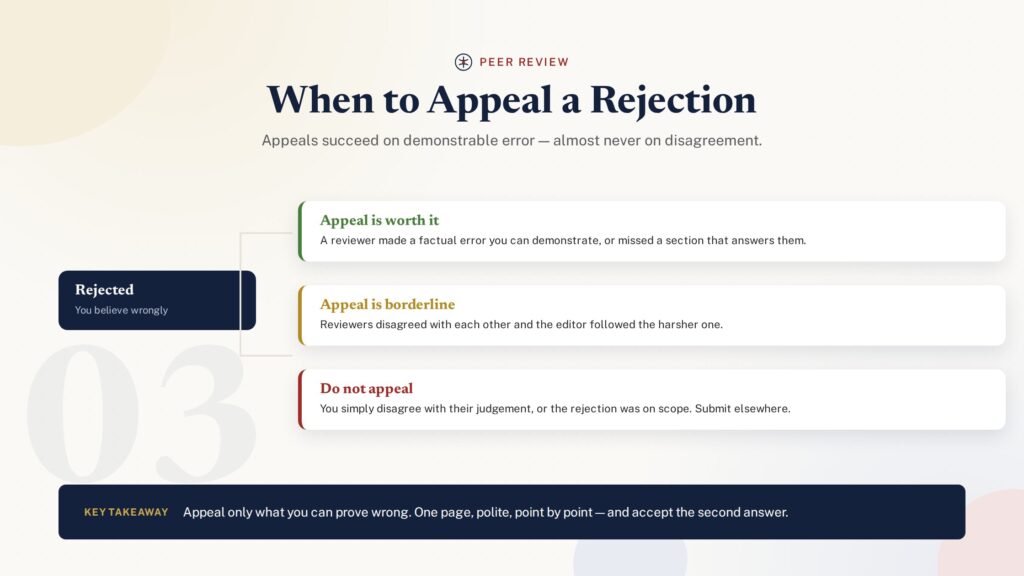
Not every rejection warrants an appeal. In many cases, reviewer feedback—however critical—is valid and useful for improving the manuscript. However, an appeal may be justified under specific circumstances:
- Factual Errors in the Review
If reviewers have misunderstood the methodology, misread results, or made objectively incorrect claims, an appeal can clarify these points. - Inconsistent or Contradictory Reviews
When reviewer comments conflict significantly and the editor’s decision does not adequately address these discrepancies, authors may seek reconsideration. - Evidence of Bias or Unprofessional Conduct
If a review contains inappropriate language, personal criticism, or clear bias, this raises concerns about the integrity of the evaluation process. - Procedural Irregularities
For example, if a manuscript was rejected without proper peer review or if editorial policies were not followed. - Overlooked Novelty or Contribution
Sometimes, reviewers may fail to recognize the significance of a study, particularly in interdisciplinary research. An appeal can highlight these contributions more clearly.
When Appeals Are Not Appropriate
Appeals should not be used simply because the author disagrees with reviewer opinions or is dissatisfied with a rejection. Journals are not obligated to accept a paper, and differences in academic judgment are normal.
Submitting an appeal without strong justification can:
- Damage the author’s credibility
- Strain relationships with editors
- Delay the process unnecessarily
A good rule of thumb is this: appeal only when you can point to clear, evidence-based issues in the review or decision.
How to Write an Effective Appeal
A well-crafted appeal letter is professional, concise, and evidence-driven. It should focus on substance rather than emotion.
- Maintain a Respectful Tone
Even if the reviews were frustrating, the appeal must remain courteous and objective. Avoid accusatory or defensive language. - Clearly State the Grounds for Appeal
Begin by explaining why you believe the decision should be reconsidered. Be specific and structured. - Address Reviewer Comments Point-by-Point
Highlight errors, misinterpretations, or inconsistencies with supporting evidence from your manuscript or relevant literature. - Provide Clarifications, Not Revisions
An appeal is not a resubmission. While minor clarifications are acceptable, extensive revisions are typically better suited for submission to another journal. - Support Claims with Evidence
Where possible, reference specific sections of your manuscript or external sources to strengthen your argument. - Keep It Concise
Editors handle many submissions, so clarity and brevity increase the likelihood of a thoughtful review of your appeal.
What Happens After an Appeal?
Once submitted, the appeal is usually reviewed by the journal editor, and sometimes by additional reviewers or editorial board members. Possible outcomes include:
- Upholding the Original Decision: The most common outcome, especially if the appeal lacks strong justification.
- Reconsideration of the Manuscript: The editor may invite revisions or send the manuscript for further review.
- Assignment to New Reviewers: In cases of questionable reviews, a fresh evaluation may be conducted.
The timeline for appeals can vary, and authors should be prepared for delays.
Challenges and Limitations of the Appeal Process
While appeals are important, they are not a perfect solution. Some challenges include:
Editorial Discretion
Editors have the final say, and not all journals have formal or transparent appeal policies.
Lack of Standardization
Procedures for appeals vary widely across journals, leading to inconsistency in how they are handled.
Time Constraints
Appeals can significantly delay publication, which may not be ideal for time-sensitive research.
Power Imbalance
Authors—especially early-career researchers—may feel hesitant to challenge decisions due to perceived risks.
Best Practices for Authors
To navigate appeals effectively, authors should:
- Carefully review journal policies before submitting an appeal
- Seek input from co-authors or mentors
- Ensure that their argument is evidence-based and not emotionally driven
- Consider whether revising and submitting to another journal may be more efficient
In many cases, moving forward with improvements and targeting a better-suited journal can be more productive than pursuing an appeal.
The Future of Peer Review Appeals
As academic publishing evolves, there is growing recognition of the need for more transparent and standardized appeal processes. Some journals are beginning to:
- Publish clear appeal guidelines
- Introduce independent review panels
- Track and analyze appeal outcomes for accountability
In the long term, integrating appeals into broader research integrity frameworks could strengthen trust in scholarly communication.
Conclusion
Peer review appeals are a vital, though often underutilized, component of academic publishing. They offer a pathway to address errors, ensure fairness, and uphold the integrity of the review process. However, their effectiveness depends on thoughtful use, strong evidence, and professional communication.
For authors, the key is to approach appeals strategically—recognizing when to challenge a decision and when to move forward. In doing so, they contribute not only to their own success but also to the continuous improvement of the scholarly publishing ecosystem.
Before appealing, check what your decision letter actually said: our guide to journal editorial decisions sets out all eight outcomes and which ones are worth contesting.