
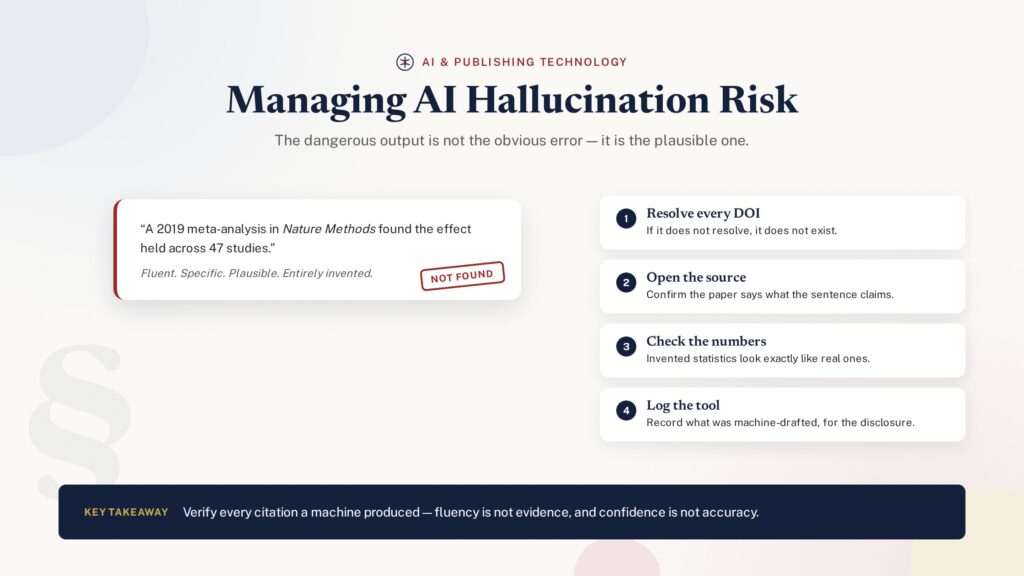
AI Hallucination Risk Management in Academic Publishing: Safeguarding Accuracy in Machine-Assisted Workflows
Reading time - 7 minutes
Introduction
As artificial intelligence becomes increasingly embedded in academic publishing—from manuscript screening and language editing to reviewer assistance and metadata generation—a new challenge has emerged: AI hallucinations. These are instances where AI systems generate plausible-sounding but incorrect, fabricated, or misleading information. In a domain built on precision, verification, and trust, even minor inaccuracies can have significant consequences. Managing AI hallucination risks is therefore becoming a critical priority for publishers, editors, and researchers alike.
Understanding AI Hallucinations in a Scholarly Context
AI hallucinations occur when machine learning models produce outputs that are not grounded in verified data. In academic publishing, this may manifest as fabricated references, incorrect interpretations of results, or misleading summaries of research findings. Unlike human errors, which often stem from oversight or misunderstanding, AI hallucinations can appear highly confident and coherent, making them harder to detect.
For example, an AI-assisted manuscript screening tool might incorrectly summarize a study’s methodology, or a language editing tool might introduce subtle inaccuracies while improving readability. If left unchecked, such errors can propagate through the publication process, ultimately affecting the integrity of the scholarly record.
Why Hallucination Risks Matter
The implications of AI hallucinations extend beyond simple factual errors. In academic publishing, they can:
- Undermine trust in editorial and peer review processes
- Introduce misinformation into the scientific literature
- Compromise reproducibility and transparency
- Damage the reputation of journals and publishers
- Mislead policymakers, practitioners, and the public
Given the growing reliance on AI tools, the risk is not hypothetical—it is systemic. As workflows become more automated, the scale and speed at which hallucinated content can spread also increase.
Points of Vulnerability in Publishing Workflows
AI hallucination risks can arise at multiple stages of the publishing process:
- Manuscript Preparation:
Authors using AI tools for drafting or editing may unknowingly include fabricated citations or misinterpreted findings. - Editorial Triage:
AI systems used to summarize or classify submissions may produce inaccurate representations of research content, influencing editorial decisions. - Peer Review Support:
AI-assisted reviewer tools may suggest incorrect critiques or overlook critical flaws due to hallucinated interpretations. - Copyediting and Production:
Automated editing tools may alter technical content in ways that introduce subtle inaccuracies. - Metadata and Indexing:
AI-generated keywords, abstracts, or classifications may misrepresent the research, affecting discoverability and citation.
Strategies for Managing Hallucination Risks
To address these challenges, academic publishers must adopt a multi-layered risk management approach that combines technology, policy, and human oversight.
- Human-in-the-Loop Verification
AI outputs should never be treated as authoritative without human review. Editors, reviewers, and authors must critically evaluate AI-generated content, especially in high-stakes areas such as data interpretation and citation accuracy. - Source Attribution and Traceability
AI tools should be designed to provide clear references or evidence for their outputs. Traceability mechanisms—such as linking generated summaries to original text segments—can help users যাচverify accuracy. - Restricted Use in High-Risk Tasks
Certain tasks, such as generating references or interpreting statistical results, should either be restricted or require mandatory human validation when AI tools are involved. - AI Usage Disclosure Policies
Journals should require authors and reviewers to disclose the use of AI tools in manuscript preparation or evaluation. Transparency enables accountability and helps editors assess potential risks. - Tool Selection and Validation
Not all AI tools are equally reliable. Publishers should evaluate tools based on their training data, accuracy benchmarks, and suitability for scholarly use. Regular audits and performance testing are essential. - Training and Awareness
Editors, reviewers, and authors must be educated about the limitations of AI, including hallucination risks. Training programs can help stakeholders पहचान common warning signs, such as overly generic statements or unverifiable references.
The Role of Technology in Risk Mitigation
Ironically, technology itself can also help mitigate hallucination risks. Emerging solutions include:
- Fact-checking algorithms that cross-verify AI outputs against trusted databases
- Reference validation tools that detect fabricated or incorrect citations
- Confidence scoring systems that indicate the reliability of AI-generated content
- Audit trails that document how AI outputs were generated and modified
These tools can act as safeguards, complementing human oversight rather than replacing it.
Ethical and Policy Considerations
Managing AI hallucination risks is not just a technical issue—it is also an ethical one. Publishers must consider:
- Responsibility: Who is accountable when AI-generated errors are published?
- Transparency: How much should readers know about AI involvement in the publication process?
- Equity: Do AI tools introduce biases or disadvantages for certain groups of researchers?
Clear policies and guidelines are essential to address these questions and ensure consistent practices across journals and disciplines.
Toward a Balanced Approach
While the risks are real, it is important not to dismiss the value of AI in academic publishing. When used responsibly, AI can enhance efficiency, improve accessibility, and support better decision-making. The goal is not to eliminate AI, but to integrate it thoughtfully and safely.
A balanced approach involves:
- Leveraging AI for low-risk, high-efficiency tasks
- Maintaining rigorous human oversight for critical decisions
- Continuously monitoring and improving AI performance
- Fostering a culture of skepticism and verification
Conclusion
AI hallucinations represent a new frontier in the ongoing effort to maintain research integrity in academic publishing. As machine-assisted workflows become the norm, the ability to पहचान, manage, and mitigate these risks will be essential.
By combining robust policies, technological safeguards, and informed human judgment, the academic publishing community can harness the benefits of AI while protecting the accuracy and credibility of the scholarly record. In doing so, it ensures that innovation does not come at the cost of trust—a principle that lies at the heart of all scientific communication.