
AI Co-Reviewers in Academic Publishing: Opportunities, Ethical Boundaries, and Policy Considerations
Reading time - 7 minutes
Introduction
The integration of artificial intelligence into academic publishing has rapidly expanded beyond manuscript screening and plagiarism detection into more nuanced areas—most notably, peer review. A new and evolving concept is the use of AI as a “co-reviewer”, where human reviewers rely on AI tools to assist in evaluating manuscripts. While this practice promises efficiency and analytical depth, it also raises critical ethical, practical, and policy-related questions that the scholarly community must address.
What Are AI Co-Reviewers?
AI co-reviewers are not independent decision-makers but tools used by human reviewers to support the evaluation process. These systems can summarize manuscripts, identify methodological inconsistencies, check statistical validity, flag potential ethical concerns, and even suggest improvements in clarity and structure.
Unlike fully automated review systems, AI co-reviewing operates as a hybrid model—combining human expertise with machine-assisted insights. This collaborative approach has the potential to reshape how peer review is conducted, particularly in high-volume publishing environments.
Opportunities and Advantages
One of the most immediate benefits of AI co-reviewers is efficiency. Reviewers often face time constraints, and AI tools can quickly process large volumes of text, highlight key findings, and identify inconsistencies. This allows reviewers to focus more on critical evaluation rather than administrative or repetitive tasks.
Another advantage is analytical support. AI can assist in checking statistical robustness, detecting image irregularities, and identifying potential data anomalies. This is particularly valuable in complex, data-heavy disciplines where manual verification can be time-consuming and error-prone.
AI also offers consistency in review quality. Human reviewers may vary in thoroughness and expertise, but AI tools can apply standardized checks across all submissions. This can help reduce variability and improve baseline quality in peer review reports.
Additionally, AI can support non-native English-speaking reviewers by improving language clarity and helping articulate feedback more effectively, thereby promoting inclusivity in the global research ecosystem.
Ethical Concerns and Risks
Despite these advantages, the use of AI co-reviewers introduces several ethical challenges. One of the most pressing concerns is confidentiality. Peer review is traditionally a confidential process, and uploading manuscripts into third-party AI tools may risk data exposure, especially if those tools store or learn from the input data.
Another critical issue is transparency. Should reviewers disclose the use of AI in their evaluations? If so, to what extent? Lack of transparency could undermine trust in the peer review process, particularly if editorial decisions are influenced by undisclosed AI-generated insights.
There is also the risk of over-reliance on AI. While AI can identify patterns and anomalies, it lacks contextual understanding, domain-specific judgment, and ethical reasoning. Blindly trusting AI outputs could lead to flawed evaluations or missed nuances in research interpretation.
Bias and fairness present additional concerns. AI systems are trained on existing datasets, which may contain inherent biases. If not carefully managed, these biases could influence review outcomes, potentially disadvantageous to certain research topics, methodologies, or geographic regions.
Authorship and Accountability
The introduction of AI into peer review raises questions about accountability. If a reviewer relies on AI-generated insights that turn out to be incorrect or misleading, who is responsible—the reviewer or the tool?
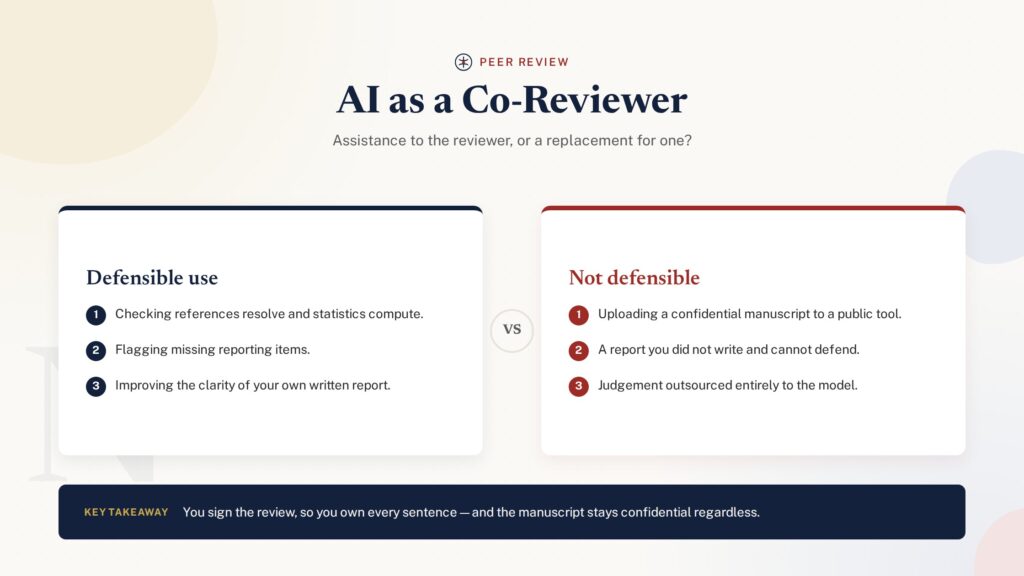
Current consensus suggests that human reviewers must retain full responsibility for their evaluations. AI should be viewed strictly as an assistive tool, not a substitute for expert judgment. This distinction is crucial to maintaining the integrity and accountability of the peer review process.
Policy and Governance Considerations
To address these challenges, journals and publishers must develop clear policies regarding the use of AI in peer review. These policies should cover several key areas:
- Disclosure Requirements: Reviewers should explicitly state whether AI tools were used and in what capacity.
- Approved Tools: Journals may provide a list of vetted AI tools that comply with data protection and confidentiality standards.
- Data Security Guidelines: Clear instructions should be provided on how to handle manuscript data when using AI tools.
- Training and Awareness: Reviewers should be educated on the capabilities and limitations of AI to ensure responsible use.
Establishing such frameworks will help balance innovation with ethical responsibility.
Implications for the Future of Peer Review
The use of AI co-reviewers is likely to become more widespread as tools become more sophisticated and accessible. This evolution could lead to a more augmented peer review system, where human expertise is enhanced by machine intelligence.
In the long term, AI could contribute to faster review cycles, improved detection of research flaws, and more structured feedback for authors. However, achieving these benefits will require careful governance to prevent misuse and maintain trust in the system.
There is also potential for standardization of review quality, where AI-assisted frameworks ensure that all manuscripts are evaluated against consistent criteria. This could be particularly beneficial in multidisciplinary and interdisciplinary research, where reviewer expertise may vary.
Striking the Right Balance
The key challenge lies in striking a balance between leveraging AI for efficiency and preserving the core values of peer review—confidentiality, fairness, accountability, and human judgment.
AI co-reviewers should be seen as partners, not replacements. Their role is to support, not supplant, the intellectual and ethical responsibilities of human reviewers.
Conclusion
AI co-reviewers represent a significant step forward in the evolution of academic publishing. They offer powerful tools to enhance efficiency, consistency, and analytical rigor in peer review. However, their adoption must be guided by clear ethical principles and robust policies.
As the scholarly community navigates this emerging landscape, the focus should remain on responsible integration—ensuring that technological innovation strengthens, rather than compromises, the integrity of academic publishing.
By embracing AI thoughtfully and transparently, academic publishing can move toward a more efficient, inclusive, and trustworthy peer review ecosystem.