
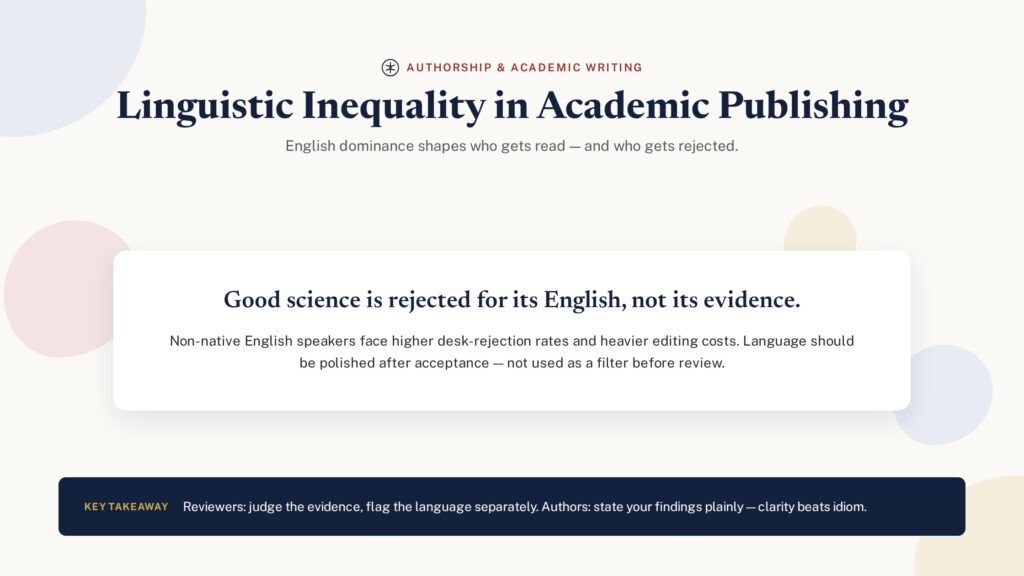
Linguistic Inequality in Academic Publishing: Addressing English Dominance and Its Impact on Global Research
Reading time - 7 minutes
Introduction
Academic publishing has long positioned itself as a global enterprise, aiming to disseminate knowledge across borders and disciplines. Yet, beneath this ideal lies a persistent structural imbalance: the dominance of the English language. While English has become the de facto lingua franca of science and scholarship, this reality introduces significant challenges for non-native English-speaking researchers. Linguistic inequality is not merely a matter of communication—it shapes access, visibility, evaluation, and ultimately, whose knowledge is recognized and valued.
The Roots of English Dominance
The rise of English as the primary language of academic publishing is historically tied to geopolitical, economic, and institutional factors. Major publishing houses, high-impact journals, and indexing databases are predominantly based in English-speaking regions. Over time, publishing in English became synonymous with international visibility, career advancement, and academic credibility.
While a shared language can facilitate global knowledge exchange, it also creates unintended barriers. Researchers from non-English-speaking backgrounds often face additional burdens that go beyond the quality of their research.
The Hidden Costs for Non-Native English Speakers
For many researchers, producing a manuscript in English requires significant time, effort, and financial resources. This includes language editing services, translation support, and repeated revisions to meet linguistic expectations. These added steps can delay submission timelines and increase the cost of publishing.
More importantly, linguistic challenges can influence how research is perceived during peer review. Studies have shown that manuscripts with grammatical imperfections or non-native phrasing may be judged more harshly, even when the underlying science is sound. This introduces a subtle but powerful bias, where language proficiency becomes entangled with perceptions of intellectual rigor.
Bias in Peer Review and Editorial Decision-Making
Linguistic inequality often manifests during the peer review process. Reviewers may unconsciously equate clarity of English with clarity of thought, leading to biased evaluations. Comments such as “poor language” or “needs major editing” can overshadow substantive contributions, shifting focus away from the research itself.
Editors, too, may rely on language quality as a proxy for readiness, sometimes issuing desk rejections based on writing style rather than scientific merit. This creates a systemic disadvantage for researchers who may have groundbreaking ideas but lack access to high-quality language support.
Impact on Knowledge Diversity
One of the most significant consequences of English dominance is the narrowing of global knowledge diversity. When researchers are discouraged from publishing due to language barriers, valuable regional insights, local data, and culturally specific perspectives may never reach the global stage.
This is particularly concerning in fields such as public health, social sciences, and environmental studies, where local context is critical. If only English-proficient voices are amplified, the academic record risks becoming skewed toward certain geographies and epistemologies.
The Marginalization of Non-English Research
In addition to barriers faced by authors, research published in other languages often remains underrepresented in global databases and citation networks. Even high-quality studies published in regional journals may be overlooked simply because they are not available in English.
This creates a feedback loop: English-language publications receive more citations, gain higher visibility, and reinforce their dominance, while non-English research remains marginalized. As a result, the global scholarly ecosystem becomes less inclusive and less representative.
Emerging Solutions and Inclusive Practices
Addressing linguistic inequality requires systemic change across multiple levels of academic publishing. Encouragingly, several strategies are gaining traction:
- Multilingual Publishing Models
Some journals are beginning to accept submissions in multiple languages or provide translated versions of published articles. This allows researchers to communicate findings both locally and globally without compromising accessibility. - Language-Agnostic Peer Review
Editors and reviewers are increasingly being encouraged to focus on scientific content rather than linguistic perfection. Clear guidelines can help separate language issues from research quality, ensuring fairer evaluations. - Editorial Language Support
Publishers can play a proactive role by offering in-house language editing services or partnering with affordable providers. This reduces the financial burden on authors and levels the playing field. - Reviewer Training on Bias Awareness
Training programs can help reviewers पहचान unconscious biases related to language. By recognizing these tendencies, reviewers can make more objective and equitable decisions. - Inclusion of Regional Journals in Indexing Systems
Expanding the coverage of non-English journals in major databases can improve visibility and citation potential for diverse research outputs.
Rethinking “Good Academic Writing”
Another important step is redefining what constitutes “good” academic writing. Clarity and precision are essential, but they do not require adherence to a single linguistic standard. Embracing diverse writing styles and expressions can enrich scholarly communication rather than diminish it.
After all, the primary goal of academic publishing is to share knowledge—not to enforce linguistic uniformity.
The Role of Technology
Advancements in language technologies, including AI-powered translation and editing tools, offer promising support for non-native English speakers. These tools can help improve readability and reduce language-related barriers. However, they must be used responsibly, ensuring that meaning and nuance are preserved.
Importantly, reliance on such tools should not shift the responsibility entirely onto authors. Structural inequities require structural solutions.
Toward a More Equitable Publishing Ecosystem
Linguistic inequality in academic publishing is a complex but addressable challenge. It calls for a shift in mindset—from viewing English proficiency as a gatekeeping mechanism to recognizing it as one of many tools for communication.
Creating a more inclusive system means valuing diverse voices, supporting equitable participation, and ensuring that knowledge is judged on its merit rather than its language. As academic publishing continues to evolve, addressing language-based disparities will be essential for building a truly global and representative scholarly community.
In the end, the strength of academic research lies in its diversity. By breaking down linguistic barriers, the publishing ecosystem can move closer to its core mission: advancing knowledge for all, by all.