
Protocol Deviations in Academic Publishing: Transparency, Accountability, and Editorial Oversight
Reading time - 7 minutes
Introduction
In an ideal research environment, studies follow pre-registered protocols with strict adherence to planned methodologies. However, in reality, deviations from original research protocols are common. These deviations may arise due to practical constraints, unforeseen challenges, or new insights discovered during the research process. While not inherently problematic, undisclosed or poorly explained protocol deviations can raise serious concerns about research integrity, reproducibility, and trust.
As academic publishing increasingly emphasizes transparency and accountability, the formal recognition and reporting of protocol deviations is emerging as a critical area of focus. Journals, editors, and reviewers now face the challenge of distinguishing between legitimate methodological evolution and questionable research practices. This blog explores the importance of protocol deviation disclosures, their implications, and how academic publishing can manage them responsibly.
What Are Protocol Deviations?
A protocol deviation occurs when a researcher departs from the original study design, methodology, or analysis plan that was pre-specified—often in a registered protocol, grant proposal, or ethics submission. These deviations can include:
- Changes in sample size or participant selection criteria
- Modifications to data collection methods
- Alterations in statistical analysis techniques
- Shifts in primary or secondary outcomes
Not all deviations are problematic. In fact, some are necessary and scientifically justified. For example, logistical barriers in fieldwork or unexpected data patterns may require researchers to adapt. The issue arises when such changes are not transparently disclosed or adequately justified in the final publication.
Why Protocol Transparency Matters
Transparent reporting of protocol deviations is essential for several reasons:
- Preserving Research Integrity
Undisclosed changes can create suspicion of selective reporting or “cherry-picking” results. When researchers modify outcomes or analyses after seeing the data, it may inflate the likelihood of statistically significant findings, compromising the study’s credibility. - Supporting Reproducibility
Reproducibility depends on accurate documentation of methods. If deviations are not reported, other researchers attempting to replicate the study may unknowingly follow an outdated or incomplete protocol. - Enabling Fair Peer Review
Reviewers rely on clarity and consistency to evaluate a manuscript. Transparent deviation statements allow reviewers to assess whether changes were justified and whether they impact the study’s conclusions. - Maintaining Public Trust
In fields like medicine, policy, and social sciences, research findings can influence real-world decisions. Transparency about deviations helps maintain trust among policymakers, practitioners, and the public.
Common Risks Associated with Undisclosed Deviations
Failure to report protocol deviations can lead to several risks:
- Outcome Switching: Changing primary outcomes to match favorable results
- HARKing (Hypothesizing After Results are Known): Presenting post hoc findings as if they were pre-planned
- Selective Reporting Bias: Omitting unfavorable or non-significant results
- Ethical Concerns: Especially in clinical research, deviations without proper reporting may violate ethical approvals
Such practices, whether intentional or accidental, can distort the scientific record and undermine the reliability of published research.
The Role of Journals and Editors
Academic journals play a central role in ensuring that protocol deviations are handled transparently and responsibly. Several strategies can strengthen editorial oversight:
- Mandatory Deviation Statements
Journals can require authors to include a dedicated “Protocol Deviations” section, clearly outlining any changes from the original plan along with justifications. - Linking to Registered Protocols
Encouraging or mandating protocol registration (e.g., clinical trial registries, pre-analysis plans) allows editors and reviewers to compare submitted manuscripts with original plans. - Reviewer Guidelines
Peer reviewers should be trained to identify inconsistencies between reported methods and expected protocols, and to request clarification when needed. - Editorial Audits
Random audits of accepted papers can help ensure compliance and identify patterns of undisclosed deviations.
Best Practices for Authors
Researchers can adopt several best practices to manage protocol deviations ethically:
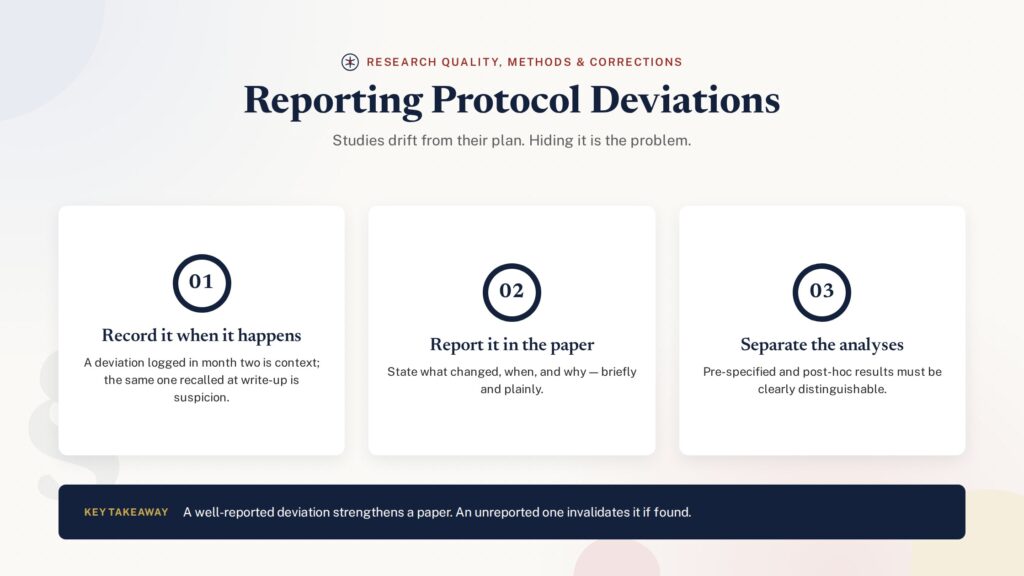
- Document Changes in Real Time: Keep a clear record of when and why deviations occur
- Justify Transparently: Explain the scientific or practical rationale behind each change
- Differentiate Exploratory vs Confirmatory Analyses: Clearly label analyses that were not part of the original plan
- Use Supplementary Materials: Provide detailed comparisons between original and revised methodologies
By proactively addressing deviations, authors can strengthen the credibility of their work rather than weaken it.
Emerging Trends and Solutions
The academic publishing ecosystem is beginning to recognize the importance of structured deviation reporting. Some emerging approaches include:
- Registered Reports Model
In this model, study protocols are peer-reviewed and accepted before data collection begins. Any deviations must be clearly justified and approved, reducing the risk of post hoc manipulation. - Versioned Protocols
Digital platforms now allow researchers to update protocols with version histories, creating a transparent audit trail of changes over time. - AI-Assisted Consistency Checks
AI tools are being explored to compare manuscripts against registered protocols, flagging potential inconsistencies for editorial review. - Standardized Reporting Frameworks
Guidelines similar to CONSORT or PRISMA may evolve to include explicit sections for protocol deviations across disciplines.
Balancing Flexibility and Accountability
It is important to recognize that rigid adherence to protocols is not always feasible or desirable. Science is inherently iterative, and flexibility can lead to valuable discoveries. However, flexibility must be balanced with accountability.
The goal is not to penalize researchers for adapting their methods, but to ensure that such adaptations are transparent, justified, and open to scrutiny. A culture that encourages honest reporting—rather than perfection—will ultimately strengthen the integrity of academic publishing.
Conclusion
Protocol deviations are a natural part of the research process, but how they are handled can significantly impact the credibility of scientific work. As academic publishing evolves toward greater transparency, the formal recognition and reporting of these deviations is becoming essential.
By implementing clear policies, fostering responsible author practices, and leveraging emerging technologies, the scholarly community can ensure that protocol deviations are not hidden liabilities but documented realities. In doing so, academic publishing moves closer to its core mission: advancing reliable, trustworthy, and reproducible knowledge.