
Ethical Implications of Citation Context Omission in Academic Publishing: Misinterpretation, Bias, and Scholarly Distortion
Reading time - 7 minutes
Introduction
Citations are the backbone of academic writing. They signal credibility, acknowledge prior work, and situate new research within an existing body of knowledge. However, while much attention has been given to how often research is cited, far less focus is placed on how it is cited. One emerging ethical concern in academic publishing is citation context omission—the practice of referencing a source without accurately representing its original meaning, limitations, or conclusions.
At first glance, this may appear to be a minor issue. After all, the cited work is still acknowledged. But when context is omitted or selectively presented, citations can become misleading tools that distort scientific understanding rather than clarify it.
What Is Citation Context Omission?
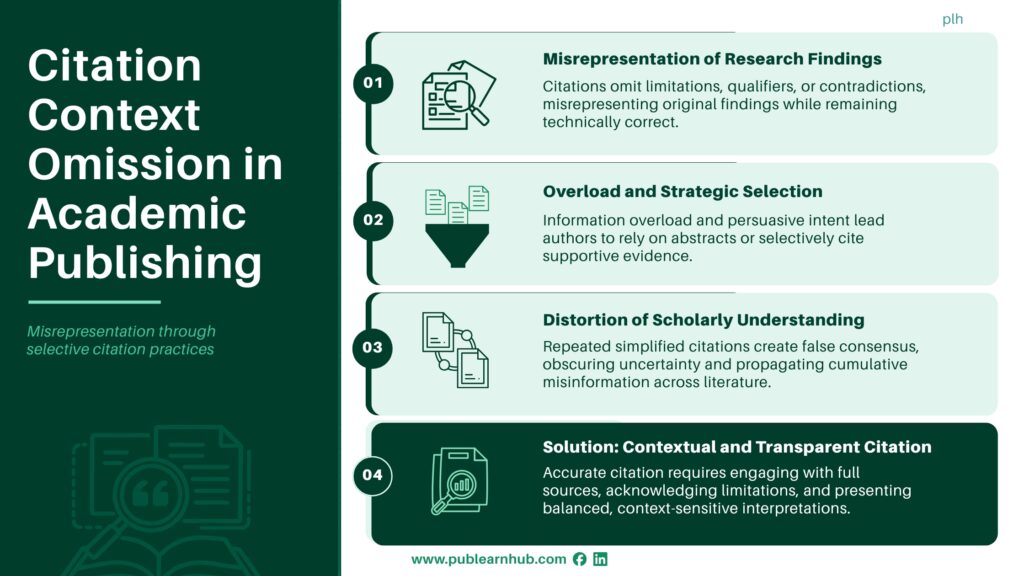
Citation context omission occurs when an author cites a study but fails to include the necessary background, qualifiers, or nuances that define the original findings. This can take several forms:
- Citing a paper’s conclusion without mentioning its limitations
- Referencing preliminary findings as if they were definitive
- Ignoring contradictory evidence within the same study
- Using a citation to support a claim it does not fully endorse
In such cases, the citation remains technically correct but becomes ethically problematic because it misrepresents the original research.
Why It Happens
There are multiple reasons why citation context omission occurs, ranging from unintentional oversight to strategic behavior.
In many cases, it is simply a result of information overload. Researchers are often required to review and cite large volumes of literature, making it difficult to engage deeply with every source. As a result, they may rely on abstracts or secondary citations, which can lead to incomplete understanding.
However, more concerning are intentional omissions. Authors may selectively cite evidence that supports their argument while ignoring conflicting details. This creates a biased narrative that strengthens their claims but weakens the integrity of the research.
There is also pressure to publish and persuade. In competitive academic environments, researchers may feel incentivized to present their work in the most convincing way possible. Selective citation becomes a subtle tool for shaping perception, even if it compromises accuracy.
The Risks to Research Integrity
The consequences of citation context omission extend far beyond individual papers. Over time, these small distortions can accumulate, leading to widespread misinformation within a field.
One major risk is the creation of false consensus. When multiple papers cite the same study in a simplified or biased way, it can appear as though there is strong agreement on a topic—even if the original evidence is more nuanced or contested.
This problem is particularly serious in fields that inform policy or clinical decisions. Misrepresented citations can influence guidelines, funding priorities, and public understanding, amplifying the impact of the original omission.
Citation context omission also undermines reproducibility. Researchers who rely on misinterpreted citations may design studies based on incorrect assumptions, leading to flawed methodologies and inconsistent results.
Furthermore, it affects author recognition and fairness. When a study is cited without proper context, its contributions—and limitations—are not accurately represented. This can distort how the work is perceived and evaluated within the academic community.
The Role of Reviewers and Editors
Addressing citation context omission is not solely the responsibility of authors. Peer reviewers and editors play a critical role in identifying and correcting misleading citations.
Reviewers should evaluate not just the presence of citations, but their accuracy and relevance. This includes checking whether cited studies genuinely support the claims being made and whether important nuances have been omitted.
Editors, on the other hand, can establish clear guidelines for responsible citation practices. These may include encouraging authors to:
- Summarize key limitations of cited studies
- Avoid overgeneralizing findings
- Include balanced references, especially in controversial areas
However, detecting citation context omission is not always straightforward. It requires subject-matter expertise and careful reading, which can be challenging in high-volume review environments.
Technological Solutions and Their Limits
Recent advances in publishing technology offer potential tools for addressing this issue. Citation context analysis systems can examine how references are used within a manuscript, identifying patterns such as overly positive or selective citations.
Some tools even compare the citing statement with the original source to detect mismatches or misinterpretations. These systems can serve as valuable aids for reviewers and editors, highlighting areas that require closer scrutiny.
However, technology is not a complete solution. Understanding context often requires human judgment, especially in complex or interdisciplinary research. Automated tools may flag potential issues, but they cannot fully replace critical evaluation.
Encouraging Ethical Citation Practices
Improving citation integrity requires a cultural shift within academic publishing. Researchers must view citations not just as formal requirements, but as ethical responsibilities.
This begins with engaging deeply with sources. Whenever possible, authors should read full papers rather than relying on abstracts or secondary references. Understanding the methodology, limitations, and context of a study is essential for accurate citation.
Transparency is also key. Authors should avoid overstating the strength of evidence and be willing to acknowledge uncertainty or disagreement within the literature.
Training and education can further support ethical practices. Early-career researchers, in particular, benefit from guidance on how to interpret and cite sources responsibly.
Conclusion
Citation context omission is a subtle but significant threat to research integrity. Unlike overt misconduct, it often goes unnoticed, quietly shaping narratives and influencing how knowledge evolves. Yet its impact can be profound, contributing to bias, misinterpretation, and the erosion of trust in academic literature.
As scholarly communication becomes more complex and interconnected, the accuracy of citations matters more than ever. By prioritizing context, transparency, and critical engagement, the academic community can ensure that citations fulfill their true purpose—not just linking research, but representing it faithfully.