
Ethical Risks of AI-Generated Literature Reviews in Academic Publishing: Comprehensiveness, Bias, and Scholarly Integrity
Reading time - 7 minutes
Introduction
The rapid integration of artificial intelligence into academic workflows has transformed how researchers gather, synthesize, and present knowledge. One emerging application is the use of AI tools to generate literature reviews—summaries of existing research that form the backbone of scholarly articles. While these tools offer speed and efficiency, they also introduce a new set of ethical risks that challenge the foundations of academic rigor and integrity.
A literature review is not merely a summary of prior work; it is a critical, interpretive process that shapes how research questions are framed, how gaps are identified, and how new contributions are positioned. When AI systems take on this role, the risk is not just technical error but a deeper distortion of scholarly understanding.
The Appeal of AI-Generated Reviews
AI-generated literature reviews are appealing for several reasons. They can process vast amounts of information in seconds, identify patterns across studies, and produce coherent summaries that would take human researchers days or weeks to compile. For early-career researchers or those working under time constraints, this capability can be especially attractive.
These tools can also help overcome access barriers by summarizing complex or interdisciplinary research into more digestible formats. In theory, they democratize knowledge synthesis by making it easier for researchers to engage with large bodies of literature.
However, this convenience comes with trade-offs that are often underestimated.
The Risk of Incomplete or Selective Coverage
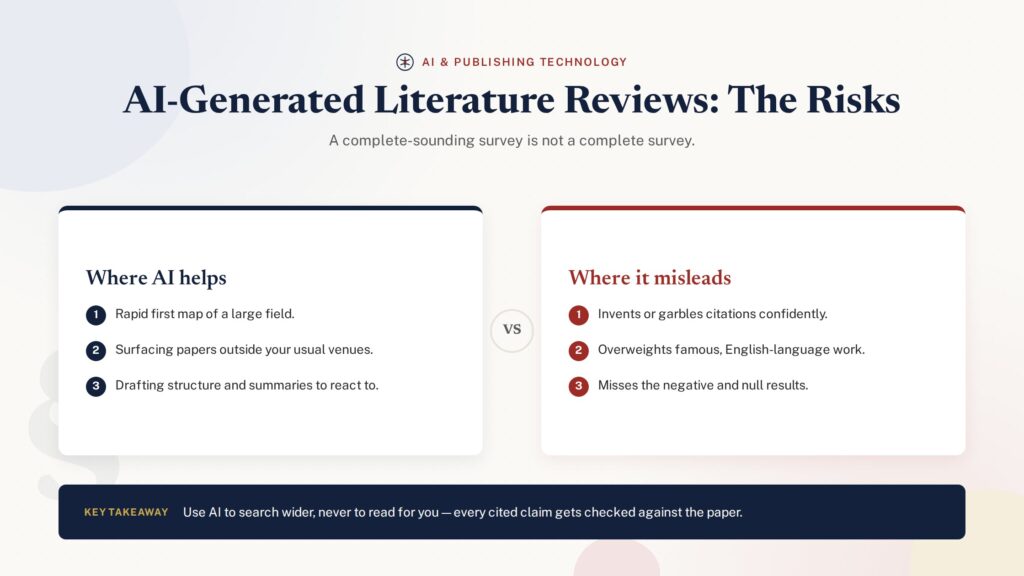
One of the most significant ethical concerns is the risk of incomplete literature coverage. AI systems rely on training data, indexing sources, and algorithmic prioritization, which may not capture the full scope of relevant research. As a result, important studies—especially those from less prominent journals, non-English sources, or emerging fields—may be excluded.
This selective visibility can distort the perceived state of knowledge. A literature review that appears comprehensive may, in reality, reflect only a narrow subset of available research. This is particularly problematic in fields where missing even a few key studies can alter the interpretation of findings or the identification of research gaps.
Algorithmic Bias and Reinforced Narratives
AI-generated reviews are also susceptible to algorithmic bias. These systems often prioritize highly cited, widely indexed, or easily accessible papers, reinforcing dominant narratives while marginalizing alternative perspectives. Over time, this can create a feedback loop where already prominent research becomes even more visible, while less-cited but potentially valuable work remains overlooked.
Such bias is not merely a technical limitation—it has ethical implications. Literature reviews shape the direction of future research, funding decisions, and policy development. If AI tools systematically favor certain viewpoints, they risk narrowing the diversity of scholarly discourse.
Loss of Critical Interpretation
Perhaps the most subtle yet profound risk is the loss of critical interpretation. A strong literature review does more than summarize—it evaluates methodologies, identifies inconsistencies, and synthesizes insights across studies. AI-generated content, while fluent, often lacks this depth of critical engagement.
There is a danger that researchers may rely on AI outputs without enough scrutiny, treating them as authoritative summaries rather than preliminary drafts. This can lead to superficial analyses, where the nuance and complexity of the literature are lost.
Moreover, AI systems may generate plausible-sounding but inaccurate statements, including misinterpretations of study findings or fabricated connections between sources. Without careful human oversight, these errors can propagate into published work.
Authorship and Accountability Concerns
The use of AI in literature reviews also raises questions about authorship and accountability. If a significant portion of a review is generated by an AI system, to what extent can the human author claim ownership of the analysis? More importantly, who is responsible for errors or omissions?
Current publishing norms place full responsibility on authors, regardless of the tools they use. However, as AI-generated content becomes more sophisticated, distinguishing between human and machine contributions becomes increasingly difficult. This creates a grey area in accountability that journals and institutions must address.
Transparency and Disclosure
A related issue is whether and how the use of AI tools should be disclosed. While some journals are beginning to require transparency to AI assistance, practices remain inconsistent. Without clear disclosure, readers may assume that a literature review reflects comprehensive human scholarship when it may, in fact, be partially automated.
Transparency is essential not only for ethical reasons but also for interpretive clarity. Knowing that AI tools were used can help readers critically evaluate the scope and limitations of the review.
Mitigating the Risks
To harness the benefits of AI-generated literature reviews while minimizing their risks, several best practices should be adopted.
First, AI outputs should be treated as starting points, not final products. Researchers must actively verify sources, cross-check findings, and ensure that key studies are not omitted.
Second, diverse and inclusive search strategies should complement AI tools. Manual searches, expert consultations, and database cross-referencing can help counteract algorithmic bias and ensure broader coverage.
Third, clear disclosure policies should be implemented. Authors should specify how AI tools were used in the literature review process, enabling transparency and accountability.
Fourth, journals should develop guidelines for evaluating AI-assisted reviews, including expectations for critical analysis, source verification, and completeness.
A Tool, Not a Substitute
AI-generated literature reviews represent a powerful tool, but they cannot replace the intellectual labor that defines scholarly work. The risk is not that AI will write literature reviews, but that researchers may gradually relinquish the critical thinking required to produce them.
At its core, a literature review is an act of scholarly judgment—deciding what matters, what connects, and what remains unresolved. These are inherently human tasks that require context, expertise, and critical reflection.
Conclusion
The integration of AI into literature review writing is both an opportunity and a challenge. While it can enhance efficiency and accessibility, it also introduces risks related to bias, incompleteness, and loss of critical depth.
As academic publishing continues to evolve, the responsible use of AI will depend on maintaining a clear boundary: using technology to support, not replace, scholarly judgment. By prioritizing transparency, accountability, and rigorous evaluation, the academic community can ensure that literature reviews remain a reliable foundation for knowledge advancement.