
Dynamic Citation Updating in Academic Publishing: Keeping References Current in a Rapidly Evolving Research Landscape
Reading time - 7 minutes
Introduction
In today’s fast-paced research environment, knowledge evolves at an unprecedented rate. New studies are published daily, preprints gain traction before formal peer review, and previously accepted findings are sometimes revised or even overturned. In this context, one emerging concept in academic publishing is dynamic citation updating—the practice of allowing references within a published article to be updated over time to reflect the most current and relevant research.
Traditionally, academic articles are treated as static records. Once published, their content—including citations—remains fixed. While this ensures stability and consistency, it also creates a disconnect between the article and the evolving body of knowledge it references. Dynamic citation updating aims to bridge this gap by introducing controlled mechanisms to keep references current without compromising the integrity of the scholarly record.
Why Static Citations Fall Short
The conventional citation model assumes that the references included at the time of publication will remain relevant indefinitely. However, this is rarely the case. In rapidly advancing fields such as medicine, artificial intelligence, and climate science, new findings can quickly render earlier studies outdated or incomplete.
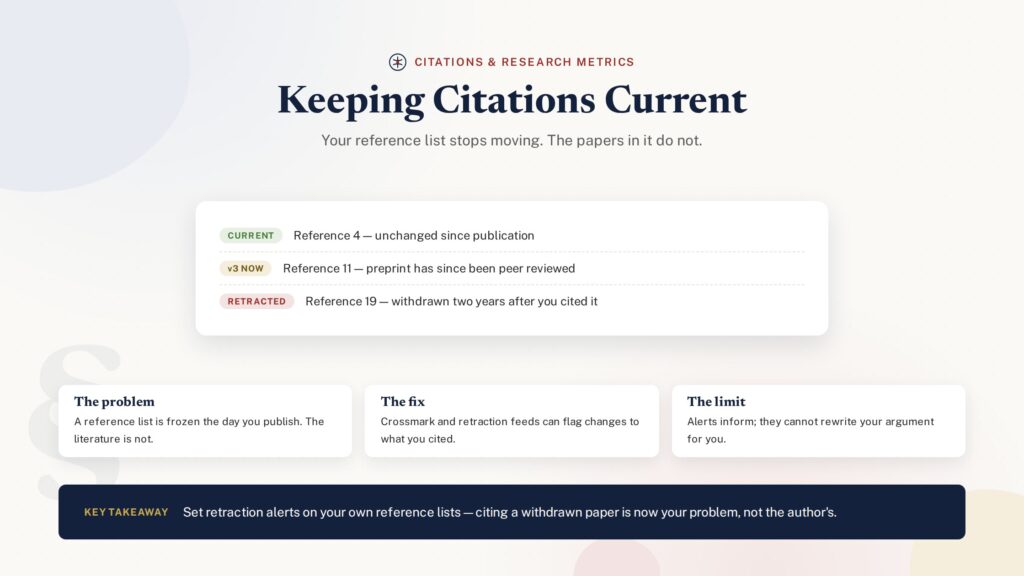
For example, a review article published today may miss several important studies released shortly afterward. Similarly, a cited paper may later be corrected, retracted, or challenged by new evidence. In such cases, the original article continues to point readers toward outdated or potentially misleading sources.
This limitation affects not only readers but also researchers who rely on existing literature to build new studies. Static citations can inadvertently perpetuate outdated knowledge, slowing the progress of research and reducing the accuracy of scholarly communication.
What Is Dynamic Citation Updating?
Dynamic citation updating refers to systems that allow references within a published article to be modified, supplemented, or annotated after publication. Rather than altering the original content invisibly, these updates are typically managed through version control, annotations, or linked updates that maintain transparency.
There are several possible models for implementing this approach:
- Annotated Citations: Adding notes to existing references indicating updates, corrections, or newer related studies.
- Supplementary Reference Lists: Appending newly relevant citations without altering the original list.
- Versioned Articles: Publishing updated versions of the article with revised references while preserving earlier versions.
These methods aim to enhance the relevance of citations while preserving the historical context of the original publication.
Benefits for Researchers and Readers
Dynamic citation updating offers several advantages. First, it improves the accuracy and relevance of academic work. Readers gain access to the most up-to-date information without needing to conduct separate literature searches.
Second, it supports living scholarship, particularly in fields where evidence evolves continuously. Review articles, meta-analyses, and policy papers can remain useful for longer periods if their references are regularly updated.
Third, it enhances research efficiency. By integrating updates directly into existing articles, researchers can save time and focus on analysis rather than repeatedly reconstructing literature reviews.
Finally, dynamic citation systems can improve research transparency by highlighting how knowledge evolves over time. Readers can see not only what was known at the time of publication but also how the evidence base has changed since.
Challenges in Implementation
Despite its potential, dynamic citation updating presents several challenges. One of the most significant is maintaining version control. If citations change over time, it becomes difficult to ensure that readers are referencing the same version of an article. This can create confusion in academic discourse, where precise citation is essential.
Another challenge is editorial responsibility. Deciding which new references should be added, and when, requires careful judgment. Without clear guidelines, updates may become inconsistent or biased, favoring certain studies over others.
There is also the issue of citation inflation. Continuously adding references could lead to excessively long and unwieldy reference lists, reducing clarity rather than improving it.
Technical infrastructure is another barrier. Implementing dynamic updates requires advanced publishing platforms capable of tracking changes, managing versions, and displaying updates in a user-friendly manner. Not all journals have access to such resources.
Balancing Stability and Flexibility
A central tension in dynamic citation updating is the need to balance stability with flexibility. Academic publishing relies on stable records that can be reliably cited and archived. At the same time, the growing pace of research demands more adaptable systems.
One solution is to adopt hybrid models. For example, the original article can remain unchanged, while updates are provided through linked annotations or separate “update layers.” This preserves the integrity of the original publication while allowing readers to access newer information.
Another approach is to limit updates to specific article types, such as review papers or guidelines, where the benefits of dynamic citations are most pronounced. This targeted implementation can reduce complexity while maximizing impact.
The Role of Technology
Advances in digital publishing technology are making dynamic citation updating increasingly feasible. Tools such as persistent identifiers, automated alerts, and linked databases can help track changes in cited literature and notify authors or editors when updates are needed.
Artificial intelligence can also play a role by identifying newly published studies مرتبط to existing citations. However, human oversight remains essential to ensure that updates are relevant, accurate, and unbiased.
Integration with digital libraries and indexing services can further enhance the effectiveness of dynamic citations, ensuring that updates are visible across platforms and accessible to a wide audience.
Looking Ahead
Dynamic citation updating represents a shift toward more adaptive and responsive scholarly communication. As research continues to accelerate, the limitations of static publishing models become increasingly apparent.
However, adopting this approach requires careful consideration of governance, transparency, and technical feasibility. Without clear standards, dynamic updates could introduce confusion rather than clarity.
The future of academic publishing may not lie in fully dynamic articles, but in systems that combine the reliability of static records with the responsiveness of digital updates. By thoughtfully integrating dynamic citation practices, publishers can create a more accurate, relevant, and connected research ecosystem.
In a world where knowledge is constantly evolving, the way we reference that knowledge must evolve as well.