
Ethical Risks of “Salami Slicing” in Academic Publishing: Fragmentation, Redundancy, and Research Integrity
Reading time - 7 minutes
Introduction
In the competitive landscape of academic publishing, researchers face increasing pressure to publish frequently and demonstrate continuous productivity. While this pressure can drive innovation, it can also lead to questionable practices—one of which is “salami slicing.” This term refers to the practice of dividing a single substantial research study into multiple smaller papers, each reporting only a portion of the findings. Although not always explicitly prohibited, salami slicing raises significant ethical concerns regarding research integrity, transparency, and the efficient use of scholarly resources.
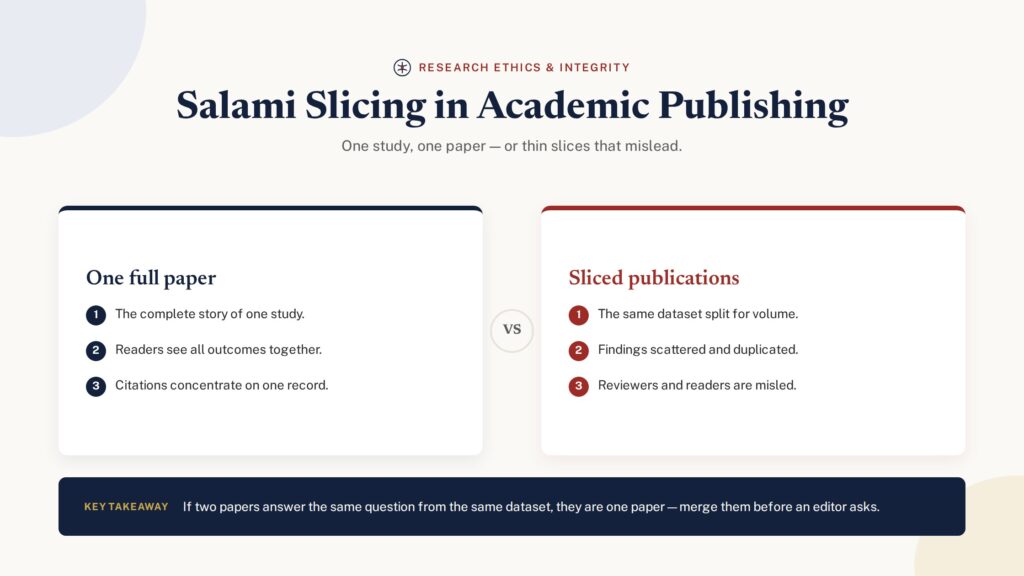
At its core, salami slicing is about maximizing output from a single dataset or research project. Instead of presenting a comprehensive and cohesive analysis in one publication, authors split the findings into several papers to increase their publication count. While this may seem like a strategic approach to career advancement, it can compromise the clarity, value, and reliability of the research record.
Why Salami Slicing Happens
The primary driver behind salami slicing is the “publish or perish” culture in academia. Hiring decisions, promotions, and funding opportunities are often influenced by the number of publications a researcher has produced. This creates an incentive to prioritize quantity over quality.
In some cases, researchers justify salami slicing by arguing that different aspects of a study may be relevant to different audiences or journals. For example, a large interdisciplinary study might contain findings that could be of interest to separate fields. When done carefully and transparently, dividing research into multiple papers can be acceptable. However, problems arise when the segmentation is artificial, redundant, or misleading.
The Problem of Fragmentation
One of the major risks of salami slicing is the fragmentation of knowledge. Instead of presenting a complete and integrated understanding of a research problem, findings are scattered across multiple publications. This makes it difficult for readers to grasp the full scope of the study and can lead to incomplete or distorted interpretations.
Fragmentation also places an additional burden on researchers conducting literature reviews or meta-analyses. They must identify and piece together related papers that may not clearly indicate they originate from the same dataset. This increases the risk of double-counting data or drawing incorrect conclusions based on partial information.
Redundancy and Self-Plagiarism
Salami slicing often involves a degree of redundancy. Multiple papers derived from the same study may contain overlapping introductions, methodologies, or background information. In some cases, this overlap can cross into self-plagiarism, where authors reuse their own previously published text without proper citation or acknowledgment.
Redundant publications can dilute the novelty of research contributions. Journals and reviewers expect submissions to offer distinct and meaningful insights. When multiple papers present only incremental differences, they may contribute little new knowledge while occupying valuable editorial and peer review resources.
Impact on Research Integrity
Beyond issues of redundancy and fragmentation, salami slicing can undermine research integrity. By selectively reporting results across multiple papers, authors may unintentionally (or deliberately) create a skewed representation of their findings. For instance, positive or statistically significant results may be highlighted in separate publications, while less favorable outcomes are minimized or omitted.
This selective reporting can contribute to publication bias, where the literature disproportionately reflects positive findings. Over time, this distorts the evidence base and can influence policy decisions, clinical practices, or future research directions.
Ethical Boundaries and Acceptable Practices
It is important to recognize that not all multi-paper outputs from a single project are unethical. Large-scale studies, longitudinal research, or complex datasets may legitimately generate multiple publications. The key distinction lies in transparency, coherence, and the uniqueness of each contribution.
Ethically acceptable practices include:
- Clearly referencing related publications derived from the same dataset
- Ensuring each paper addresses a distinct research question or hypothesis
- Avoiding unnecessary overlap in content and analysis
- Providing sufficient context for readers to understand how each paper fits into the broader study
Journals and publishers increasingly require authors to disclose related submissions and prior publications to prevent redundant or fragmented reporting.
Editorial and Peer Review Challenges
Detecting salami slicing is not always straightforward. Editors and reviewers may not have access to all related manuscripts or may be unaware that multiple submissions originate from the same dataset. This makes it difficult to assess the novelty and independence of a paper.
Technological tools, such as plagiarism detection software, can identify textual overlap but may not detect conceptual redundancy or dataset reuse. As a result, addressing salami slicing often relies on author honesty and clear disclosure.
Some journals have begun implementing stricter policies, requiring authors to provide detailed information about related works and datasets. Cross-journal collaboration and shared databases may also help identify patterns of fragmented publishing.
The Way Forward
Addressing the ethical risks of salami slicing requires a cultural shift in how academic success is measured. Moving away from purely quantitative metrics toward qualitative assessments of research impact can reduce the incentive to fragment studies unnecessarily.
Institutions, funders, and publishers all play a role in this transition. Encouraging comprehensive reporting, valuing replication and negative results, and recognizing diverse research contributions can help create a more balanced and ethical publishing environment.
Education is equally important. Early-career researchers should be trained to understand the ethical implications of publication practices and to prioritize integrity over output volume.
Conclusion
Salami slicing sits in a grey area of academic publishing—often tolerated, sometimes justified, but frequently problematic. While it may offer short-term gains in publication counts, it can lead to long-term consequences for research quality, transparency, and trust.
The goal of academic publishing is not merely to produce more papers, but to advance knowledge in a meaningful and coherent way. By emphasizing transparency, originality, and responsible reporting, the academic community can ensure that research outputs serve their true purpose: contributing reliable and valuable insights to the global body of knowledge.