
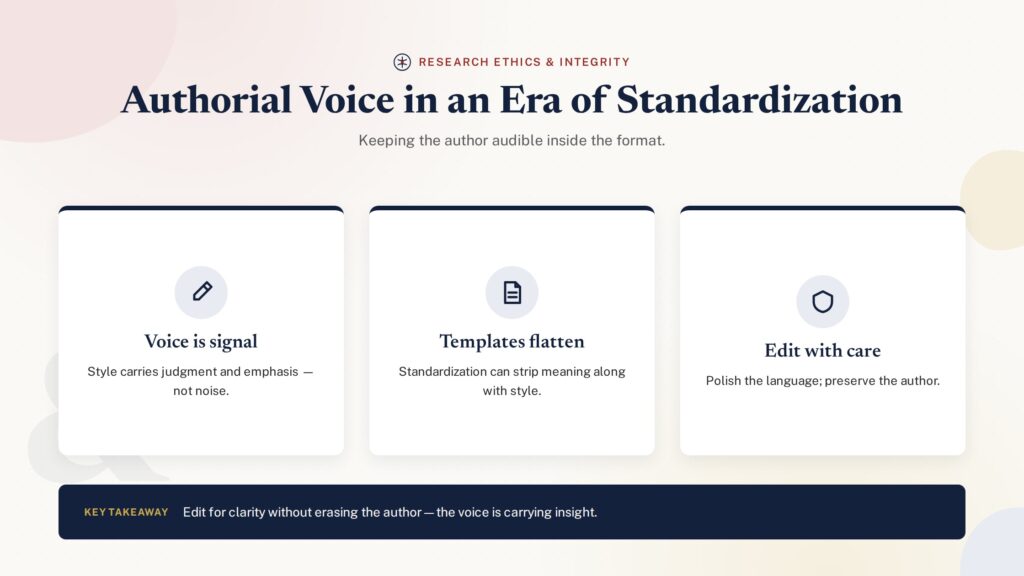
Authorial Voice in Academic Publishing: Preserving Individual Expression in an Era of Standardization
Reading time - 7 minutes
Introduction
Academic writing has long been associated with precision, clarity, and objectivity. Over time, these expectations have led to increasing standardization in how research is written, structured, and presented. While consistency helps maintain quality and readability across disciplines, it also raises an important question: what happens to the author’s voice?
Authorial voice refers to the unique style, tone, and intellectual presence a researcher brings to their writing. It reflects how arguments are framed, how ideas are connected, and how the narrative of research unfolds. In recent years, however, this voice is increasingly at risk of being diluted—shaped by strict journal guidelines, editorial preferences, and the growing use of automated writing tools.
The Rise of Standardization
Standardization in academic publishing is not inherently problematic. Guidelines for structure—such as the widely used IMRaD format (Introduction, Methods, Results, and Discussion)—help ensure that research is presented logically and transparently. Similarly, editorial standards for language and formatting improve accessibility, particularly for global audiences.
However, as these standards become more rigid, they can unintentionally suppress individuality. Authors often feel compelled to conform to a “safe” writing style that prioritizes neutrality over expression. This can lead to articles that are technically sound but stylistically indistinguishable from one another.
The pressure to publish in high-impact journals further reinforces this trend. Researchers may adapt their writing to match perceived editorial expectations, sometimes at the cost of clarity, creativity, or critical nuance.
Why Authorial Voice Matters
At first glance, the idea of “voice” in academic writing may seem secondary to the content itself. However, authorial voice plays a crucial role in how research is understood and evaluated.
A strong voice enhances clarity and engagement. It helps guide readers through complex arguments, making connections more intuitive and interpretations more compelling. In contrast, overly standardized writing can feel mechanical, making it harder for readers to grasp the significance of the research.
Voice also contributes to intellectual transparency. The way an author frames a problem, interprets findings, or acknowledges limitations reflects their analytical perspective. Removing this voice can create an illusion of objectivity while masking the interpretive nature of research.
Moreover, preserving voice supports diversity in scholarly communication. Researchers from different cultural, linguistic, and disciplinary backgrounds bring varied ways of thinking and expressing ideas. Excessive standardization risks flattening this diversity, leading to a more homogeneous academic landscape.
The Influence of AI and Editing Tools
The growing use of AI-assisted writing and editing tools adds another layer to this issue. These tools often optimize for clarity, grammar, and fluency—but in doing so, they may also standardize tone and phrasing.
While such tools are valuable for improving readability, especially for non-native English speakers, they can inadvertently erase stylistic nuances. Over-reliance on automated suggestions may result in writing that is polished but lacks distinctiveness.
Similarly, professional editing services may impose uniform stylistic norms, further aligning manuscripts with a generalized “academic voice.” While this can increase acceptance rates, it also raises concerns about authenticity and ownership of expression.
Editorial Expectations and Constraints
Editors and reviewers play a significant role in shaping authorial voice. Feedback often focuses on clarity, conciseness, and adherence to journal style. While these are valid concerns, they can sometimes lead to over-editing, where unique phrasing or unconventional structures are removed in favor of standard formulations.
In some cases, reviewers may equate unfamiliar writing styles with lack of rigor, even when the underlying research is strong. This can disadvantage authors who experiment with narrative forms or who come from different academic traditions.
Balancing editorial quality control with respect for authorial voice is a delicate task. Excessive intervention risks turning diverse contributions into uniform outputs, whereas too little oversight may compromise clarity and coherence.
Finding the Right Balance
The challenge is not to reject standardization altogether, but to find a balance that preserves both consistency and individuality. Several approaches can help achieve this.
First, journals can adopt flexible style guidelines that prioritize clarity without enforcing rigid uniformity. Allowing some variation in tone and structure can encourage more expressive and engaging writing.
Second, reviewers can be trained to distinguish between issues of clarity and differences in style. Not all deviations from standard phrasing are problematic; some may enhance the readability or impact of the work.
Third, authors should be encouraged to view writing as an integral part of scholarship, not just a technical requirement. Developing a clear and confident voice can improve both the quality and the influence of their research.
Finally, transparency in the use of AI and editing tools can help maintain authenticity. Rather than relying on these tools to shape the entire manuscript, authors can use them selectively while retaining control over their narrative style.
The Future of Academic Expression
As academic publishing continues to evolve, the question of authorial voice will become increasingly important. In a landscape shaped by automation, metrics, and global standardization, preserving individuality is essential for maintaining the richness of scholarly communication.
Research is not just about data—it is about interpretation, argument, and insight. These elements are inherently tied to how ideas are expressed. A purely standardized approach risks reducing academic writing to a formula, where originality is confined to results rather than communication.
Conclusion
Authorial voice is more than a stylistic preference; it is a fundamental aspect of how knowledge is created and shared. While standardization ensures clarity and consistency, it should not come at the expense of individuality and intellectual expression.
By recognizing the value of voice and creating space for it within editorial frameworks, academic publishing can support more engaging, diverse, and meaningful scholarship. In doing so, it ensures that research is not only accurate but also thoughtfully communicated—reflecting the human insight behind every study.