
Citation Manipulation by Editors in Academic Publishing: Ethics, Detection, and Preventive Safeguards
Reading time - 7 minutes
Introduction
Citations are the backbone of academic publishing. They not only acknowledge prior work but also shape research visibility, journal rankings, and academic careers. However, while much attention has been given to unethical citation practices among authors—such as citation cartels or excessive self-citation—an equally concerning issue often remains underexplored: citation manipulation by editors.
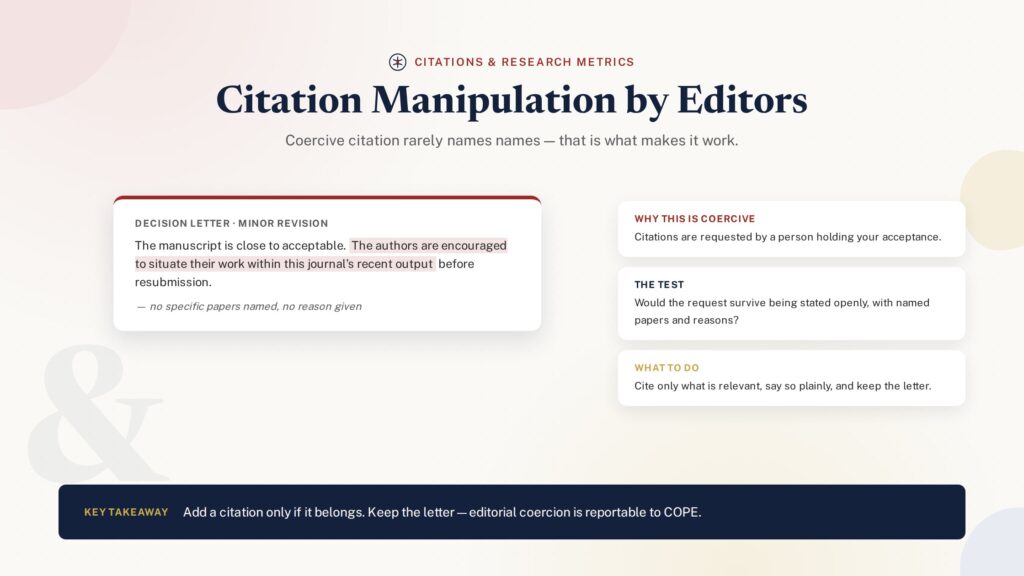
Editorial influence over citations occurs when journal editors, intentionally or indirectly, pressure authors to add unnecessary references—often from the same journal—to boost citation metrics. While sometimes framed as “suggestions” to improve manuscript quality, these practices can cross ethical boundaries and compromise the integrity of scholarly communication.
Understanding Editorial Citation Manipulation
Editors play a critical role in guiding manuscripts toward publication. Their feedback is expected to improve clarity, rigor, and contextual relevance. However, problems arise when citation recommendations are driven not by academic merit but by metric-based incentives.
This manipulation can take several forms:
- Requesting authors to cite additional articles from the same journal without clear relevance
- Encouraging excessive citations to boost impact factors
- Implicitly linking acceptance decisions to compliance with citation requests
Such practices are often subtle. Authors, particularly early-career researchers, may feel obligated to comply with editorial suggestions to avoid rejection or delays. Over time, this creates a system where citation patterns are shaped not by scholarly value but by strategic interests.
Why This Practice Is Concerning
The implications of editorial citation manipulation extend beyond individual manuscripts. At a systemic level, it distorts the academic record by artificially inflating the visibility and perceived impact of certain journals or articles.
One major concern is the erosion of citation integrity. Citations are meant to reflect intellectual influence and relevance. When they are added for strategic reasons, they lose their meaning as indicators of scholarly contribution.
This practice also contributes to metric inflation. Journal impact factors and other citation-based metrics are widely used in research evaluation, funding decisions, and institutional rankings. Manipulating citations undermines the reliability of these metrics and can create unfair advantages.
Furthermore, editorial pressure can compromise author autonomy. Researchers should have the freedom to decide which sources are relevant to their work. When citation decisions are influenced by editorial authority rather than academic judgment, it weakens the independence of the research process.
The Grey Area: Legitimate vs. Manipulative Suggestions
Not all editorial citation recommendations are unethical. In many cases, editors genuinely suggest relevant literature that authors may have overlooked. The challenge lies in distinguishing between constructive guidance and coercive practices.
Legitimate citation suggestions typically:
- Are directly relevant to the manuscript’s topic
- Improve the depth or context of the research
- Are presented as optional recommendations
Manipulative practices, on the other hand, often:
- Lack clear justification or relevance
- Involve multiple citations from the same journal without necessity
- Are framed in a way that implies obligation
The distinction may seem straightforward, but in practice, it can be difficult for authors to assess intent—especially when power dynamics are involved.
Detecting Editorial Citation Manipulation
Identifying such practices requires both qualitative and quantitative approaches. Journals, publishers, and indexing bodies are increasingly using data analytics to monitor unusual citation patterns.
Some red flags include:
- Unusually high rates of journal self-citation
- Sudden spikes in citations to specific articles or issues
- Patterns of repeated citation requests across multiple manuscripts
In addition to data analysis, author feedback plays a crucial role. Anonymous surveys and reporting mechanisms can help uncover patterns of editorial behavior that may not be visible through metrics alone.
Indexing services and organizations are also beginning to scrutinize journals for unethical citation practices. In extreme cases, journals may face penalties such as removal from indexing databases or suppression of impact factors.
Preventive Safeguards and Best Practices
Addressing editorial citation manipulation requires a combination of policy, transparency, and accountability.
Clear editorial guidelines are essential. Journals should explicitly state that citation recommendations must be based on relevance and academic value, not metric considerations. These policies should be publicly accessible and consistently enforced.
Transparency in peer review can also help. When citation suggestions are documented and visible—either through open peer review or detailed decision letters—it becomes easier to assess their legitimacy.
Author empowerment is another key factor. Authors should feel confident in questioning or declining citation requests that do not align with their work. Providing guidance on how to respond to such situations can help reduce undue pressure.
Independent oversight mechanisms, such as editorial audits or ethics committees, can further strengthen accountability. Regular reviews of citation patterns and editorial practices can identify potential issues before they become systemic.
The Role of the Research Community
Ultimately, preventing citation manipulation is a shared responsibility. Editors, authors, publishers, and institutions all play a role in maintaining ethical standards.
Editors must prioritize scholarly integrity over metric performance. Authors should critically evaluate citation suggestions and advocate for relevance. Publishers need to implement robust monitoring systems, while institutions should avoid over-reliance on citation-based metrics in evaluation processes.
Conclusion
Citation manipulation by editors is a subtle yet significant threat to the credibility of academic publishing. While it may offer short-term gains in metrics, it undermines the fundamental purpose of citations as indicators of knowledge and influence.
As the academic community continues to evolve, greater awareness and stronger safeguards are needed to ensure that citations remain meaningful and trustworthy. By promoting transparency, accountability, and ethical editorial practices, the scholarly ecosystem can preserve the integrity of its most essential currency—trust.