
Ethical Challenges of Dynamic Authorship Contributions in Academic Publishing: Credit Allocation, Accountability, and Evolving Roles
Reading time - 7 minutes
Introduction
Academic publishing has long relied on a relatively static concept of authorship—researchers contribute to a study, their roles are defined before submission, and their names are fixed upon publication. However, the modern research ecosystem is becoming increasingly dynamic. Collaborative projects now span institutions, countries, and even disciplines, with contributions evolving over time. In this context, the idea of “dynamic authorship contributions” is gaining attention, raising important ethical questions about how credit and responsibility should be assigned when roles are not fixed.
Dynamic authorship refers to situations where contributions change during the research lifecycle or even after submission. For example, a researcher may initially provide minor support but later become deeply involved in data analysis or revisions. Conversely, some contributors may disengage over time. Traditional authorship models struggle to capture these evolving roles, leading to potential misrepresentation of contributions.
The Shift from Static to Evolving Contributions
Historically, authorship decisions were made based on a snapshot of contributions at a particular moment—usually at submission. However, research today is rarely linear. Projects often involve continuous iterations, revisions, and updates, especially in collaborative and interdisciplinary studies.
In such environments, contributions can shift significantly. A statistician might play a minor role early on but become central during data interpretation. A junior researcher may take on substantial responsibilities during revisions. Despite these changes, authorship lists often remain unchanged, failing to reflect the true distribution of effort.
This disconnect creates ethical tension. If authorship does not accurately represent contributions, it undermines both fairness and accountability.
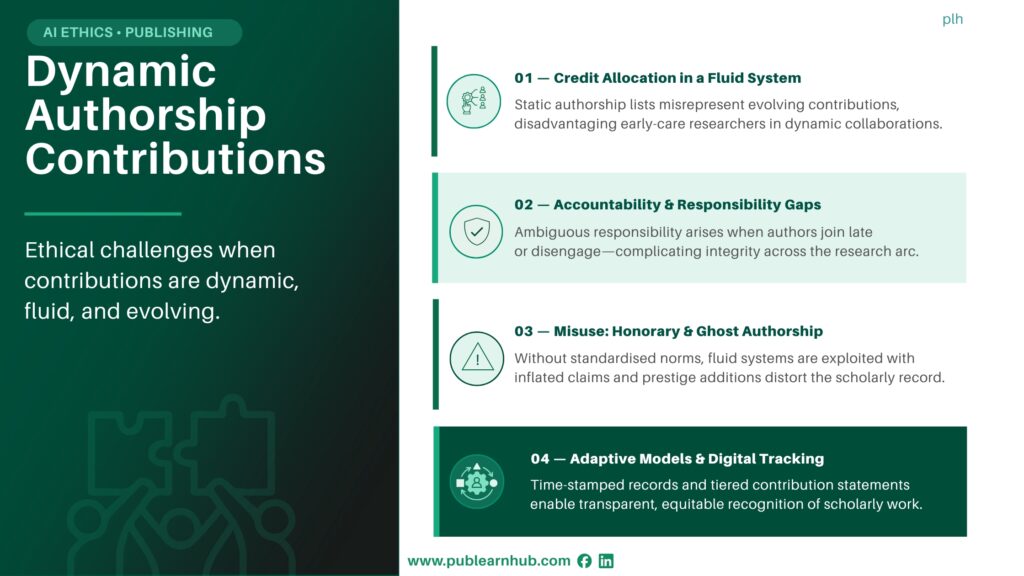
Credit Allocation in a Fluid System
One of the core challenges of dynamic authorship is determining how credit should be allocated when roles evolve. Traditional practices, such as listing authors in order of contribution or using equal authorship statements, assume a stable contribution structure. These methods may not adequately capture changes that occur over time.
Misaligned credit can have real consequences. Academic careers depend heavily on publication records, and inaccurate authorship can affect promotions, funding opportunities, and professional recognition. Early-career researchers are particularly vulnerable, as their contributions may be overlooked or undervalued in complex collaborations.
To address this, some journals and institutions are encouraging more granular contribution disclosures. Instead of relying solely on author order, detailed statements can describe who did what at different stages of the research. However, even these systems often capture contributions at a single point in time, rather than reflecting their evolution.
Accountability and Responsibility
Authorship is not just about credit—it also carries responsibility. Each listed author is typically expected to take responsibility for the integrity of the work. In a dynamic contribution model, this becomes more complicated.
If a researcher joins a project late, to what extent are they responsible for earlier stages of the work? Conversely, if someone contributed significantly early on but was less involved later, should they remain accountable for the final version?
These questions highlight the need for clearer definitions of responsibility. Without them, dynamic authorship can create gaps in accountability, making it difficult to assign responsibility in cases of errors or misconduct.
Risks of Misuse and Manipulation
Dynamic authorship also opens the door to potential misuse. For example, contributors might exaggerate their involvement during later stages to justify authorship, or influential researchers might be added late in the process to increase the chances of publication—a practice sometimes referred to as honorary or guest authorship.
Similarly, contributors who disengage from a project may still expect authorship credit, even if their input becomes less relevant over time. Without clear guidelines, these situations can lead to disputes and undermine trust within research teams.
The lack of standardized practices for handling evolving contributions makes it easier for such issues to go unaddressed. This is particularly problematic in large collaborations, where tracking individual contributions can be challenging.
Toward More Adaptive Authorship Models
To address these challenges, academic publishing needs to move toward more flexible and transparent authorship models. One promising approach is the use of time-stamped contribution records, which document who contributed what at each stage of the research process. This allows for a more accurate representation of evolving roles.
Another solution is dynamic contribution statements that can be updated during revisions and even post-publication. Instead of being fixed at submission, these statements would reflect the final distribution of work, including contributions made during peer review and revision stages.
Some have also proposed tiered authorship models, where contributors are grouped based on the nature and timing of their involvement. For example, primary contributors, revision contributors, and supporting contributors could be clearly distinguished.
Importantly, these models require strong editorial policies and clear communication among collaborators. Research teams should discuss authorship expectations early in the project and revisit them as roles evolve. Journals, in turn, should provide guidance on how to handle changes in contributions transparently and fairly.
The Role of Technology
Digital tools can play a crucial role in supporting dynamic authorship. Collaborative platforms can track contributions in real time, providing a detailed record of who did what and when. These records can then be integrated into submission systems, making it easier for journals to assess authorship claims.
Blockchain-based systems and other secure tracking technologies have also been proposed as ways to create tamper-proof records of contributions. While still emerging, these tools highlight the potential for technology to enhance transparency and accountability in authorship practices.
Striking a Fair Balance
Dynamic authorship reflects the reality of modern research, where collaboration is fluid and contributions evolve over time. However, without careful management, it can create confusion, inequity, and ethical risks.
The challenge for academic publishing is to balance flexibility with clarity. Authorship models must be adaptable enough to reflect changing contributions, yet structured enough to ensure fair credit and clear accountability.
As research continues to grow more collaborative and complex, rethinking authorship is no longer optional—it is essential. By adopting transparent, adaptive practices, the academic community can ensure that credit and responsibility are aligned with the true nature of scholarly work.