
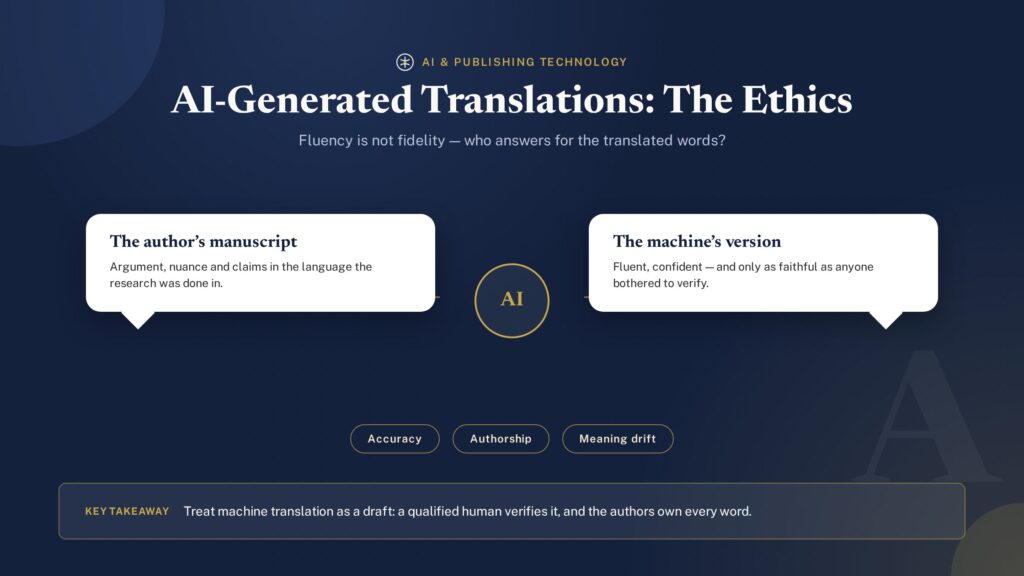
Ethical Implications of AI-Generated Translations in Academic Publishing: Accuracy, Authorship, and Cross-Language Integrity
Reading time - 7 minutes
Introduction
As academic publishing becomes increasingly global, the demand for multilingual research communication continues to grow. Artificial intelligence (AI) has emerged as a powerful tool to bridge language barriers, enabling authors to translate manuscripts quickly and cost-effectively. While AI-generated translations offer significant advantages in accessibility and efficiency, they also introduce complex ethical challenges related to accuracy, authorship, and the integrity of scholarly communication.
AI-powered translation tools are now widely used by researchers, especially those writing in a second language. These tools can convert manuscripts, abstracts, and even peer review comments into different languages within seconds. For many researchers, particularly those from non-English-speaking backgrounds, AI translation represents an opportunity to participate more actively in global scholarship. However, the convenience of these tools should not overshadow the risks they introduce.
The Promise of AI in Breaking Language Barriers
One of the most significant benefits of AI-generated translations is increased inclusivity. Academic publishing has long been dominated by English, creating barriers for researchers who are more comfortable working in other languages. AI tools can help level the playing field by allowing authors to write in their native language and translate their work for international journals.
This not only improves accessibility but also enhances the diversity of perspectives in research. Scholars from different regions can share locally relevant findings with a global audience, contributing to a more inclusive and representative body of knowledge.
Additionally, AI translation reduces reliance on expensive professional translation services. This is particularly beneficial for early-career researchers or those working in resource-constrained environments. Faster turnaround times also support more efficient submission and publication processes.
The Risk of Meaning Distortion
Despite these advantages, AI-generated translations are not always reliable. One of the most critical concerns is the potential for subtle distortions in meaning. Academic writing often involves complex terminology, nuanced arguments, and discipline-specific language. AI tools may struggle to capture these subtleties accurately.
Even small translation errors can have significant consequences. A misinterpreted term in a methodology section could affect reproducibility, while an inaccurate translation of results might lead to incorrect conclusions. In fields such as medicine or public policy, these errors can have real-world implications.
Moreover, AI systems are trained on large datasets that may contain biases or inconsistencies. As a result, translations may reflect these biases, leading to uneven quality across languages or disciplines. This raises concerns about fairness and reliability in cross-language communication.
Authorship and Responsibility
Another important ethical issue is the question of authorship and responsibility. When AI tools are used to translate a manuscript, who is accountable for the final text? Unlike human translators, AI systems cannot take responsibility for errors or misinterpretations.
Authors remain ultimately responsible for the accuracy of their work, regardless of the tools used. However, not all authors may have the linguistic proficiency to verify the quality of AI-generated translations. This creates a gap between responsibility and capability, increasing the risk of unintentional errors entering the published record.
There is also the question of disclosure. Should authors be required to state that AI tools were used for translation? Transparency in this regard can help editors and reviewers assess potential risks, but policies on disclosure are still evolving across journals.
Implications for Peer Review and Editorial Processes
AI-generated translations can also affect the peer review process. Reviewers may evaluate a manuscript based on a translated version that does not fully reflect the author’s original intent. This can lead to misunderstandings, misinterpretations, or unfair assessments.
Editors face additional challenges in ensuring the quality and integrity of translated submissions. Without clear guidelines, it can be difficult to determine whether a manuscript’s language issues are due to translation errors or underlying problems in the research itself.
In multilingual publishing environments, inconsistencies between different language versions of the same article can further complicate matters. If discrepancies arise, which version should be considered authoritative?
Best Practices for Responsible Use
To address these challenges, academic publishing must adopt clear and responsible practices for the use of AI-generated translations.
First, human oversight is essential. AI translations should be reviewed and, where possible, edited by individuals with strong proficiency in both the source and target languages. This helps ensure that meaning and context are preserved.
Second, transparent disclosure policies should be implemented. Authors should indicate whether AI tools were used in the translation process, allowing editors and reviewers to make informed decisions.
Third, journals can establish language quality checks as part of their editorial workflows. This may include additional review stages for translated manuscripts or the use of specialized editors with multilingual expertise.
Fourth, standardization of terminology can help reduce inconsistencies. Providing glossaries or discipline-specific language guidelines ensures that key terms are translated accurately and consistently.
The Future of Multilingual Publishing
AI-generated translations are likely to play an increasingly important role in academic publishing. As technology continues to improve, the accuracy and reliability of these tools will also advance. However, ethical considerations must remain at the forefront of their adoption.
The goal should not be to replace human expertise but to augment it. By combining the speed of AI with the judgment of human reviewers and editors, the academic community can create a more inclusive and reliable publishing ecosystem.
Conclusion
AI-generated translations offer a powerful solution to one of the longstanding challenges in academic publishing—language barriers. They have the potential to democratize access to knowledge and amplify diverse voices across the global research landscape.
However, with this potential comes responsibility. Ensuring accuracy, maintaining transparency, and clearly defining accountability are essential to preserving the integrity of scholarly communication. As journals and researchers navigate this evolving landscape, thoughtful policies and careful implementation will be key to harnessing the benefits of AI while minimizing its risks.
In the pursuit of global knowledge exchange, how we translate research is just as important as the research itself.