
Ethical Risks of Preprint Withdrawal in Academic Publishing: Transparency, Accountability, and the Integrity of Early Research
Reading time - 7 minutes
Introduction
The rise of preprints has transformed academic publishing by enabling researchers to share findings rapidly, receive early feedback, and establish priority before formal peer review. However, with this increased flexibility comes a less-discussed ethical challenge: preprint withdrawal. While withdrawing a preprint may seem like a simple corrective action, it raises complex questions about transparency, accountability, and the permanence of the scholarly record.
Unlike traditional journal articles, preprints exist in a more fluid and iterative space. Authors can upload, revise, and even remove their work with relative ease. This flexibility is beneficial for correcting errors or responding to new evidence, but it also introduces risks when withdrawals occur without clear explanations or documentation.
Why Do Authors Withdraw Preprints?
Preprints may be withdrawn for a variety of reasons, some entirely legitimate. Authors may discover errors in their data, identify methodological flaws, or realize that their conclusions were premature. In such cases, withdrawal can be a responsible decision that prevents the spread of inaccurate information.
In other instances, preprints are withdrawn due to journal policies. Some journals still maintain restrictions on prior dissemination, prompting authors to remove their preprint before formal submission. Although this practice is becoming less common, it still influences author behavior in certain disciplines.
There are also more concerning scenarios. Authors may withdraw preprints after receiving criticism, attempting to avoid scrutiny rather than engage with it. In extreme cases, withdrawal may be used to obscure questionable research practices or to quietly erase flawed work without accountability.
The Transparency Dilemma
One of the central ethical concerns surrounding preprint withdrawal is the lack of transparency. When a preprint is removed without explanation, readers are left with unanswered questions. Was the withdrawal due to an honest mistake, a major flaw, or external pressure?
This ambiguity can undermine trust in the research process. Preprints are increasingly cited in academic literature, policy discussions, and even media reports. If a cited preprint is later withdrawn without a traceable record, it creates confusion and weakens the reliability of downstream research.
Moreover, silent withdrawals can disrupt the continuity of scientific discourse. Preprints often generate early discussions, comments, and critiques. Removing the original document without preserving its history can erase valuable scholarly interactions and hinder collective learning.
Accountability in Early-Stage Research
Preprints occupy a unique position in the research lifecycle—they are public but not yet peer-reviewed. This raises important questions about accountability. Should authors be held to the same standards of permanence and transparency as they are for published articles?
On one hand, the informal nature of preprints suggests that flexibility is necessary. Researchers should have the freedom to correct or withdraw work that they no longer stand by. On the other hand, once research is made publicly accessible, it becomes part of the scholarly conversation and should be treated with a degree of responsibility.
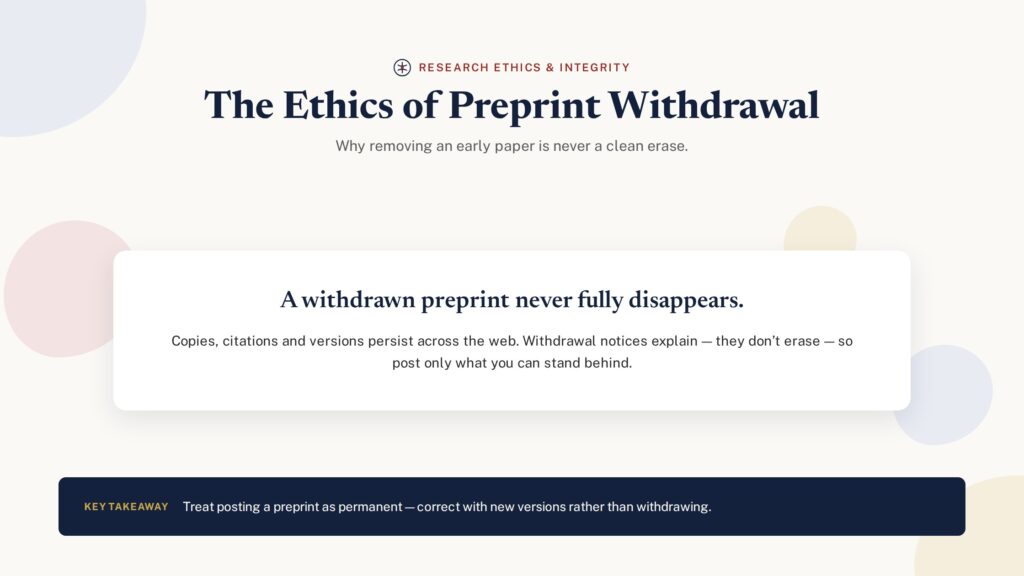
Without clear norms, withdrawal practices can vary widely across platforms and disciplines. Some preprint servers retain a “tombstone page” indicating that a paper has been withdrawn, often with a brief explanation. Others may remove the content entirely, leaving no visible record. This inconsistency makes it difficult to establish shared expectations for ethical behavior.
Risks to the Scholarly Record
The withdrawal of preprints can have broader implications for the integrity of the scholarly record. As preprints become more integrated into citation networks, their disappearance can create gaps in the literature. Researchers may unknowingly rely on findings that are no longer accessible or verifiable.
There is also the risk of selective withdrawal. Authors might remove preprints that receive negative feedback while leaving more favorable work online, creating a biased representation of their research. This selective visibility can distort the perception of evidence within a field.
Additionally, withdrawal without proper documentation can complicate meta-research and systematic reviews. Scholars analyzing research trends or evaluating evidence may struggle to account for missing or withdrawn preprints, leading to incomplete or skewed analyses.
Best Practices for Ethical Withdrawal
To address these challenges, the academic community must develop clearer guidelines for preprint withdrawal. Transparency should be the guiding principle.
First, all withdrawals should include a visible and permanent notice. Even if the full content is removed, a record should remain indicating that the preprint existed, along with the reason for its withdrawal. This ensures that readers are informed and that the research trail remains intact.
Second, platforms should adopt standardized withdrawal categories. For example, distinguishing between withdrawals due to honest error, ethical concerns, or journal requirements can provide valuable context and reduce ambiguity.
Third, versioning should be encouraged over withdrawal whenever possible. If issues can be addressed through revision, updating the preprint with clear documentation of changes is often preferable to removing it entirely. This preserves the evolution of the research and supports transparency.
Fourth, clear author guidelines are essential. Researchers should understand when withdrawal is appropriate, how to communicate it responsibly, and what information must be disclosed. Consistent policies across platforms can help establish shared norms.
The Role of Preprint Platforms
Preprint servers play a critical role in shaping ethical practices. By implementing transparent withdrawal policies, maintaining visible records, and providing guidance to authors, platforms can ensure that flexibility does not come at the cost of accountability.
Technological solutions can also support this effort. Persistent identifiers, version tracking, and automated notifications can help maintain continuity even when preprints are withdrawn or updated. These tools make it easier for researchers to track changes and verify the status of a paper.
Striking a Responsible Balance
Preprint withdrawal is not inherently unethical—it is often a necessary part of responsible research practice. However, the way it is handled determines whether it strengthens or undermines trust in the scholarly ecosystem.
The challenge lies in balancing flexibility with accountability. Researchers must have the ability to correct mistakes, but they also have a responsibility to maintain transparency once their work enters the public domain.
As preprints continue to reshape academic publishing, establishing clear and ethical withdrawal practices will be essential. By prioritizing openness, consistency, and traceability, the research community can ensure that even early-stage work contributes to a trustworthy and resilient scholarly record.