
Ethical Risks of Research Scope Inflation in Academic Publishing: Overgeneralization, Credibility, and Misleading Impact
Reading time - 7 minutes
Introduction
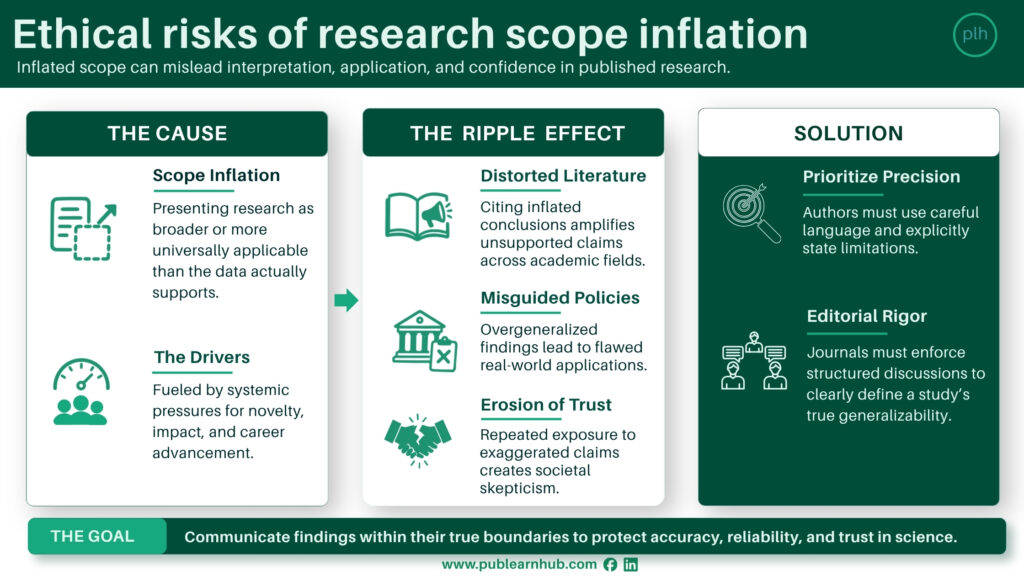
In academic publishing, clearly defining the scope of a study is fundamental to maintaining accuracy and credibility. However, in an increasingly competitive research environment, there is a growing tendency among authors to “inflate” the scope of their work—presenting findings as broader, more universally applicable, or more impactful than the data वास्तव supports. This phenomenon, known as research scope inflation, raises significant ethical concerns about misrepresentation, reader interpretation, and the long-term reliability of scholarly literature.
Scope inflation does not necessarily involve falsifying data. Instead, it operates in subtler ways—through overstated conclusions, generalized claims, or suggestive language that extends beyond the study’s actual boundaries. While such practices may increase the perceived importance of a paper, they risk distorting scientific understanding and misleading both academic and non-academic audiences.
Understanding Scope Inflation
Research scope inflation typically occurs when authors present findings derived from limited samples, specific contexts, or controlled environments as broadly applicable across populations, settings, or disciplines. For example, a study conducted on a small, homogeneous group may be framed as having implications for global populations, or preliminary findings may be described as definitive conclusions.
This issue is often amplified in sections like abstracts, discussions, and conclusions—where authors summarize their work and highlight its significance. In an effort to make research appear more impactful, language may shift from cautious interpretation to confident generalization, even when the evidence does not fully support such claims.
Drivers Behind the Practice
Several systemic pressures contribute to scope inflation in academic publishing. One of the most prominent is the emphasis on novelty and impact. Journals often prioritize research that appears broadly relevant or groundbreaking, incentivizing authors to frame their findings in expansive terms.
Career advancement also plays a role. Researchers are frequently evaluated based on publication metrics, citations, and perceived influence. Presenting a study as widely applicable can enhance its visibility and appeal, increasing the likelihood of acceptance and citation.
Additionally, interdisciplinary research environments can unintentionally encourage overgeneralization. When studies aim to appeal to multiple fields, authors may broaden their claims to resonate with diverse audiences, sometimes at the expense of precision.
Ethical and Practical Consequences
The ethical risks of scope inflation are significant. At its core, it represents a form of misrepresentation—subtly overstating what the research actually demonstrates. This can mislead readers, particularly those who rely on abstracts or summaries rather than full-text analysis.
One major consequence is the propagation of weak or unsupported claims. When inflated conclusions are cited by other researchers, they can create a chain of misinterpretation that amplifies the original overstatement. Over time, this can distort entire research areas, making it difficult to separate well-supported findings from exaggerated ones.
Scope inflation also affects policy and practice. Decision-makers, practitioners, and media outlets often rely on published research to inform actions. If findings are presented as more generalizable than they truly are, it can lead to inappropriate applications or misguided policies.
From a credibility standpoint, repeated exposure to overstated claims can erode trust in academic publishing. Readers may become skeptical of research findings, questioning whether conclusions are genuinely supported by evidence or strategically framed for impact.
The Role of Peer Review and Editorial Oversight
Peer review serves as a critical checkpoint for identifying and addressing scope inflation. Reviewers are expected to assess whether the conclusions align with the data and whether claims are appropriately qualified. However, detecting subtle overgeneralization can be challenging, especially when it is embedded in persuasive language.
Editors also play a key role in setting expectations. Journals that emphasize rigorous interpretation and discourage exaggerated claims can help reduce the prevalence of scope inflation. Clear author guidelines regarding appropriate language, limitations, and generalizability are essential.
However, editorial practices themselves can sometimes contribute to the problem. Requests to “strengthen the discussion” or “highlight broader implications” may inadvertently encourage authors to expand their claims beyond what is justified.
Strategies for Responsible Reporting
Addressing scope inflation requires a combination of individual responsibility and systemic change. Authors should prioritize accuracy over impact, ensuring that conclusions are directly supported by the data. clear acknowledgment of limitations, sample constraints, and contextual factors is essential.
Using precise language is equally important. Terms like “suggests,” “indicates,” or “is limited to” can help convey appropriate levels of certainty, while avoiding absolute or universal statements unless they are clearly justified.
Journals can support responsible reporting by encouraging structured discussion sections that separate evidence-based findings from speculative implications. Requiring explicit statements about generalizability can also help readers understand the boundaries of a study.
Training and awareness are key components. Early-career researchers, in particular, should be educated about the ethical implications of scope inflation and the importance of accurate representation.
Moving Toward Integrity and Precision
In a research ecosystem driven by visibility and impact, the temptation to overstate findings is understandable—but it is ultimately counterproductive. The value of academic publishing lies in its ability to provide reliable, evidence-based knowledge. When scope is inflated, that reliability is compromised.
By fostering a culture that values precision over exaggeration, the academic community can strengthen trust in research and ensure that findings are interpreted and applied appropriately. Scope should not be a tool for persuasion, but a reflection of what the research genuinely reveals.
As scholarly communication continues to evolve, maintaining clarity about what research does—and does not—claim will remain essential. In the long run, credibility is built not on how broadly findings are framed, but on how accurately they represent reality.