
Post-Acceptance Authorship Changes in Academic Publishing: Ethics, Risks, and Editorial Safeguards
Reading time - 7 minutes
Introduction
In academic publishing, the moment a manuscript is accepted is often seen as the final checkpoint before formal publication. However, an increasingly complex and sensitive issue arises in the period between acceptance and publication: requests for changes in authorship. Whether it involves adding a new author, removing an existing one, or rearranging the order of contributors, post-acceptance authorship changes pose ethical, procedural, and trust-related challenges for journals, editors, and research institutions.
While authorship disputes are not new, their occurrence after acceptance raises particular concerns. At this stage, the manuscript has already passed peer review and editorial scrutiny based on a defined set of contributors. Altering that record can affect accountability, intellectual credit, and even the perceived integrity of the review process.
Why Do Post-Acceptance Authorship Changes Happen?
There are several reasons why authorship changes are requested after a paper has been accepted. In some cases, genuine oversights occur—such as unintentionally omitting a contributor who meets authorship criteria. In collaborative, multi-institutional projects, communication gaps can lead to late recognition of contributions.
However, not all changes are benign. Problematic scenarios include:
- Honorary or gift authorship, where influential individuals are added post-acceptance to enhance the paper’s credibility.
- Ghost authorship corrections, where previously unacknowledged contributors seek rightful inclusion.
- Conflict-driven removals, where disputes among co-authors lead to attempts to exclude individuals after acceptance.
- Strategic authorship manipulation, aimed at influencing citation metrics, institutional recognition, or funding outcomes.
The timing of these requests—after editorial approval—makes them particularly sensitive, as they may bypass the scrutiny applied during submission and peer review.
Ethical Implications
Authorship is not merely a matter of recognition; it is a declaration of responsibility and accountability. Each listed author is expected to stand behind the integrity of the work. Post-acceptance changes can disrupt this accountability chain.
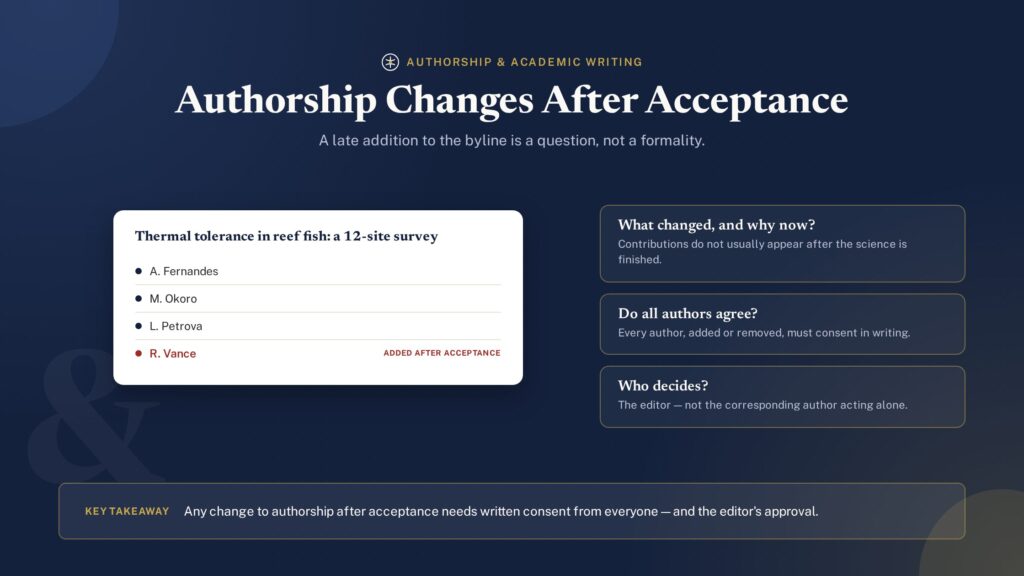
Adding an author after acceptance raises questions such as: Did this individual contribute significantly enough to meet authorship criteria? If so, why were they not included earlier? Conversely, removing an author may obscure responsibility, especially if that individual played a key role in the research.
These changes also intersect with broader ethical principles:
- Transparency: Readers and reviewers expect a stable and accurate record of contributions.
- Fairness: All contributors should receive appropriate credit without manipulation.
- Accountability: პასუხისმგibility for the research should remain clearly traceable.
Without proper oversight, post-acceptance changes risk undermining these principles.
Editorial Challenges and Responsibilities
Editors are often placed in a difficult position when handling such requests. On one hand, they must remain open to correcting genuine errors. On the other, they must guard against unethical practices.
A key challenge lies in verification. Editors typically rely on author-provided information and may not have direct insight into the internal dynamics of research teams. This makes it difficult to assess whether a requested change is justified.
To address this, many journals and publishers have adopted structured policies requiring:
- Written consent from all original and proposed authors
- Clear justification for the change
- Documentation of individual contributions
- Institutional confirmation in disputed cases
These measures aim to ensure that any modification is transparent, consensual, and ethically sound.
Risks to the Scholarly Record
Frequent or poorly managed authorship changes can erode trust in the scholarly record. Readers, reviewers, and indexing systems rely on stable metadata, including author lists, to track contributions and assign credit.
Post-acceptance changes may also create inconsistencies across versions of the manuscript, especially if preprints, accepted manuscripts, or early online versions already exist. This can lead to confusion in citations and attribution.
Moreover, such changes may signal deeper issues within the research process, including inadequate collaboration practices, unclear authorship agreements, or even misconduct.
Preventive Strategies
The most effective way to handle post-acceptance authorship changes is to minimize their occurrence through proactive measures earlier in the research and submission process.
- Clear Authorship Agreements:
Research teams should establish authorship criteria and order at the beginning of a project, with periodic reviews as contributions evolve. - Contributor Transparency:
Using structured contribution statements (such as CRediT taxonomy) helps clarify roles and reduce ambiguity. - Submission-Level Verification:
Journals can require all authors to confirm their involvement and consent during submission, reducing the likelihood of later disputes. - Education and Awareness:
Institutions and publishers should educate researchers about ethical authorship practices and the implications of late-stage changes.
Managing Legitimate Changes
Despite preventive efforts, legitimate cases will still arise. In such situations, the goal should not be to reject all changes outright but to manage them responsibly.
Best practices include:
- Treating each request on a case-by-case basis
- Requiring unanimous agreement among authors
- Pausing publication until the issue is resolved
- Involving institutional ethics committees when necessary
In extreme cases where disputes cannot be resolved, journals may need to delay publication or withdraw acceptance to protect the integrity of the process.
Looking Ahead
As research becomes more collaborative and interdisciplinary, authorship complexity will continue to grow. This makes it increasingly important for academic publishing systems to develop robust, transparent, and fair mechanisms for handling authorship changes—especially at critical stages like post-acceptance.
Emerging tools such as digital contribution tracking, version-controlled author records, and blockchain-based attribution systems may offer future solutions. However, technology alone cannot replace the need for ethical clarity and responsible research culture.
Conclusion
Post-acceptance authorship changes sit at the intersection of ethics, accountability, and editorial governance. While some requests are justified and necessary, others may reflect deeper issues that threaten the credibility of scholarly communication.
By combining clear policies, rigorous verification, and proactive education, journals and institutions can navigate this complex landscape effectively. Ultimately, preserving trust in academic publishing requires not only managing what is published—but also ensuring that credit and responsibility are assigned with integrity at every stage of the process.