
Post-Publication Annotation Systems in Academic Publishing: Enhancing Dialogue Beyond the Printed Page
Reading time - 7 minutes
Introduction
Academic publishing has long been built on a linear model: researchers submit manuscripts, peer reviewers evaluate them, and once accepted, the work becomes part of the permanent scholarly record. However, this traditional system often limits meaningful discussion to pre-publication stages, leaving little room for continued engagement after an article is published. In response, post-publication annotation systems are emerging as a powerful tool to extend scholarly dialogue beyond the printed page.
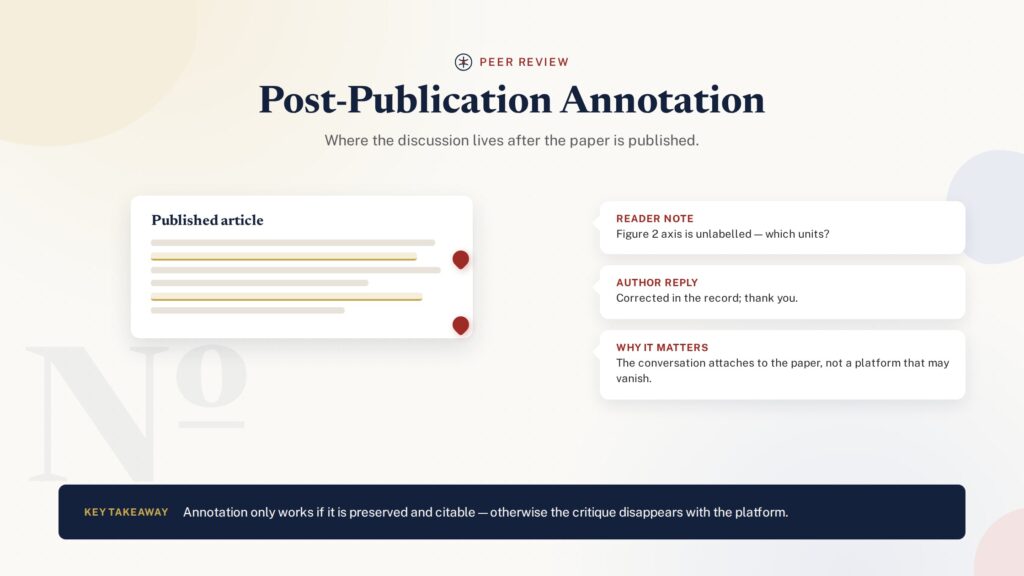
Post-publication annotation refers to the ability for readers—researchers, reviewers, or even the broader academic community—to comment on, critique, and add insights directly to published articles. Unlike traditional letters to the editor or formal responses, these annotations are often integrated into digital platforms, appearing alongside the original content. This shift represents a move toward more interactive, transparent, and collaborative knowledge-building.
Rethinking the Finality of Publication
In the conventional publishing model, publication marks the end of formal evaluation. While post-publication peer review exists, it is often slow, fragmented, and limited in visibility. Annotation systems challenge this notion by treating publication not as an endpoint, but as the beginning of an ongoing conversation.
This approach aligns with the reality of modern research, where findings are continuously reinterpreted, challenged, and expanded upon. By enabling real-time feedback, annotation systems allow the scholarly record to evolve in a more dynamic and responsive manner.
For example, a researcher reading a newly published study can highlight a methodological concern, suggest additional literature, or point out a potential error—all directly within the article interface. This immediate interaction fosters a more engaged and participatory research community.
Benefits of Post-Publication Annotations
One of the primary advantages of annotation systems is the enhancement of transparency. Readers gain access not only to the original article but also to a layer of commentary that provides context, critique, and clarification. This can be particularly valuable for complex or controversial studies, where multiple perspectives enrich understanding.
Annotations also support collective intelligence. Instead of relying solely on a small group of peer reviewers, the broader academic community can contribute insights. This crowdsourced approach can identify errors, highlight overlooked connections, and accelerate the refinement of knowledge.
Another key benefit is educational value. For early-career researchers and students, annotations offer a window into how experienced scholars engage critically with research. Seeing how experts question assumptions or interpret findings can be as instructive as the article itself.
Additionally, annotation systems can improve research quality over time. Authors can respond to comments, clarify ambiguities, and, in some cases, update their work based on feedback. This ongoing interaction helps ensure that research remains accurate and relevant.
Challenges and Risks
Despite their potential, post-publication annotation systems introduce several challenges. One major concern is quality control. Unlike traditional peer review, annotations may not always be vetted, raising the risk of inaccurate, misleading, or low-quality comments.
There is also the issue of moderation. Without proper oversight, annotation platforms can become cluttered with redundant or irrelevant comments, reducing their usefulness. Journals and platforms must establish clear guidelines and moderation mechanisms to maintain constructive discourse.
Another challenge is author sensitivity and reputation. Public annotations can sometimes feel like open criticism, which may discourage authors from engaging or create tension within the academic community. Balancing open critique with respectful communication is essential.
Furthermore, participation inequality can limit the effectiveness of these systems. Not all researchers have the time, confidence, or incentive to contribute annotations. As a result, discussions may be dominated by a small subset of voices, potentially skewing perspectives.
Integration with Existing Publishing Models
For annotation systems to succeed, they must be thoughtfully integrated into existing publishing frameworks. This includes aligning them with peer review processes, editorial policies, and citation practices.
One approach is to link annotations to verified researcher identities, ensuring accountability and credibility. Another is to introduce tiered annotation systems, where certain comments—such as those from recognized experts—are highlighted or prioritized.
Journals can also incorporate annotations into formal evaluation processes. For instance, significant post-publication critiques could trigger editorial review or lead to formal corrections if necessary. This creates a bridge between informal commentary and formal quality control.
Technological Enablers
Advances in digital publishing platforms are making annotation systems increasingly feasible. Tools that allow text highlighting, inline comments, and threaded discussions can be seamlessly integrated into online articles.
Artificial intelligence can further enhance these systems by filtering comments, identifying key themes, and flagging potentially important insights. However, as with all AI-assisted tools, human oversight remains critical to ensure accuracy and fairness.
Integration with academic profiles and citation systems can also add value. For example, annotations themselves could become citable contributions, recognizing the intellectual effort involved in post-publication critique.
Cultural Shift in Academic Communication
Beyond technical implementation, the success of annotation systems depends on a cultural shift within academia. Researchers must be willing to engage openly with feedback, and institutions must recognize the value of post-publication contributions.
This shift challenges traditional notions of authority and expertise. Instead of viewing published articles as definitive statements, the academic community must embrace them as evolving documents subject to ongoing interpretation and refinement.
Encouraging constructive dialogue, rewarding meaningful contributions, and fostering a respectful environment are key to building this culture.
Looking Ahead
Post-publication annotation systems represent a significant step toward more interactive and transparent scholarly communication. By enabling continuous dialogue, they have the potential to enhance research quality, accelerate knowledge development, and democratize academic discourse.
However, their success depends on careful design, clear governance, and active participation. Without these elements, annotation systems risk becoming underutilized or counterproductive.
As academic publishing continues to evolve in the digital age, the ability to engage with research in real time will become increasingly important. Post-publication annotations offer a pathway to a more connected and collaborative research ecosystem—one where knowledge is not just published, but continuously discussed, challenged, and improved.